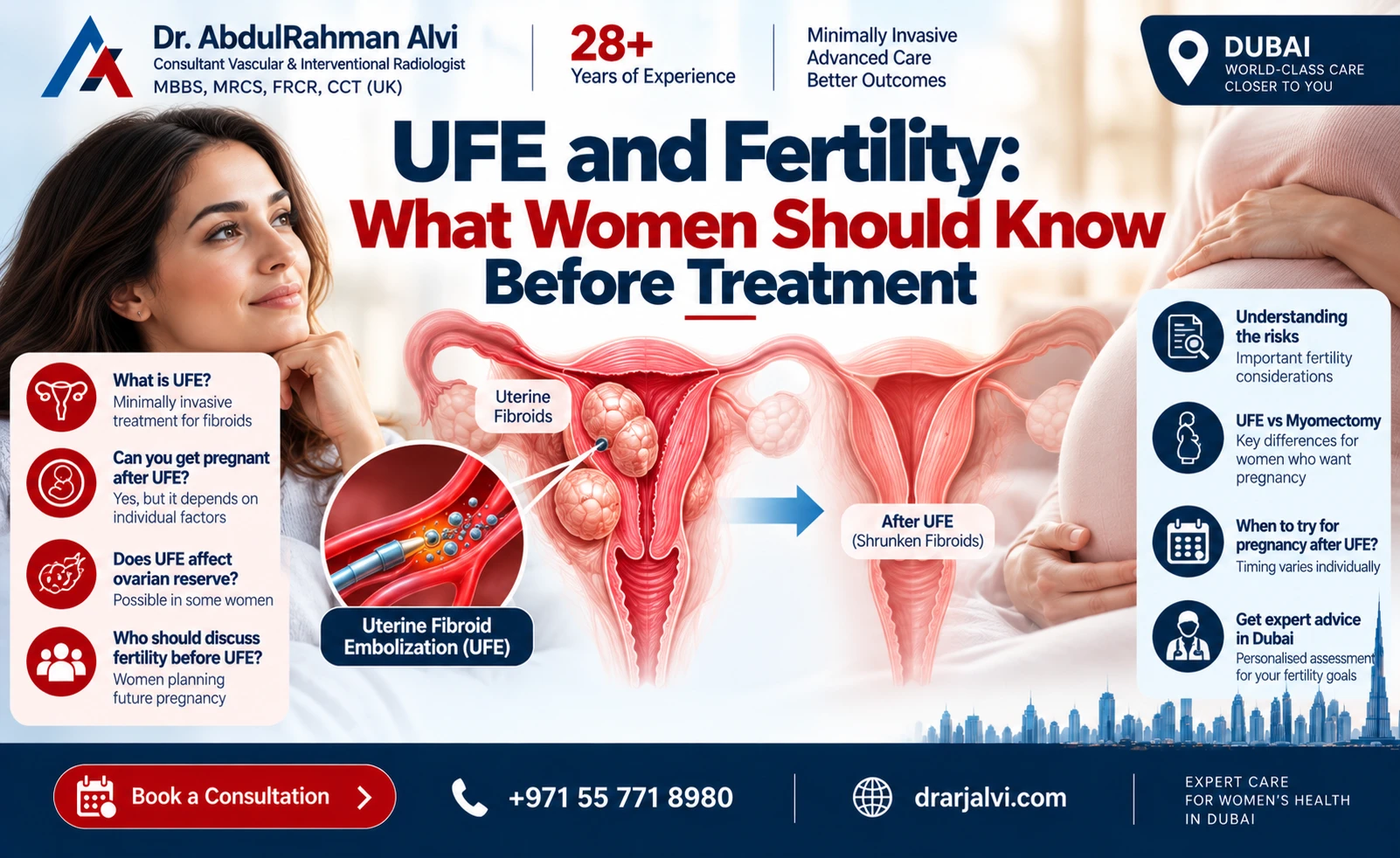
If you are considering Uterine Fibroid Embolization (UFE) and hope to become pregnant in the future, fertility should be discussed before treatment, not after.
UFE preserves the uterus, but preserving the uterus does not mean that future fertility or pregnancy outcomes are guaranteed. If you are considering uterine fibroid embolization in Dubai, your fertility plans should be discussed as part of the treatment assessment. Pregnancy has been reported after UFE, but the available evidence remains less certain than for some alternative fibroid treatments, particularly myomectomy. The effect of UFE on future pregnancy should therefore be discussed as part of an individualised treatment decision.
For women whose main priority is future pregnancy, the location and size of the fibroids, age, ovarian reserve, fertility history and alternative treatments all need to be considered before choosing UFE.
Why Does Fertility Matter When Considering UFE?
Uterine fibroids are benign growths that can develop within or around the uterus.
Many fibroids cause no symptoms. Others can cause:
- Heavy or prolonged menstrual bleeding
- Pelvic pain
- Pelvic pressure
- Abdominal fullness
- Pain during intercourse
- Frequent urination
- Constipation
- Anaemia
- Problems with fertility in some women
Fibroids themselves can sometimes contribute to infertility, although they are not the only possible cause.
This creates an important clinical question:
If fibroids may be affecting fertility, could treating them improve the chance of pregnancy — and could the treatment itself affect fertility?
That is where the decision becomes more complex.
UFE is an effective treatment for many women with symptomatic fibroids, but fertility considerations require a more careful discussion than simply saying that the uterus is preserved.
What Is Uterine Fibroid Embolization?
Uterine Fibroid Embolization, commonly called UFE, is a minimally invasive treatment performed by an interventional radiologist.
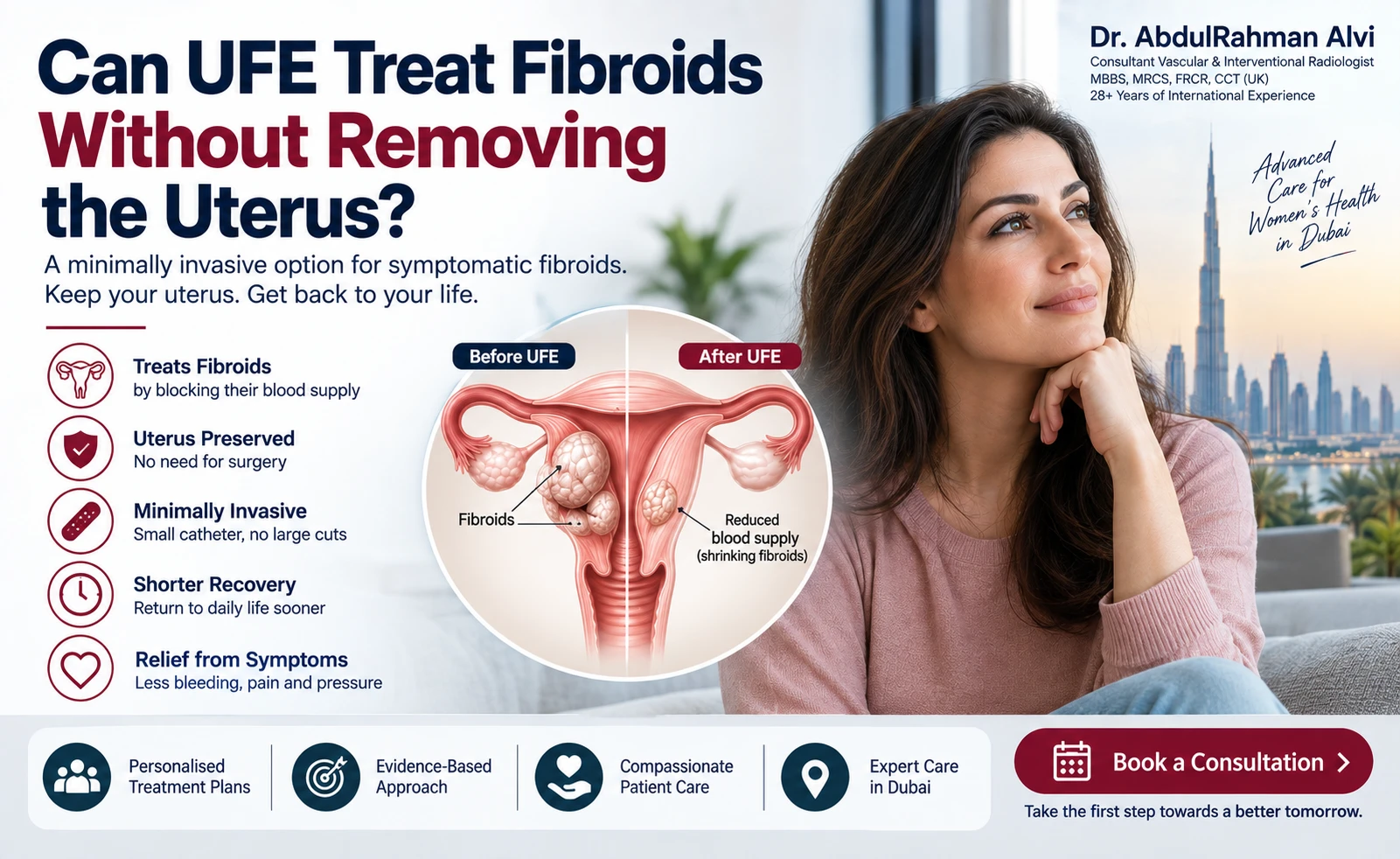
Instead of surgically removing the fibroids, UFE reduces their blood supply.
A thin catheter is introduced through a small arterial access point, commonly through the wrist or groin. Under X-ray guidance, the catheter is advanced into the uterine arteries supplying the fibroids.
Tiny embolic particles are then delivered into the appropriate vessels.
The reduced blood supply causes the fibroids to gradually shrink and become less active.
The uterus remains in place.
This is one of the major reasons UFE is attractive to women who want to avoid hysterectomy. If you are exploring how to avoid hysterectomy for fibroids, our detailed guide explains UFE and other treatment considerations.
However, uterus preservation and fertility preservation are not identical concepts.
That distinction is particularly important for younger women who are considering pregnancy.
Can You Get Pregnant After UFE?
Yes, pregnancies have been reported after UFE.
However, the medical answer is more nuanced than simply saying that UFE is “fertility-safe.”
The available research includes pregnancies following UFE, but studies vary considerably in their patient populations, fibroid characteristics, treatment techniques and follow-up.
A systematic review and meta-analysis published in 2024 examined 15 studies involving women who underwent uterine artery embolization and evaluated subsequent pregnancy outcomes.
The overall analysis found that UAE was associated with a lower postoperative pregnancy rate compared with control treatments and an increased risk of postpartum haemorrhage. The researchers also emphasised the limited availability of high-quality long-term comparative evidence.
This is why fertility should be considered a major factor when deciding whether UFE is appropriate.
Does UFE Cause Infertility?
It would be too strong to say that UFE causes infertility in every woman.
At the same time, it would also be incorrect to tell a woman that UFE has no potential effect on fertility.
The impact may depend on several factors, including:
- Age
- Ovarian reserve
- Fibroid location
- Fibroid size
- Number of fibroids
- Baseline fertility
- Uterine anatomy
- Ovarian blood supply
- Previous fertility treatment
- Embolization technique
- The presence of other fertility factors
There is also concern that embolic material can occasionally affect blood flow beyond the intended fibroid circulation.
In some women, particularly those closer to menopause, ovarian function may be affected.
For this reason, fertility planning should be discussed before treatment.
Does UFE Affect Ovarian Reserve?
This is one of the most important fertility questions.
The ovaries have their own blood supply, but there can be connections between the uterine and ovarian circulation.
During embolization, the objective is to selectively reduce blood flow to the fibroids while preserving normal uterine and ovarian tissue.
However, individual vascular anatomy varies.
In some patients, blood flow to the ovaries can potentially be affected.
The risk may be more relevant in women who already have reduced ovarian reserve or are approaching an age where ovarian reserve is naturally declining.
This is particularly important because fertility is strongly influenced by age and ovarian reserve independently of fibroid treatment.
Therefore, a woman who is actively planning pregnancy may benefit from fertility assessment before deciding on UFE.
UFE and Age: Why It Matters
Age is an important part of fertility counselling regardless of whether fibroids are present.
Female fertility naturally declines with age, particularly during the later reproductive years.
This means the same UFE procedure may have very different fertility implications for:
- A woman in her late 20s
- A woman in her mid-30s
- A woman approaching 40
- A woman with already reduced ovarian reserve
For example, if a woman is approaching 40 and already has reduced ovarian reserve, delaying pregnancy while undergoing fibroid treatment may have a different significance than it would for a younger woman.
The treatment decision therefore needs to consider the woman’s reproductive timeline, not just the fibroid itself.
Can Fibroids Themselves Affect Fertility?
Yes, certain fibroids can interfere with fertility.
The location of the fibroid matters considerably.
Submucosal Fibroids
Fibroids that grow toward or into the uterine cavity can interfere with implantation and may have a stronger relationship with infertility or miscarriage.
Intramural Fibroids
These develop within the muscular wall of the uterus.
Their effect on fertility can vary depending on their size and whether they distort the uterine cavity.
Subserosal Fibroids
These grow toward the outside of the uterus and may have less direct effect on implantation, although large fibroids can still cause pressure symptoms and other problems.
This distinction is important because the best treatment for a woman who wants pregnancy depends not simply on having “fibroids”, but on what type of fibroids she has and how they affect the uterus.
Could Treating Fibroids Improve Fertility?
Potentially, yes.
If a fibroid is interfering with the uterine cavity or contributing to infertility, treating it may improve reproductive prospects.
However, not every fibroid is responsible for infertility.
Other factors can include:
- Age
- Ovulation problems
- Ovarian reserve
- Fallopian tube blockage
- Endometriosis
- Adenomyosis
- Male-factor infertility
- Previous pelvic surgery
- Other uterine abnormalities
This is why fertility treatment should not begin with the assumption that the fibroid is automatically the cause.
A proper fertility assessment is often necessary before choosing the treatment.
UFE vs Myomectomy for Women Who Want Pregnancy
This is one of the most important comparisons to understand. For more detail on how UFE works as a minimally invasive option, see our Uterine Fibroid Embolization (UFE) treatment page.
UFE
UFE treats fibroids by reducing their blood supply.
Potential advantages:
- Minimally invasive
- No major abdominal incision
- Uterus remains in place
- Multiple fibroids can often be treated in one session
- Generally shorter recovery than major open surgery
- Can be useful for women who are not ideal surgical candidates
Fertility consideration:
The effect of UFE on future fertility and pregnancy remains less certain than some surgical approaches.
Myomectomy
Myomectomy removes the fibroids while leaving the uterus in place.
Potential advantages:
- Direct removal of the fibroid
- Allows the surgeon to specifically target selected fibroids
- Established treatment option for women whose fibroids are contributing to infertility
- May be preferred in selected women actively planning pregnancy
Fertility consideration:
Myomectomy itself can have complications, including scarring, adhesions and surgical risks. The approach also depends heavily on the number, size and location of fibroids.
There is therefore no single treatment that is automatically best for every woman.
UFE vs Hysterectomy When Fertility Matters
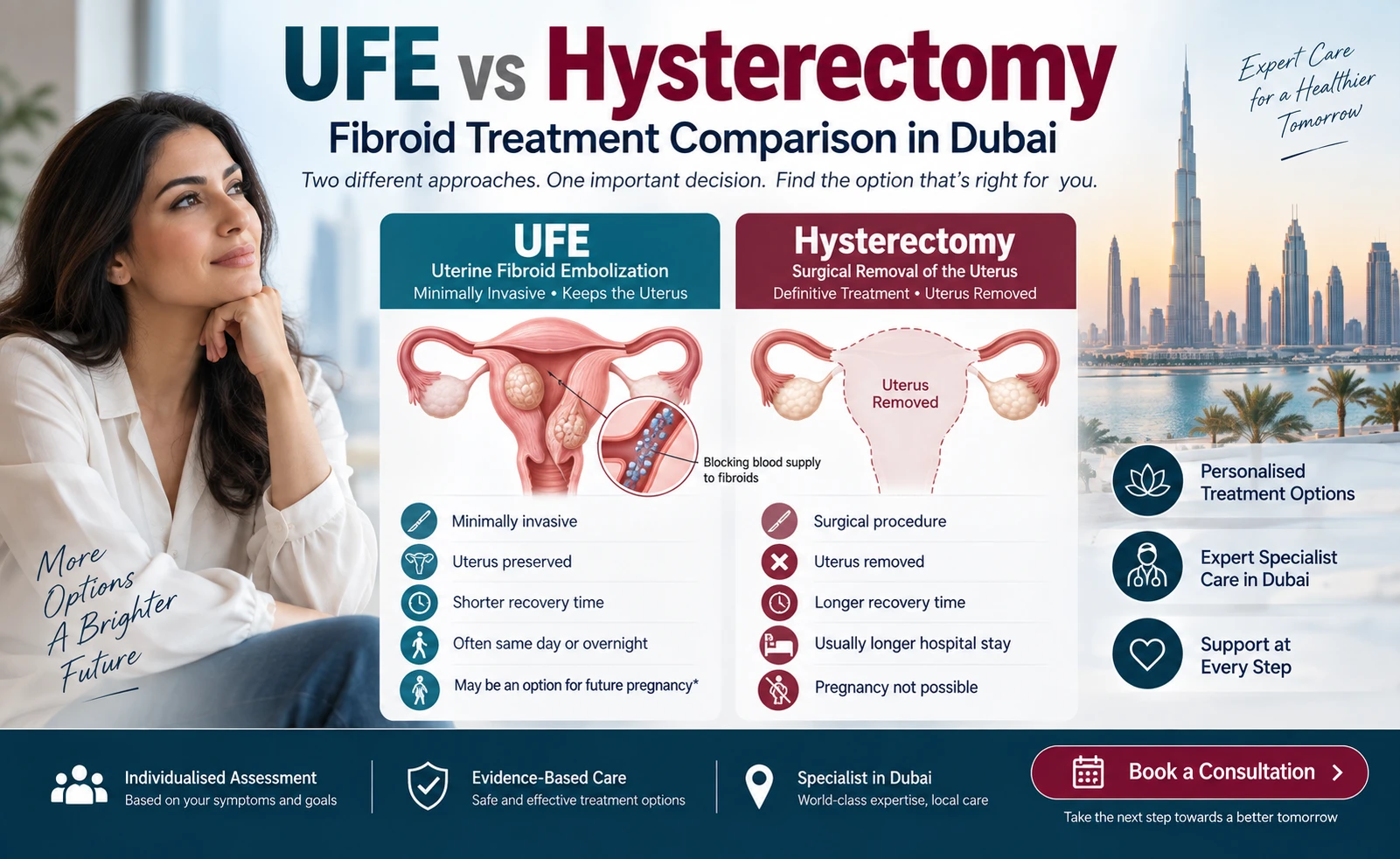
Hysterectomy removes the uterus.
Once the uterus has been removed, pregnancy is no longer possible.
For a woman who wants future pregnancy, hysterectomy is therefore not a fertility-preserving option.
This is one reason UFE can be attractive to women who want to avoid removal of the uterus. If you are exploring ways to **avoid hysterectomy for fibroids**, our detailed guide explains the treatment considerations and alternatives.
However, the fact that UFE preserves the uterus does not mean that it should automatically replace myomectomy in women whose primary goal is pregnancy.
For a broader comparison, see our guide to UFE vs hysterectomy for fibroid treatment in Dubai.
What Does the Evidence Say About Pregnancy After UFE?
The evidence is mixed and should be presented honestly.
A 2024 systematic review and meta-analysis evaluated 15 studies, including randomized and observational research.
The analysis found that women who underwent UAE had a lower overall postoperative pregnancy rate compared with control groups.
It also found an increased risk of postpartum haemorrhage.
At the same time, subgroup analyses produced different findings depending on the underlying condition and comparison group.
This is important because fertility research after UFE is complicated by differences between patients.
A woman treated for severe symptomatic fibroids is not necessarily comparable with a woman who has smaller fibroids, no infertility history and a different reproductive profile.
For that reason, population-level research cannot predict exactly what will happen to one individual patient.
Published Evidence: What We Know
| Fertility question | What current evidence suggests |
|---|---|
| Can pregnancy occur after UFE? | Yes, pregnancies have been reported after UFE |
| Does UFE guarantee preserved fertility? | No |
| Does UFE always cause infertility? | No |
| Is pregnancy after UFE well studied? | Research exists, but high-quality long-term evidence remains limited |
| Is ovarian function always unaffected? | No; ovarian effects are possible in some patients |
| Is myomectomy automatically safer for fertility? | Not automatically; the decision depends on fibroid characteristics and the individual patient |
| Is hysterectomy compatible with future pregnancy? | No |
| Should women planning pregnancy discuss alternatives before UFE? | Yes |
The most important point is that uterus preservation should not be presented as a guarantee of fertility preservation.
Who Should Be Especially Careful Before Choosing UFE?
Additional fertility counselling is particularly important if you:
- Are actively trying to become pregnant
- Want to become pregnant within the next few years
- Are undergoing IVF or fertility treatment
- Have previously experienced infertility
- Have reduced ovarian reserve
- Are approaching 40
- Have a history of miscarriage
- Have very large or numerous fibroids
- Have fibroids that distort the uterine cavity
- Have previously undergone pelvic surgery
- Have other known fertility problems
In these situations, treatment should ideally be planned around your reproductive goals.
What Fertility Tests May Be Useful Before UFE?
The exact evaluation depends on the individual patient.
Depending on your history, your doctor may consider:
- Pelvic ultrasound
- Pelvic MRI
- Ovarian reserve assessment
- Anti-Müllerian hormone testing
- Antral follicle count
- Menstrual history
- Ovulation assessment
- Previous pregnancy history
- Previous fertility treatment
- Assessment of the uterine cavity
- Fallopian tube assessment where appropriate
- Partner fertility assessment
Not every woman needs every test.
The purpose is to understand your reproductive position before choosing a treatment.
What Should You Ask Your Specialist Before UFE?
If future pregnancy matters to you, I recommend asking very direct questions.
Ask:
- Could my fibroids themselves be affecting fertility?
- Where exactly are my fibroids located?
- Do they distort the uterine cavity?
- Would myomectomy be a better option for my fertility goals?
- What is known about pregnancy after UFE?
- Could UFE affect my ovarian reserve?
- Do I need an ovarian reserve assessment before treatment?
- Should I see a fertility specialist before UFE?
- How might my age affect the decision?
- What happens if my fibroids recur after treatment?
- Could I require another procedure in the future?
- How long should I wait before trying to conceive?
- What pregnancy risks should I understand before choosing UFE?
These questions can make the consultation much more useful.
How Long Should You Wait to Try for Pregnancy After UFE?
There is no single waiting period that is appropriate for every woman.
The fibroids need time to respond to treatment, and the uterus needs time to recover.
Your treating specialist may recommend follow-up imaging before you begin trying to conceive.
The timing can depend on:
- Fibroid response
- Uterine appearance
- Symptoms
- Age
- Ovarian reserve
- Fertility history
- Whether fertility treatment is planned
If pregnancy is an immediate priority, this timing issue should be discussed before UFE rather than after the procedure.
What Are the Other Risks of UFE?
Fertility is only one consideration.
UFE can also be associated with:
- Pelvic pain
- Cramping
- Nausea
- Low-grade fever
- Fatigue
- Vaginal discharge
- Infection
- Fibroid expulsion
- Menstrual changes
- Rare effects on ovarian function
- Rare need for additional treatment
- Rare complications requiring further intervention
Most patients recover without major complications, but the individual risk depends on the patient’s anatomy, fibroid characteristics and medical history.
What If UFE Does Not Relieve My Symptoms?
UFE does not guarantee complete symptom resolution.
Some women may have:
- Incomplete fibroid shrinkage
- Persistent bleeding
- Persistent pressure symptoms
- Recurrent symptoms
- Fibroid expulsion
- New fibroids developing later
- A need for additional treatment
If symptoms persist, the next step is reassessment.
Depending on the findings, treatment may include medication, repeat intervention, myomectomy or another appropriate fibroid treatment.
This is why I recommend viewing UFE as part of a long-term treatment plan, particularly for younger women.
Does UFE Preserve the Uterus?
Yes.
UFE is specifically designed to treat fibroids while leaving the uterus in place.
This can be an important advantage for women who strongly wish to avoid hysterectomy.
However, the statement should be understood correctly:
Preserving the uterus does not guarantee fertility, successful pregnancy or normal ovarian function.
That distinction is central to informed decision-making.
Why Choose Dr. AbdulRahman Alvi for UFE in Dubai?
UFE requires detailed understanding of pelvic vascular anatomy and careful image-guided embolization.
Dr. AbdulRahman Alvi is a UK-trained Consultant Vascular and Interventional Radiologist with 28+ years of clinical experience, holding MBBS, MRCS, FRCR and Dual CCT-UK qualifications.
His specialist training includes Sheffield Teaching Hospitals and advanced fellowship experience at the Royal Free Hospital in London.
For a procedure such as UFE, the important question is not simply whether embolization can be performed.
The more important question is:
Is UFE the right treatment for this particular woman, considering her fibroids, symptoms, age and reproductive goals?
That assessment should come before treatment.
When Should You Seek Specialist Advice?
Consider a specialist assessment if you have:
- Heavy menstrual bleeding
- Anaemia related to menstrual blood loss
- Persistent pelvic pain
- Pelvic pressure
- Increasing abdominal fullness
- Frequent urination caused by fibroids
- Fibroids that are growing
- Difficulty becoming pregnant
- Recurrent miscarriage with known fibroids
- A recommendation for hysterectomy that you would like to discuss further
- A desire to preserve your uterus
If pregnancy is an important future goal, make this clear during your first consultation.
It can change the treatment discussion significantly.
Direct Answer: Is UFE Right for Women Who Want Children?
UFE can preserve the uterus and pregnancies have occurred after treatment, but it should not be presented as a guaranteed fertility-preserving procedure. If you are specifically exploring UFE for fibroids without removing the uterus, the fertility implications still need individual assessment.
For women who want future pregnancy, the decision between UFE, myomectomy and other treatments should be based on fibroid location, size, symptoms, age, ovarian reserve, fertility history and reproductive goals.
In some women, UFE may be a reasonable option. In others, particularly those actively pursuing pregnancy, myomectomy or another fertility-focused strategy may deserve stronger consideration.
The right treatment is the one that balances effective fibroid control with the woman’s reproductive priorities.
Frequently Asked Questions
Book a UFE Consultation in Dubai
If you have uterine fibroids and future pregnancy is important to you, the treatment decision deserves careful consideration.
UFE can provide effective symptom relief for appropriately selected women while preserving the uterus, but fertility considerations should be discussed openly before treatment.
Dr. AbdulRahman Alvi provides image-guided UFE assessment and treatment in Dubai, with treatment recommendations based on the patient’s fibroid characteristics, symptoms, medical history and reproductive goals.
Book a Consultation to discuss your fibroids, fertility plans and whether UFE is an appropriate option for you.