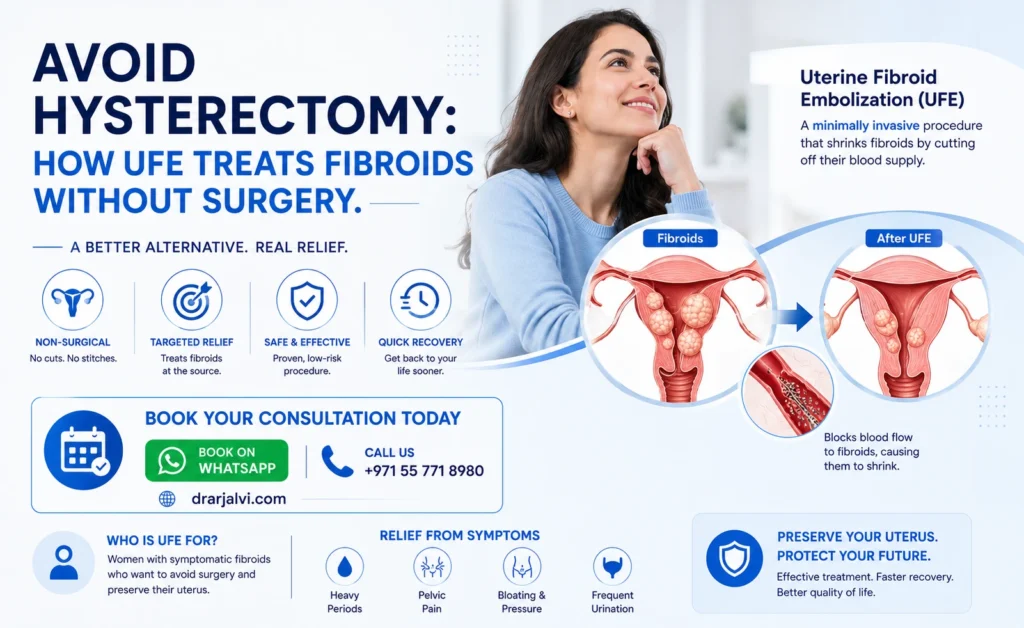
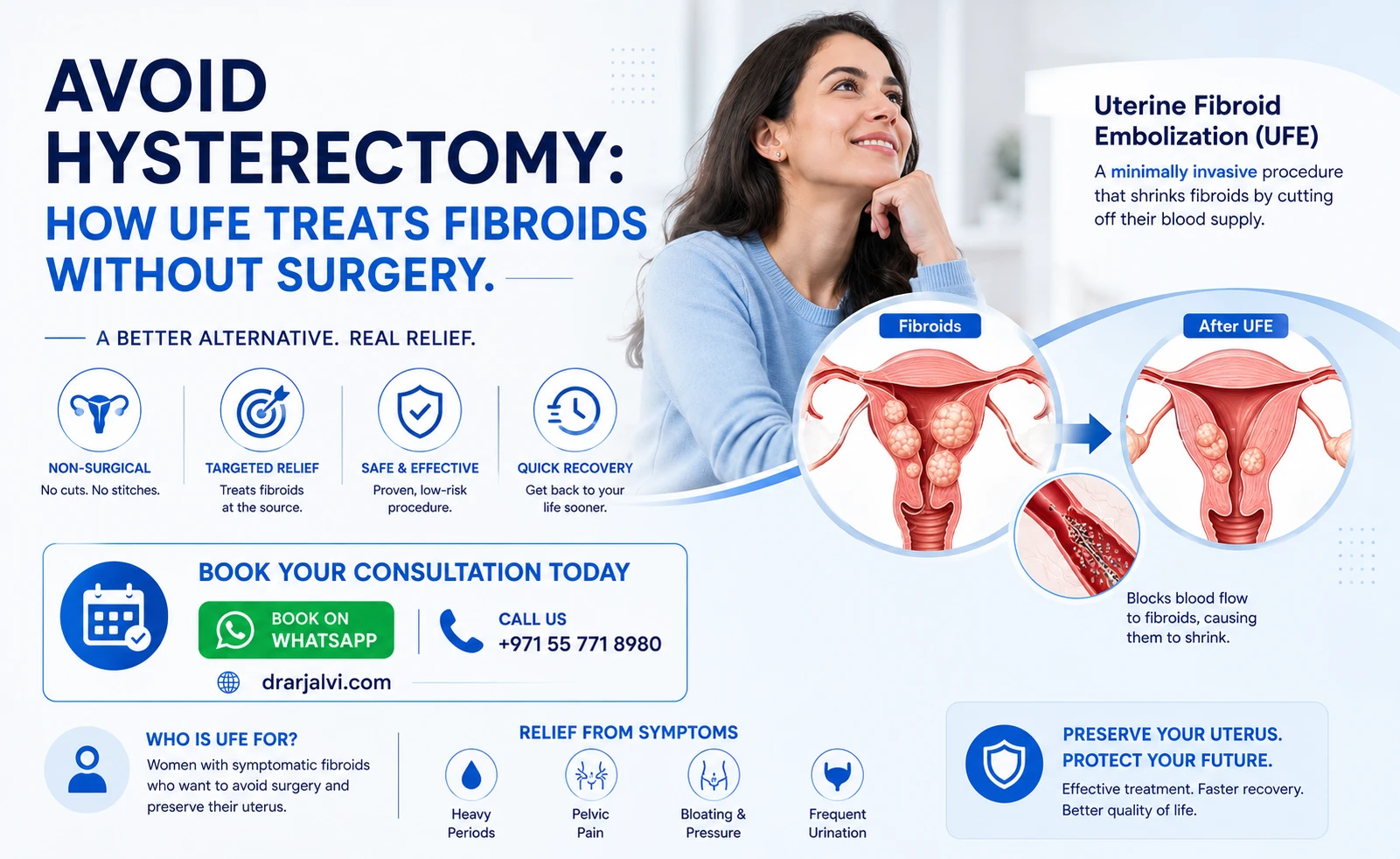
If uterine fibroids are causing heavy menstrual bleeding, pelvic pressure, pain or other troublesome symptoms, you may be exploring alternatives to hysterectomy. Uterine Fibroid Embolization (UFE) is a minimally invasive treatment that can reduce the blood supply to fibroids, causing them to shrink over time while leaving the uterus in place.
For selected patients, UFE may offer an alternative to surgical treatment. However, it is not suitable for every fibroid or every patient. Your fibroid size, number, location, symptoms, medical history and future pregnancy plans all need to be considered before treatment is recommended.
If you have been advised to consider hysterectomy, speak with a specialist about whether UFE may be an appropriate option for you.
Why Consider an Alternative to Hysterectomy?
Hysterectomy removes the uterus and is an established treatment for fibroids when appropriate. However, some women may prefer to explore less invasive options before deciding on major surgery.
UFE works differently. Instead of removing the uterus or surgically removing individual fibroids, an interventional radiologist uses a thin catheter to deliver tiny particles into the arteries supplying the fibroids. This reduces their blood supply and causes the fibroids to gradually shrink.
For appropriately selected patients, UFE may provide an alternative to major surgical treatment while keeping the uterus in place.
The important point is that UFE and hysterectomy are different treatment approaches, and the most appropriate option depends on your individual circumstances.
What Happens to Fibroids During UFE?
During UFE, an interventional radiologist guides a small catheter through an artery, commonly accessed through the wrist or groin.
Using imaging guidance, the catheter is directed toward the arteries supplying the uterus. Small embolic particles are then released to reduce blood flow to the fibroids. Over the following weeks and months, the treated fibroids gradually shrink.
UFE does not involve removing the uterus.
Because the procedure is performed through a small vascular access point rather than a large surgical incision, recovery may be shorter than with major surgical treatment for suitable patients.
UFE vs Hysterectomy
| Consideration | UFE | Hysterectomy |
|---|---|---|
| Uterus | Preserved | Removed |
| Approach | Minimally invasive catheter procedure | Surgical procedure |
| Abdominal incision | No large abdominal incision | Depends on surgical approach |
| Anaesthesia | Usually local anaesthesia with sedation | Usually general anaesthesia |
| Hospital stay | Often same day or overnight, depending on the case | Usually requires a hospital stay |
| Recovery | Often shorter than major surgery | Generally longer than UFE |
| Future pregnancy | Fertility effects require individual discussion | Pregnancy is not possible after uterus removal |
| Fibroids | Treated by reducing their blood supply | Uterus containing fibroids is removed |
The exact experience varies between patients, and your doctor should explain the expected benefits, limitations and risks before you make a treatment decision.
Who May Be Suitable for UFE?
UFE may be considered if you have symptomatic uterine fibroids and are looking for a minimally invasive treatment option.
Symptoms that may lead to treatment include:
- Heavy menstrual bleeding
- Prolonged periods
- Pelvic pressure
- Pelvic pain
- Period-related pain
- Abdominal fullness or pressure
- Frequent urination caused by pressure from fibroids
- Anaemia related to heavy menstrual bleeding
Not every patient with fibroids requires treatment. UFE suitability depends on factors such as the size, number and location of fibroids, your symptoms, imaging findings and overall health.
What About Pregnancy After UFE?
If future pregnancy is important to you, this should be discussed before choosing UFE.
The effect of UFE on fertility remains an important consideration. For this reason, fertility and pregnancy plans should be discussed carefully with your treating specialists before proceeding.
UFE should not be presented as a guaranteed fertility-preserving treatment.
Your doctor can discuss UFE alongside other options, including myomectomy, when appropriate.
When Might Hysterectomy Still Be Recommended?
UFE is not the right treatment for every woman.
Depending on your symptoms, fibroid characteristics and overall health, your doctor may recommend another treatment instead.
Hysterectomy may remain an appropriate option when:
- Fibroids are causing significant symptoms
- Other treatment options are unsuitable
- The uterus needs to be removed for another medical reason
- You prefer a definitive surgical treatment
- Your individual clinical assessment indicates surgery is more appropriate
The decision should be made after reviewing your medical history and imaging rather than relying on the size of a fibroid alone.
If you have been advised to undergo hysterectomy, ask whether a specialist UFE assessment could help you understand your available options.
What to Expect During UFE
1. Consultation and Imaging
Your specialist will review your symptoms and previous medical history. Ultrasound or MRI may be used to assess the number, size and location of your fibroids and determine whether UFE may be appropriate.
2. Treatment Planning
Your imaging and medical history are reviewed to determine the most appropriate treatment approach.
If UFE is suitable, your doctor will explain the procedure, expected recovery, potential benefits and possible risks.
3. The Procedure
A small catheter is inserted through an artery in the wrist or groin and guided toward the arteries supplying the fibroids.
Embolic particles are then delivered through the catheter to reduce blood flow to the fibroids. UFE commonly takes around 90 minutes, although procedure times can vary.
4. Initial Recovery
Some patients can return home the same day, while others may stay overnight for observation or pain management.
Pelvic cramping, nausea, fatigue or a mild fever can occur following UFE and can generally be managed with appropriate medication.
5. Returning to Normal Activities
Recovery varies between patients. Many people can gradually return to normal activities within one to two weeks, depending on their symptoms and the nature of their work.
Symptom improvement is not necessarily immediate because the fibroids shrink gradually over time.
UFE Recovery: What Should You Expect?
The first few days are usually when cramping and discomfort are most noticeable.
You may experience:
- Pelvic cramps
- Tiredness
- Mild nausea
- Low-grade fever
- Temporary changes in menstrual bleeding
- Discomfort around the catheter access site
These symptoms generally improve as recovery progresses.
Your doctor will provide specific instructions regarding pain medication, physical activity and follow-up.
Follow-up imaging may also be recommended to assess the response of the fibroids to treatment.
Is UFE Safer Than Hysterectomy?
It is better not to describe one treatment as universally “safer” because the risks depend on the individual patient and the procedure being considered.
UFE is less invasive than hysterectomy because it does not require removal of the uterus or a major abdominal operation. However, it still carries potential risks, including bleeding or bruising at the catheter site, infection, blood-vessel injury and other complications.
Rarely, complications affecting the uterus can require additional treatment.
This is why a proper consultation and imaging assessment are important before deciding between UFE, hysterectomy, myomectomy or another treatment.
Can UFE Replace Hysterectomy?
For selected patients, UFE may provide an alternative to hysterectomy for symptomatic fibroids.
However, it should not be described as a replacement for hysterectomy in every case.
UFE treats fibroids by reducing their blood supply and allowing them to shrink, while hysterectomy removes the uterus. The two procedures have different advantages, limitations and implications.
Your specialist can help you understand which option may be appropriate based on your symptoms, imaging findings and personal priorities.
Why Choose Dr. AbdulRahman Alvi for UFE?
Dr. AbdulRahman Alvi is a UK-trained Consultant Vascular & Interventional Radiologist with 28+ years of clinical experience.
His qualifications include:
- MBBS
- MRCS
- FRCR
- CCT (UK)
- Dual CCT in Interventional & Clinical Radiology
His practice focuses on minimally invasive and image-guided procedures.
For patients considering UFE, the consultation can focus on:
- Reviewing your fibroid imaging
- Understanding your symptoms
- Assessing whether UFE may be appropriate
- Discussing alternative treatment options
- Explaining the procedure and recovery
- Discussing risks and expected outcomes
- Considering your future treatment or pregnancy plans
The aim is to help you make an informed decision rather than recommending the same treatment to every patient.