
If you have been diagnosed with uterine fibroids, you may be wondering what your treatment options are. For many women, the decision eventually comes down to UFE vs hysterectomy.
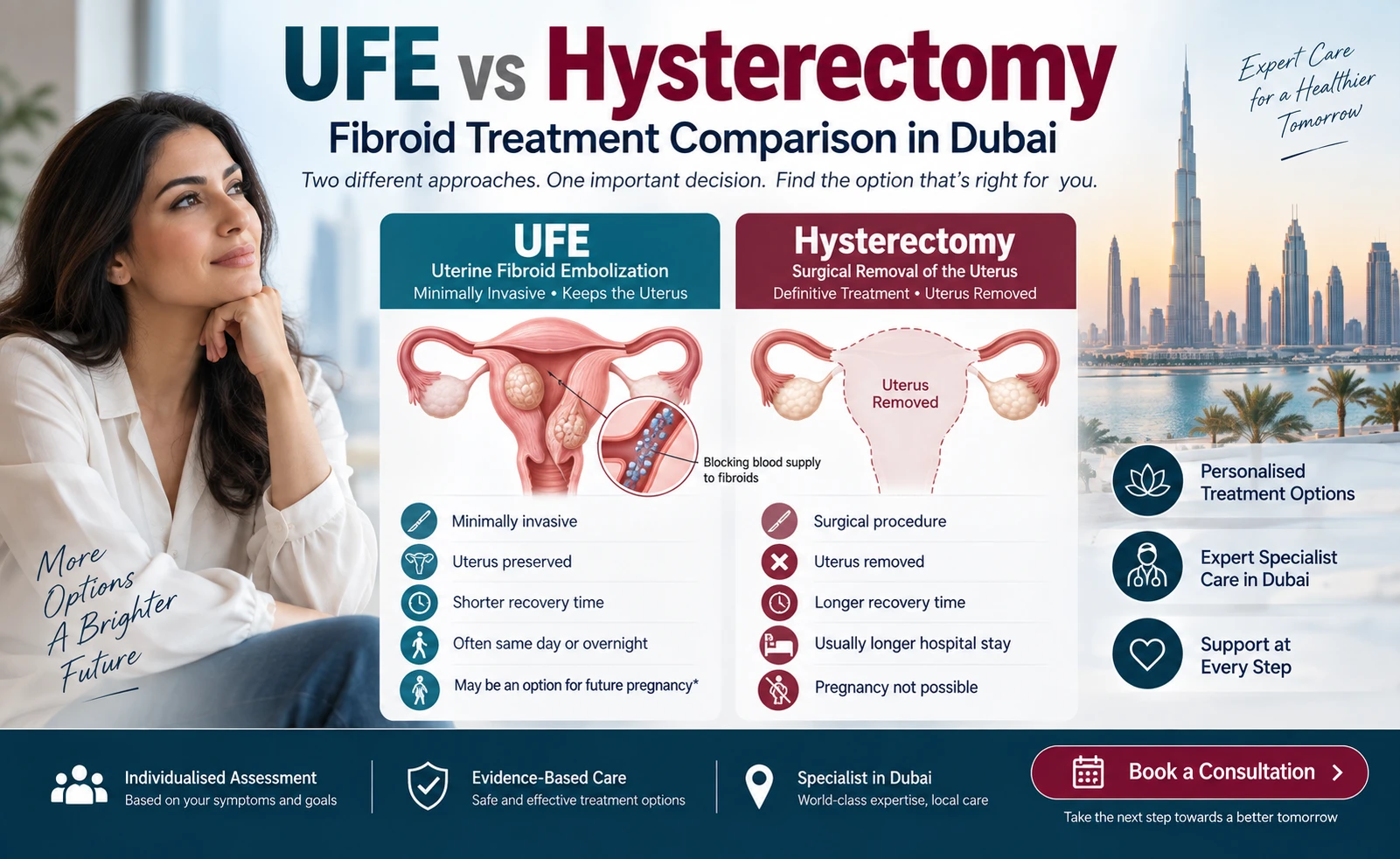
Both treatments can help manage symptoms caused by fibroids, but they work in very different ways. Hysterectomy removes the uterus, while Uterine Fibroid Embolization (UFE) is a minimally invasive procedure that reduces the blood supply to fibroids so they can shrink over time.
For some women, keeping the uterus is an important priority. For others, a definitive surgical treatment may make more sense. Your symptoms, fibroid size and location, medical history and future pregnancy plans all matter when choosing an approach.
If you have been advised to consider hysterectomy, understanding UFE and other available fibroid treatments can help you have a more informed conversation with your doctor.
What Is Uterine Fibroid Embolization (UFE)?
Uterine Fibroid Embolization, commonly called UFE, is a minimally invasive treatment for symptomatic uterine fibroids.
The procedure is performed by an interventional radiologist. Instead of removing the fibroids surgically, a thin catheter is guided through a blood vessel toward the arteries supplying the uterus. Small embolic particles are then delivered to reduce blood flow to the fibroids.
With less blood supply, the treated fibroids generally shrink over time, which may help reduce symptoms.
UFE may be considered when fibroids are causing problems such as:
- Heavy or prolonged menstrual bleeding
- Pelvic pressure or fullness
- Pelvic pain
- Abdominal bloating
- Frequent urination caused by pressure
- Anaemia related to heavy menstrual bleeding
- Symptoms caused by multiple fibroids
One of the main reasons women consider UFE is that the uterus remains in place.
If you want to understand the procedure in more detail, you can explore our Uterine Fibroid Embolization (UFE) in Dubai service page.
What Is a Hysterectomy?
A hysterectomy is a surgical procedure to remove the uterus.
There are several types of hysterectomy, and the surgical approach depends on the patient’s individual circumstances. It may be performed through abdominal, laparoscopic, robotic or vaginal surgery depending on the situation.
Because the uterus is removed, fibroids in the uterus cannot come back after hysterectomy.
However, hysterectomy also means that pregnancy is no longer possible.
For some women, this definitive approach may be appropriate, particularly when symptoms are severe, other treatment options are unsuitable, or the patient prefers definitive surgery.
UFE vs Hysterectomy: What Is the Difference?
The biggest difference is what happens to the uterus.
With UFE, the uterus remains in place and the blood supply to the fibroids is reduced.
With hysterectomy, the uterus is surgically removed.
Here is a simple comparison:
| Feature | UFE | Hysterectomy |
|---|---|---|
| Type of treatment | Minimally invasive procedure | Surgery |
| Uterus | Preserved | Removed |
| Fibroids | Blood supply is reduced | Removed with the uterus |
| Large abdominal incision | Usually not required | Depends on surgical approach |
| Hospital stay | Often same day or overnight | Usually longer |
| Recovery | Often around 1–2 weeks for many normal activities | Usually several weeks |
| Pregnancy afterward | Requires individual fertility discussion | Not possible |
| Fibroid recurrence | Further symptoms or treatment may occur | Uterine fibroids cannot recur after uterus removal |
| Treatment approach | Uterus-preserving | Definitive surgical treatment |
These are general differences. Your individual recovery, risks and treatment suitability can be different.
Is UFE Less Invasive Than Hysterectomy?
Generally, yes.
UFE is performed through a small catheter rather than through surgery to remove the uterus. This means there is usually no large abdominal incision.
However, minimally invasive does not mean risk-free.
Some women may experience:
- Pelvic cramping
- Pain
- Nausea
- Fatigue
- Mild fever
- Bruising or bleeding around the catheter access site
- Infection
- Temporary changes in menstrual bleeding
- Other procedure-related complications
Hysterectomy also carries surgical and anaesthetic risks.
The important question is not simply which treatment is less invasive. It is whether the treatment is appropriate for your specific medical situation.
Which Has a Faster Recovery: UFE or Hysterectomy?
Recovery is one of the reasons some women explore UFE.
After UFE, pelvic cramping and discomfort are common during the early recovery period. Some patients can leave the hospital on the same day, while others may stay overnight.
Many women can gradually return to normal daily activities within approximately one to two weeks, although individual recovery varies.
Hysterectomy generally requires a longer recovery because the procedure involves surgery. The exact recovery time depends on the type of hysterectomy, surgical technique and individual health.
If you have work, family or other responsibilities that make recovery time important, discuss your expected recovery with your doctor before making a decision.
Does UFE Preserve the Uterus?
Yes.
This is one of the biggest differences between UFE vs hysterectomy.
UFE treats the fibroids while leaving the uterus in place. For some women, preserving the uterus is an important personal preference.
However, preserving the uterus does not automatically mean preserving fertility.
If you are planning a future pregnancy, this should be discussed before treatment. Depending on your fibroid characteristics and reproductive plans, another treatment such as myomectomy may sometimes be considered.
For more information, read our article Avoid Hysterectomy? UFE Fibroid Treatment in Dubai.
Can You Get Pregnant After UFE?
This is an important question for women who may want children in the future.
After hysterectomy, carrying a pregnancy is not possible because the uterus has been removed.
UFE leaves the uterus in place, and pregnancy can occur after UFE. However, UFE should not be presented as a guaranteed fertility-preserving treatment.
Pregnancy and fertility outcomes can vary between women. The decision should therefore be personalised, particularly if future pregnancy is a major priority.
Your gynaecologist and interventional radiologist can discuss how UFE, myomectomy and other treatment options may relate to your individual reproductive goals.
Can UFE Treat Multiple Fibroids?
UFE can be considered for women who have multiple symptomatic fibroids.
Because UFE targets the blood supply to the uterus rather than removing individual fibroids one by one, it may be suitable in situations where several fibroids are contributing to symptoms.
However, the number of fibroids alone does not determine whether UFE is appropriate.
Your doctor may consider:
- Number of fibroids
- Size of the fibroids
- Location of the fibroids
- Appearance on imaging
- Severity of your symptoms
- Previous treatments
- Overall health
- Future pregnancy plans
Ultrasound and, when appropriate, MRI can provide important information for treatment planning.
When Might UFE Be Considered?
UFE may be considered if you have symptomatic fibroids and want to explore a minimally invasive treatment option.
You may want to discuss UFE if:
- Heavy periods are affecting your quality of life
- Fibroids are causing pelvic pressure
- You experience pelvic discomfort or pain
- Fibroids are contributing to urinary pressure
- Medication has not adequately controlled your symptoms
- You have multiple symptomatic fibroids
- You want to explore an alternative to major surgery
- You have been advised to consider hysterectomy and want to understand whether another option may be suitable
A consultation does not mean you have to choose UFE. It allows your specialist to review your condition and discuss whether it is appropriate.
When Might Hysterectomy Be More Appropriate?
Hysterectomy remains an important treatment option for many women.
It may be considered when:
- Symptoms are severe
- Definitive surgical treatment is preferred
- Other treatments are unsuitable
- Previous treatments have not provided sufficient relief
- Another uterine condition requires surgery
- The patient understands the implications and prefers hysterectomy
UFE is not suitable for every woman, and it should not be viewed as a universal replacement for hysterectomy.
The best treatment depends on your individual diagnosis and priorities.
What About Myomectomy?
When discussing UFE vs hysterectomy, it is important to remember that these are not the only treatment options.
Myomectomy removes fibroids while keeping the uterus in place.
For some women, particularly those who want to become pregnant in the future, myomectomy may be an important option to discuss.
The appropriate treatment can depend on:
- Number of fibroids
- Size
- Location
- Symptoms
- Age
- Overall health
- Pregnancy plans
- Previous treatments
Your doctor can help you understand which options are realistic for your individual situation.
What Tests Are Needed Before UFE?
Before UFE is considered, your specialist will need to understand your symptoms and evaluate your fibroids.
Medical History
Your menstrual history, symptoms, previous treatments, medications and pregnancy plans may be reviewed.
Ultrasound
Pelvic ultrasound can identify fibroids and provide information about their size and location.
MRI
MRI may be recommended when more detailed information about the fibroids is needed for treatment planning.
Blood Tests
Blood tests may be recommended, particularly if heavy menstrual bleeding has caused or may have caused anaemia.
Specialist Assessment
Your symptoms, medical history and imaging findings are considered together before deciding whether UFE is appropriate.
If you already have recent ultrasound or MRI reports, take them with you to your consultation.
What Happens During UFE?
If UFE is considered appropriate, the procedure generally involves several steps.
First, you are prepared for the procedure and given medication to keep you comfortable.
A local anaesthetic is used at the catheter access site. A thin catheter is then inserted into an artery, commonly through the wrist or groin.
Using medical imaging, the catheter is guided toward the uterine arteries.
Small embolic particles are then delivered to reduce blood flow to the fibroids.
After treatment, the catheter is removed and the access site is managed. You are then monitored during the initial recovery period.
The procedure commonly takes around 45 to 90 minutes, although the actual time can vary.
The fibroids do not disappear immediately. They generally shrink gradually over the following weeks and months.
How Do You Choose Between UFE and Hysterectomy?
There is no single answer that applies to every woman.
When considering UFE vs hysterectomy, think about your personal priorities as well as your medical situation.
Your Symptoms
How much are heavy bleeding, pelvic pressure, pain or urinary symptoms affecting your quality of life?
Your Fibroids
How many fibroids do you have, and what are their sizes and locations?
Your Priorities
Is keeping your uterus important to you?
Your Pregnancy Plans
Do you want to carry a pregnancy in the future?
Your Recovery
How much time can you realistically take away from work and normal activities?
Your Previous Treatment
Have medications or other procedures already been tried?
Your Overall Health
Are there health factors that could affect your suitability for surgery or UFE?
Your Personal Preference
After understanding the benefits, limitations and risks, which option best fits your goals?
These questions can make your consultation more productive and help you participate in the treatment decision.
Why Consult an Interventional Radiologist?
Interventional radiologists specialise in minimally invasive, image-guided procedures.
If you have been advised to consider hysterectomy for symptomatic fibroids, an interventional radiology consultation can help determine whether UFE may be appropriate for you.
Dr Abdul Rahman Alvi is a UK-trained Consultant Vascular & Interventional Radiologist with 28+ years of international clinical experience.
He holds MBBS, MRCS, FRCR and CCT (UK) qualifications, with Dual CCT in Interventional & Clinical Radiology.
His practice includes minimally invasive image-guided treatments for uterine fibroids and other vascular conditions.
You can learn more about his qualifications and experience on the About Dr Abdul Rahman Alvi page.
UFE in Dubai: What Should You Ask Your Doctor?
If you are considering fibroid treatment in Dubai, you may want to ask:
- Am I a suitable candidate for UFE?
- How many fibroids do I have?
- Where are my fibroids located?
- What treatment options are available for me?
- Would my pregnancy plans affect the recommended treatment?
- What should I expect during UFE recovery?
- What are the potential risks in my individual case?
- Could I require additional treatment later?
- How long might I need away from work?
- What will the overall treatment involve?
Having your previous imaging and medical reports available can help your specialist assess your situation more effectively.
UFE vs Hysterectomy: Which Treatment Is Right for You?
The answer depends on your individual circumstances.
UFE may be considered by selected women who want a minimally invasive treatment that keeps the uterus in place.
Hysterectomy may be appropriate for women who want or require definitive surgical removal of the uterus.
Myomectomy may also be an important option for selected women, particularly when preserving the uterus and considering future pregnancy.
There is no need to choose a treatment simply because it worked for someone else. Your fibroids, symptoms, health and personal goals are unique.
If you have been told that hysterectomy may be necessary, discussing your complete range of suitable options with the appropriate specialists can help you make a more informed decision.
If you would like to explore whether UFE may be suitable for your fibroids, book a consultation with Dr Abdul Rahman Alvi in Dubai.