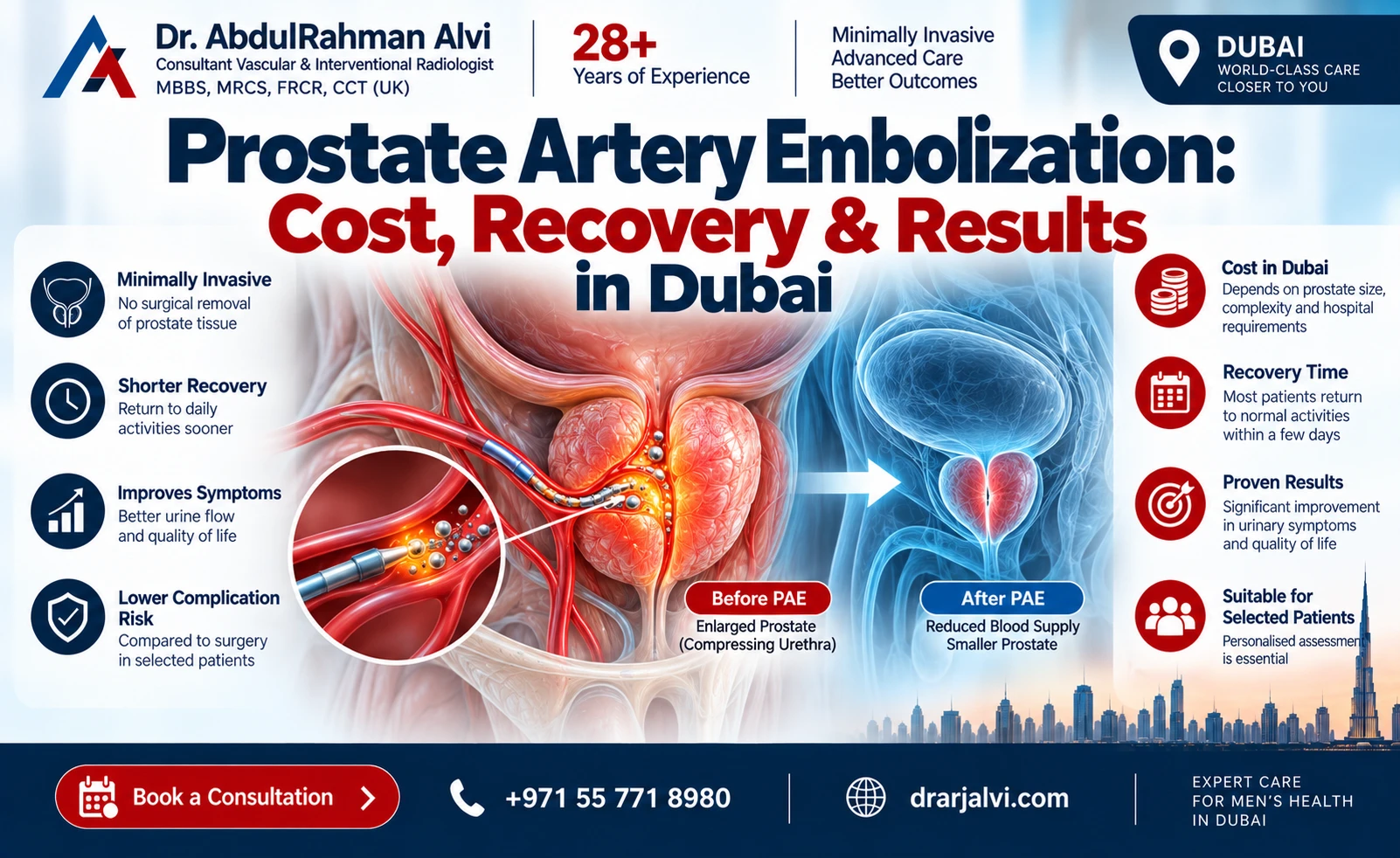
Prostate Artery Embolization (PAE) is a minimally invasive, image-guided treatment for urinary symptoms caused by benign prostatic hyperplasia (BPH), commonly known as an enlarged prostate. Instead of removing prostate tissue, PAE reduces blood flow to selected prostate arteries, allowing the prostate to gradually shrink and potentially relieve pressure on the urethra.
PAE is generally performed through a small arterial access point, often using local anaesthesia, and many patients can return home the same day. Improvement in urinary symptoms usually develops progressively rather than immediately.
Clinical studies have reported meaningful improvement in urinary symptoms and quality of life after PAE. However, when compared with established surgical treatments such as TURP, the results are not identical. Surgery generally produces greater improvements in urinary flow and prostate-volume reduction, while PAE offers a less invasive treatment pathway with a different recovery and risk profile.
The cost of PAE in Dubai varies according to prostate size, vascular anatomy, imaging, hospital or day-care charges, and follow-up requirements. A personalised estimate can only be provided after clinical assessment.
What Is Prostate Artery Embolization?
Prostate Artery Embolization, commonly abbreviated as PAE, is a minimally invasive treatment for lower urinary tract symptoms associated with benign prostatic hyperplasia.
The prostate sits beneath the bladder and surrounds part of the urethra. As the prostate enlarges, it can place pressure on the urethra and interfere with normal urinary flow.
This can lead to symptoms such as:
- Weak or slow urine stream
- Difficulty starting urination
- Frequent urination
- Urgency
- Interrupted urine flow
- Feeling that the bladder has not emptied completely
- Dribbling after urination
- Waking repeatedly during the night to urinate
PAE approaches the problem through the prostate’s blood supply rather than by removing prostate tissue.
A thin catheter is introduced into an artery, usually through the wrist or groin. Using X-ray and angiographic imaging, the interventional radiologist identifies the arteries supplying the prostate and delivers tiny embolic particles into selected vessels.
Reduced blood flow can cause the enlarged prostate tissue to shrink over time, potentially improving urinary symptoms.
PAE is therefore fundamentally different from procedures such as TURP, where prostate tissue causing obstruction is surgically removed.
Why Do Men Consider PAE?
Men with BPH have several possible treatment pathways.
Depending on symptom severity, treatment may include:
- Monitoring and lifestyle changes
- Prescription medication
- Office-based or minimally invasive procedures
- Prostate Artery Embolization
- TURP
- HoLEP
- Other surgical or minimally invasive procedures
PAE may be particularly attractive to men who want to explore a minimally invasive approach and avoid direct surgical removal of prostate tissue.
However, wanting a non-surgical treatment does not automatically make someone a candidate.
The prostate size, anatomy, symptom pattern, bladder function, previous treatment, medications and overall health all need to be considered.
For a broader explanation of BPH symptoms and non-surgical treatment options, see the existing article Enlarged Prostate Symptoms? Explore Non-Surgical BPH Treatment in Dubai.
What Are the Results of PAE?
One of the most important questions patients ask is whether PAE actually works.
The answer requires some nuance.
Clinical studies have consistently reported improvement in urinary symptoms and quality of life after PAE. However, PAE does not produce identical results in every patient, and studies comparing it with surgery show differences in objective measures such as urinary flow rate and prostate-volume reduction.
A meta-analysis involving 484 men with BPH found significant improvements in International Prostate Symptom Score (IPSS), urinary flow, residual urine and quality of life during follow-up from 3 to 24 months.
The reported mean IPSS improvement was approximately:
- 14 points at 3 months
- 12 points at 6 months
- 16 points at 12 months
- 17 points at 24 months
These figures represent results reported across clinical studies and should not be interpreted as a guaranteed result for an individual patient.
A large long-term cohort of 1,075 patients also reported substantial improvements in urinary symptoms and quality of life following PAE.
Among patients who were catheter-dependent because of urinary retention, 94% were catheter-free at three months in that study.
These results are encouraging, but observational studies have limitations.
Long-term observational data can show how patients perform after treatment, but randomized comparisons are more useful when determining how PAE compares with established surgical alternatives.
PAE vs TURP: What Does the Evidence Show?
TURP remains an established surgical treatment for BPH.
In randomized research comparing PAE and TURP, both treatments improved urinary symptoms.
At 12 months, one randomized study reported a mean IPSS reduction of approximately 21 points with PAE and 18 points with TURP.
However, the reduction in prostate volume was greater with TURP in that study:
- Approximately 34% after PAE
- Approximately 71% after TURP
The PAE group experienced fewer reported adverse events.
Another randomized trial found that PAE produced symptom improvement close to TURP during early follow-up, but TURP produced greater improvements in maximum urinary flow, post-void residual urine and prostate volume.
Longer-term research is also important.
A five-year randomized follow-up reported mean IPSS reductions of approximately 7.8 points after PAE and 11.6 points after TURP.
The study found that TURP was superior for several secondary outcomes, while PAE had advantages in certain areas including erectile-function outcomes.
This is why I would not describe PAE simply as “better than surgery.”
It is better understood as a different treatment approach with its own advantages, limitations and patient-selection criteria.
Published PAE Results at a Glance
| Evidence | Patients | Main finding |
|---|---|---|
| Meta-analysis of BPH studies | 484 | Significant improvements in IPSS, urinary flow, residual urine and quality of life during follow-up |
| Randomized PAE vs TURP study | 114 | Both improved symptoms; TURP produced greater prostate-volume reduction |
| UK-ROPE study | 305 | PAE produced meaningful symptom improvement with a less invasive treatment pathway |
| Five-year randomized follow-up | 103 | Both treatments provided symptom improvement; TURP had stronger results for several secondary outcomes |
| Large long-term cohort | 1,075 | Sustained symptom and quality-of-life improvement reported; 94% of catheter-dependent patients were catheter-free at 3 months |
These studies involved different patient populations, treatment methods and follow-up periods.
Their results should therefore not be treated as a direct prediction for an individual patient.
How Does PAE Work?
PAE is based on the vascular supply of the prostate.
The procedure generally involves several stages.
1. Arterial Access
A small puncture is made in an artery, commonly at the wrist or groin.
2. Catheter Navigation
A very thin catheter is advanced through the blood vessels toward the arteries supplying the prostate.
3. Angiographic Mapping
Contrast imaging is used to understand the patient’s individual arterial anatomy.
This step is particularly important because prostate arteries can vary considerably between patients.
4. Selective Embolization
Once the appropriate vessels are identified, tiny embolic particles are carefully delivered to reduce blood flow to the targeted prostate tissue.
5. Completion Imaging
The treated vessels are reassessed to confirm the intended embolization and minimise the risk of non-target treatment.
6. Recovery
The catheter is removed and the access site is monitored before discharge.
The technical complexity of PAE is one reason specialist experience and careful vascular imaging are important.
How Long Does PAE Take?
The exact duration varies depending on the patient’s arterial anatomy and procedural complexity.
A typical PAE procedure may take approximately 60–90 minutes, although individual cases can take longer or shorter.
PAE is usually performed using local anaesthesia, with sedation when appropriate.
Because there is no surgical incision into the prostate and no direct removal of prostate tissue, many patients can return home on the same day, depending on their clinical condition and the facility’s protocol.
PAE Recovery: What Should You Expect?
Recovery after PAE is usually less disruptive than recovery from many surgical BPH procedures, but it is important not to expect immediate urinary improvement.
The prostate does not shrink immediately after embolization.
The treatment changes its blood supply, and the resulting reduction in prostate volume and pressure develops progressively.
First 24 Hours
Some patients may experience:
- Mild pelvic discomfort
- Burning during urination
- Increased urinary frequency
- Mild cramping
- Fatigue
- Discomfort or bruising around the arterial access site
First Week
Many patients can return to light daily activities within several days, depending on how they feel and the advice of their treating team.
Strenuous exercise and heavy lifting should be avoided until the specialist confirms that it is appropriate.
Weeks 2–6
Urinary symptoms may gradually improve.
Some men notice:
- Stronger urinary flow
- Less urgency
- Fewer nighttime bathroom visits
- Better bladder emptying
The pace of improvement varies considerably.
One to Three Months
The prostate continues to respond to the reduction in blood flow.
Follow-up allows the treating team to assess symptom improvement and determine whether additional management is required.
Is PAE Painful?
PAE is generally performed under local anaesthesia, so significant pain during catheter placement is not expected.
After the procedure, some men experience temporary pelvic discomfort, urinary burning or cramping.
The severity varies from patient to patient.
Your treating team can prescribe appropriate medication if needed and provide specific instructions for managing symptoms during the first few days.
Who Is a Good Candidate for PAE?
PAE may be considered for men who have:
- Confirmed BPH-related urinary symptoms
- Moderate or severe lower urinary tract symptoms
- Symptoms that continue despite medication
- Medication side effects that make long-term treatment difficult
- A desire to explore a minimally invasive treatment
- Prostate anatomy that is suitable for embolization
- A clinical situation where PAE is a reasonable alternative to another treatment
The assessment should not be based on prostate size alone.
The relationship between prostate size, symptoms, obstruction and bladder function is more important than a single measurement.
Who May Not Be Suitable for PAE?
PAE is not appropriate for every man with urinary symptoms.
Further assessment may be needed when:
- Symptoms are caused by something other than BPH
- There is significant bladder dysfunction
- There is untreated urinary infection
- The arterial anatomy is unsuitable
- There is another urological condition requiring a different treatment
- The patient requires a treatment that directly removes obstructing prostate tissue
- There is severe obstruction or a complication that requires urgent urological management
A coordinated assessment with an interventional radiologist and urologist can be particularly useful when treatment options overlap.
What Tests Are Needed Before PAE?
Before recommending PAE, the specialist may review:
- Medical history
- Urinary symptoms
- International Prostate Symptom Score (IPSS)
- Medication history
- Urine testing
- Blood tests
- PSA where clinically appropriate
- Prostate size
- Bladder emptying
- Imaging
- Previous urological procedures
Depending on the individual case, ultrasound, MRI, CT angiography or other imaging may be used.
The objective is not simply to confirm that the prostate is enlarged.
It is to determine whether the symptoms are actually related to BPH and whether PAE is technically and clinically appropriate.
What Are the Risks of PAE?
PAE is minimally invasive, but no procedure is completely risk-free.
Potential complications include:
- Temporary pelvic pain or discomfort
- Burning during urination
- Increased urinary frequency
- Temporary urinary retention
- Infection
- Bruising or bleeding at the arterial access site
- Vascular injury
- Non-target embolization
- Rare ischaemic injury to surrounding tissues
- Persistent or recurrent urinary symptoms
- Need for repeat treatment
- Rare need for another prostate procedure
In a large long-term patient cohort, severe complications were uncommon, but serious complications can occur.
The individual risk depends on vascular anatomy, prostate anatomy, medical history and procedural factors.
Does PAE Affect Sexual Function?
Sexual function is an important consideration when choosing a BPH treatment.
One potential advantage of PAE is that it does not require surgical removal of prostate tissue through the urethra.
Research has generally found that erectile and sexual-function outcomes can be preserved with PAE, although individual results vary.
This does not mean that PAE guarantees preservation of sexual function.
The type of BPH treatment, baseline sexual health, age, medications and other medical conditions can all influence sexual outcomes.
In comparative studies, PAE has often shown a favourable profile for certain sexual-function outcomes compared with TURP, but this needs to be balanced against the stronger objective urinary-flow and prostate-volume improvements generally seen with TURP.
Can PAE Treat a Very Large Prostate?
PAE can be considered in men with large prostate volumes, and studies have reported symptom improvement in this group.
Research has specifically examined PAE in patients with prostate volumes of 80 mL or more and reported improvements in urinary symptoms and quality of life.
However, prostate size alone does not determine suitability.
A large prostate with suitable vascular anatomy may be technically treatable, while another patient with a smaller prostate may require a different approach.
How Much Does Prostate Artery Embolization Cost in Dubai?
There is no single fixed PAE price that applies to every patient.
The cost of Prostate Artery Embolization in Dubai can depend on:
- Prostate size
- Vascular anatomy
- Complexity of embolization
- Pre-procedure imaging
- Blood and urine tests
- Hospital or day-care facility charges
- Anaesthesia or sedation requirements
- Follow-up appointments
- Insurance coverage
The final cost should therefore be discussed after the patient’s clinical assessment and treatment plan have been established.
A consultation is the appropriate point at which to establish the recommended treatment and expected cost.
Is PAE Covered by Insurance in Dubai?
Insurance coverage depends on the insurer, policy, medical indication and facility.
Some policies may require pre-authorisation or specific documentation before treatment.
Patients should confirm coverage with their insurance provider and treatment centre before scheduling the procedure.
PAE vs TURP: Which Treatment Should You Choose?
There is no universal answer.
PAE Offers:
- Minimally invasive treatment
- No surgical removal of prostate tissue
- Usually local anaesthesia
- Short hospital or day-care pathway
- Potential preservation of sexual function
- A different recovery profile from TURP
TURP Offers:
- Direct removal of obstructing prostate tissue
- Established long-term clinical experience
- Strong improvements in urinary flow
- Greater prostate-volume reduction in comparative studies
- A direct approach to mechanical obstruction
The evidence does not support presenting one treatment as universally superior.
The appropriate treatment depends on the individual patient’s prostate, symptoms, anatomy, medical history and treatment goals.
What If PAE Does Not Work?
Not every patient experiences sufficient improvement after PAE.
If urinary symptoms persist, the next step may include reassessment of:
- Prostate size
- Residual urine
- Urinary flow
- Bladder function
- Medication response
- Prostate arterial anatomy
- The original diagnosis
Depending on the findings, further treatment could involve:
- Repeat embolization
- Medication
- Another minimally invasive procedure
- TURP
- HoLEP
- Another surgical treatment
This is one reason I prefer to discuss PAE as part of a treatment pathway, rather than promising that it will permanently eliminate BPH symptoms.
How Long Do PAE Results Last?
The duration of benefit varies.
Long-term observational evidence shows that some patients maintain substantial symptom improvement for several years.
However, some patients require further treatment.
In one large long-term cohort, approximately 16% of patients eligible for reintervention underwent a second prostatic intervention during follow-up extending to five years.
This is an important point when discussing results.
A successful initial response does not necessarily mean that no future treatment will ever be required.
Why Choose Dr. AbdulRahman Alvi for PAE in Dubai?
Prostate Artery Embolization is technically demanding because the prostate has variable arterial anatomy and the treatment requires selective catheterisation of small vessels.
Dr. AbdulRahman Alvi is a UK-trained Consultant Vascular and Interventional Radiologist with 28+ years of clinical experience, holding MBBS, MRCS, FRCR and Dual CCT-UK qualifications.
His training includes Sheffield Teaching Hospitals and advanced fellowship experience at the Royal Free Hospital in London.
His practice focuses on minimally invasive, image-guided procedures.
For PAE, the goal is not simply to perform an embolization.
The important part is determining whether embolization is appropriate for the patient’s symptoms, prostate anatomy, vascular anatomy and treatment goals.
Questions to Ask Before Having PAE
Before proceeding with Prostate Artery Embolization, ask your specialist:
- Are my urinary symptoms definitely caused by BPH?
- How large is my prostate?
- Is my prostate anatomy suitable for PAE?
- Do I need MRI, CT or ultrasound before treatment?
- How severe are my symptoms according to IPSS?
- Would medication still be appropriate?
- How does PAE compare with TURP or HoLEP in my case?
- What improvement should I realistically expect?
- How long could it take before I notice improvement?
- What are the specific risks in my anatomy?
- Could I need another procedure later?
- What is the expected total cost?
- Does my insurance cover the treatment?
- Will I need follow-up with a urologist?
When Should You See a BPH Specialist?
You should consider a specialist assessment if urinary symptoms are affecting your sleep, work, travel, relationships or daily activities.
Particularly important symptoms include:
- Increasingly weak urine flow
- Difficulty starting urination
- Repeated nighttime urination
- Urinary urgency
- Incomplete bladder emptying
- Recurrent urinary infections
- Increasing urinary retention
- Symptoms that are not improving with medication
- Significant medication side effects
Seek Urgent Medical Attention If You Cannot Urinate
Sudden inability to pass urine can represent acute urinary retention and requires prompt medical assessment.
Do not delay emergency care while waiting for a routine PAE consultation.
Is PAE Worth Considering in Dubai?
For appropriately selected men with symptomatic BPH, Prostate Artery Embolization is a legitimate minimally invasive treatment option with evidence of meaningful improvement in urinary symptoms and quality of life.
Its main advantages are its minimally invasive nature, lack of surgical tissue removal and generally shorter recovery pathway.
However, PAE should not be presented as a guaranteed cure or as universally superior to TURP.
The best treatment depends on prostate anatomy, symptom severity, bladder function, previous treatment, overall health and personal priorities.
Frequently Asked Questions
Book a Prostate Artery Embolization Consultation in Dubai
If an enlarged prostate is affecting your sleep, urinary flow or quality of life, a specialist assessment can help determine whether PAE is appropriate for you.
Dr. AbdulRahman Alvi provides minimally invasive, image-guided treatment for selected patients with BPH in Dubai.
A consultation allows your symptoms, prostate size, imaging, vascular anatomy and previous treatments to be reviewed before deciding whether PAE, medication, another minimally invasive treatment or surgery is the most appropriate pathway.
Book a Consultation to discuss Prostate Artery Embolization and your BPH treatment options in Dubai.