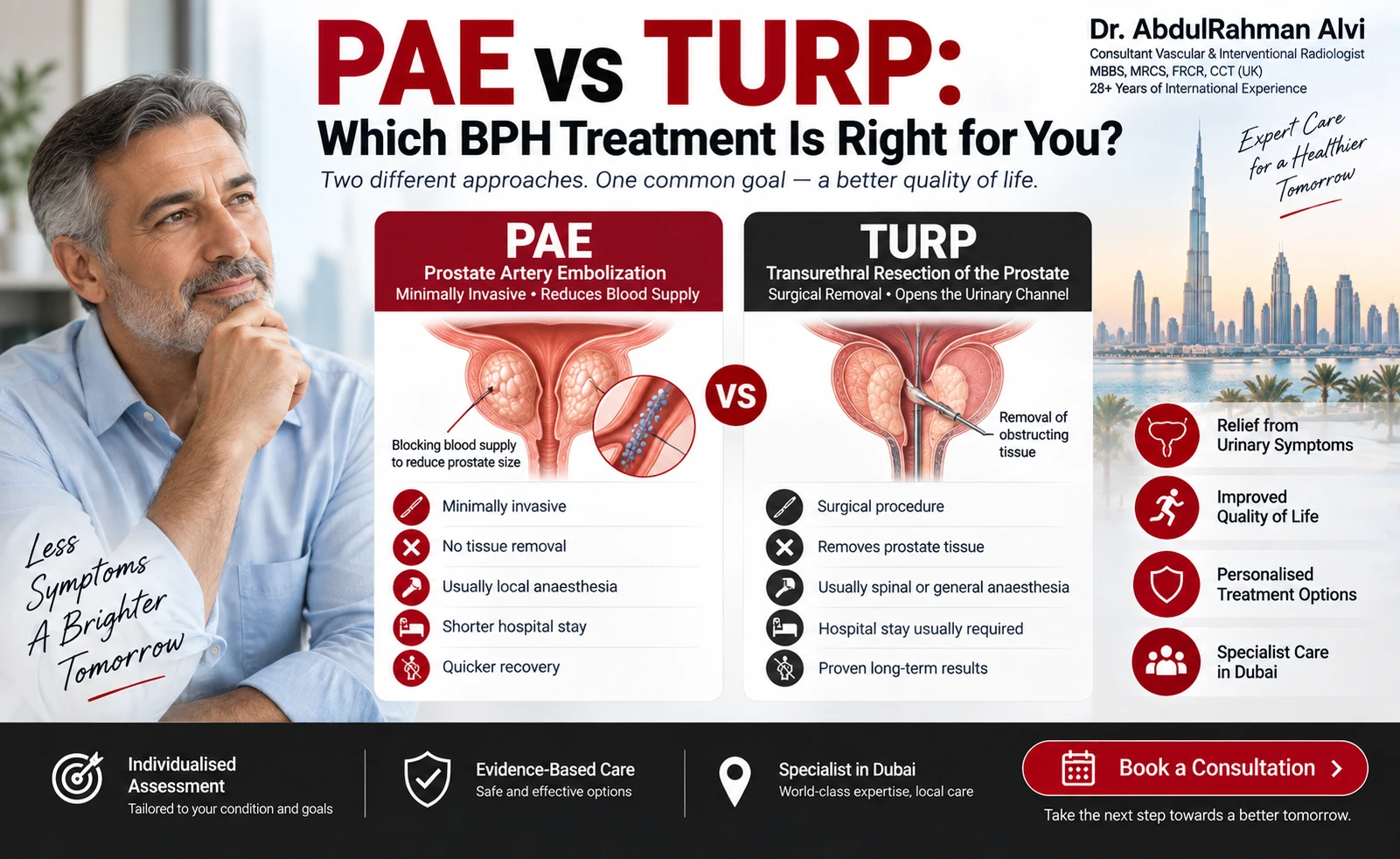
PAE and TURP are both treatments for urinary symptoms caused by benign prostatic hyperplasia (BPH), but they work in very different ways. PAE reduces blood flow to the prostate through a small catheter, while TURP removes obstructing prostate tissue through the urethra.
Clinical studies show that both treatments can improve BPH symptoms. However, TURP generally provides greater improvement in urinary flow and other objective measures, while PAE offers a minimally invasive approach with less tissue removal and a different recovery profile.
PAE can be an option for appropriately selected men who want to explore a minimally invasive alternative to conventional prostate surgery. The decision should be based on prostate size and anatomy, symptom severity, medical history, treatment goals and specialist assessment.
Why Are Men Comparing PAE and TURP?
Living with an enlarged prostate can affect much more than urination.
A weak urinary stream, difficulty starting urination, frequent trips to the bathroom or waking several times at night can gradually interfere with sleep, work, travel and everyday life.
Medication is often used to manage BPH symptoms, but it does not provide enough relief for every man. When symptoms remain troublesome, a procedure may become an option.
This is where the discussion often becomes PAE vs TURP.
TURP is an established surgical treatment that removes prostate tissue blocking urine flow. PAE takes a different approach by reducing blood flow to the prostate through a catheter.
Understanding how the two treatments differ can help you have a more useful conversation with your urologist and interventional radiologist.
What Is Prostate Artery Embolization (PAE)?
Prostate Artery Embolization (PAE) is a minimally invasive procedure used to treat urinary symptoms associated with an enlarged prostate.
During PAE, an interventional radiologist guides a thin catheter through an artery, commonly from the wrist or groin, toward the blood vessels supplying the prostate.
Small embolic particles are then delivered to reduce blood flow to the prostate.
Over time, the prostate may shrink or become smaller, potentially reducing pressure on the urethra and improving urinary symptoms.
Unlike TURP, PAE does not physically remove prostate tissue.
PAE may be considered for men experiencing symptoms such as:
- Weak urinary stream
- Difficulty starting urination
- Frequent urination
- Urgency
- Getting up repeatedly at night to urinate
- Feeling that the bladder has not completely emptied
- Persistent urinary symptoms despite medication
PAE is generally performed using local anaesthesia, with sedation when appropriate.
For men interested in this approach, the Prostate Artery Embolization in Dubai service page provides more information about treatment, recovery and assessment.
What Is TURP?
Transurethral Resection of the Prostate (TURP) is an established surgical treatment for BPH.
During TURP, a specialised instrument called a resectoscope is passed through the urethra into the prostate.
The surgeon removes prostate tissue that is obstructing the urinary passage, creating more space for urine to flow.
There is no external abdominal incision, but TURP is still a surgical procedure.
TURP has been used for many years and remains an important treatment option for men whose BPH symptoms require procedural or surgical management.
PAE vs TURP: What Does the Research Show?
When comparing PAE and TURP, it is important to look beyond marketing claims.
Research suggests that both treatments can improve BPH symptoms, but TURP generally has an advantage in objective measures of urinary function.
A randomised clinical trial published in 2018 found that both treatments significantly improved symptoms. At 12 weeks, the average International Prostate Symptom Score (IPSS) reduction was approximately 9.2 points with PAE and 10.8 points with TURP.
However, TURP produced greater improvements in maximum urinary flow and prostate volume.
Long-term research also shows a similar pattern.
In a five-year randomised trial, the average IPSS reduction was approximately 7.8 points following PAE compared with 11.6 points following TURP. Maximum urinary flow improved by approximately 3.6 mL/s with PAE compared with 9.3 mL/s with TURP.
These figures come from published clinical research and should not be interpreted as a guarantee of an individual patient’s result.
Published Evidence Snapshot
| Outcome | PAE | TURP |
|---|---|---|
| IPSS reduction at 12 weeks | About 9.2 points | About 10.8 points |
| Maximum flow improvement at 12 weeks | About 5.2 mL/s | About 15.3 mL/s |
| Prostate-volume reduction at 12 weeks | About 12.2 mL | About 30.3 mL |
| IPSS reduction at 5 years | About 7.8 points | About 11.6 points |
| Maximum flow improvement at 5 years | About 3.6 mL/s | About 9.3 mL/s |
These statistics are compiled from published comparative clinical studies. They represent study results rather than Dr. Alvi’s personal patient outcomes.
The evidence therefore does not support simply calling PAE “better” than TURP. Instead, the two procedures offer different advantages and trade-offs.
Who May Be a Good Candidate for PAE?
PAE may be worth discussing if you:
- Have moderate-to-severe urinary symptoms associated with BPH
- Have not received adequate relief from medication
- Want to explore a minimally invasive treatment
- Prefer to avoid conventional prostate surgery where clinically appropriate
- Have medical factors that make conventional surgery less attractive
- Have prostate anatomy suitable for embolization
- Understand the potential benefits and limitations of PAE
- Accept that additional treatment may be needed in the future
The European Association of Urology recognises PAE as an option for appropriately selected men with moderate-to-severe lower urinary tract symptoms who want a minimally invasive approach and understand that outcomes may be less optimal than TURP.
Who May Not Be Suitable for PAE?
PAE is not appropriate for every man with BPH.
Another treatment may be more suitable if:
- Your urinary obstruction is severe and requires another form of intervention
- You have significant urinary retention or BPH complications
- Your prostate artery anatomy is unsuitable for safe embolization
- There is concern about another prostate or urinary condition
- Your priority is the greatest possible improvement in urinary flow
- You cannot complete appropriate follow-up
- Another treatment offers a better balance of benefits and risks for your situation
BPH symptoms can also have causes other than prostate enlargement, so proper assessment is important before selecting a treatment.
PAE vs TURP: Which Treatment Provides Better Results?
If your main priority is maximum improvement in urinary flow, current evidence generally favours TURP.
If your priority is a minimally invasive procedure that avoids surgical removal of prostate tissue, PAE may be attractive for appropriately selected patients.
This distinction is important.
PAE can significantly improve symptoms, but it should not be presented as producing exactly the same results as TURP.
TURP generally produces greater improvements in maximum urinary flow and other objective measures of obstruction.
At the same time, PAE can offer advantages related to its minimally invasive nature, including less surgical tissue disruption and potentially shorter hospitalisation.
The right choice depends on which outcomes matter most to you and what your medical assessment shows.
PAE vs TURP: Comparison Table
| Factor | PAE | TURP |
|---|---|---|
| Treatment approach | Minimally invasive embolization | Surgical tissue removal |
| Access | Through a blood vessel | Through the urethra |
| Prostate tissue removed | No | Yes |
| External incision | No | No external abdominal incision |
| Anaesthesia | Usually local anaesthesia with appropriate sedation | Usually spinal or general anaesthesia |
| Urinary catheter | Usually shorter catheterisation | Temporary catheter commonly required |
| Hospital stay | Often shorter | Usually longer than a day-case procedure |
| Urinary flow improvement | Generally less than TURP | Generally greater |
| Prostate reduction | Generally less than TURP | Generally greater |
| Retreatment | Higher likelihood than TURP | Lower likelihood in comparative evidence |
| Sexual/ejaculatory effects | Different profile; individual risks should be discussed | Ejaculatory changes are a recognised consideration |
| What it does not guarantee | Permanent symptom relief or avoiding future treatment | Complete symptom resolution or absence of complications |
This comparison shows why there is no universal winner. The most appropriate treatment depends on the individual patient.
What Happens During PAE?
If PAE is considered appropriate, the procedure generally follows these steps:
- Your symptoms, medical history and previous investigations are reviewed.
- Appropriate prostate imaging and treatment planning are performed.
- Local anaesthesia is applied at the vascular access site.
- A thin catheter is introduced through an artery, commonly at the wrist or groin.
- Imaging is used to identify the arteries supplying the prostate.
- Small embolic particles are delivered to reduce blood flow to the prostate.
- The catheter is removed.
- You are monitored before discharge and given recovery instructions.
The procedure itself commonly takes around one to two hours, although the exact time varies between patients.
What Happens During TURP?
During TURP, a resectoscope is passed through the urethra into the prostate.
The surgeon identifies and removes the prostate tissue that is blocking the urinary channel.
Because tissue is physically removed, TURP can provide a substantial improvement in urinary flow.
A urinary catheter is generally placed after the procedure while the urinary tract begins to recover.
Hospital observation and recovery requirements depend on the individual patient and the surgical approach.
Recovery After PAE
One of the reasons men consider PAE is its minimally invasive nature.
After treatment, some patients experience:
- Pelvic discomfort
- Mild cramping
- Temporary urinary frequency or urgency
- Fatigue
- Discomfort or bruising at the catheter access site
- Temporary worsening of urinary symptoms
Improvement does not necessarily happen immediately because the prostate gradually responds to the reduced blood supply.
Some patients can be treated as day cases, while others may require overnight observation.
Your individual recovery depends on your health, symptoms and response to treatment.
Recovery After TURP
Recovery after TURP involves a surgical healing period.
A urinary catheter is commonly required temporarily after the procedure.
During recovery, some men experience:
- Burning when urinating
- Increased urinary frequency
- Urgency
- Blood in the urine
- Temporary difficulty controlling the bladder
- Fatigue
Your urologist will advise you about returning to work, exercise, sexual activity and other normal activities.
Recovery varies according to the patient and the extent of the procedure.
What Are the Risks of PAE?
PAE is minimally invasive, but it still carries potential risks.
Possible complications include:
- Pain or pelvic discomfort
- Temporary urinary symptoms
- Bleeding or bruising at the catheter access site
- Infection
- Blood-vessel complications
- Non-target embolization
- Radiation exposure
- Temporary urinary retention
- Incomplete symptom improvement
- Need for additional treatment
Modern imaging and embolization techniques are designed to reduce the risk of non-target treatment, but the possibility cannot be completely eliminated.
Your specialist should explain the risks that are particularly relevant to your anatomy and medical history.
What Are the Risks of TURP?
TURP also has potential risks and complications.
These can include:
- Bleeding
- Infection
- Temporary urinary difficulties
- Urethral stricture
- Bladder-neck problems
- Urinary incontinence in some patients
- Need for further treatment
- Ejaculatory changes
- Anaesthetic or surgical complications
The risk profile varies between patients.
A urologist should discuss the potential complications and expected benefits before you decide to proceed.
What About Sexual Function?
Sexual and reproductive considerations can be important when comparing PAE and TURP.
TURP is associated with a significant risk of retrograde ejaculation, in which semen enters the bladder rather than leaving through the penis during ejaculation.
PAE may have a different sexual side-effect profile, and preservation of sexual function is one reason some men are interested in the procedure.
However, PAE should not be described as guaranteeing preservation of sexual function.
If sexual function is an important priority for you, discuss this specifically with your urologist and interventional radiologist before choosing treatment.
What If PAE Does Not Work Well Enough?
No BPH treatment guarantees complete or permanent relief.
If symptoms remain after PAE, your specialist may reassess:
- Urinary flow
- Post-void residual urine
- Prostate size
- Remaining obstruction
- Bladder function
- Your current symptoms
- Whether another condition is contributing to your urinary problems
Additional treatment may sometimes be required.
This is an important difference when comparing PAE and TURP. Research indicates that retreatment is more likely after PAE than after TURP.
That does not make PAE unsuitable. It simply means that retreatment is an important part of the decision and should be discussed before treatment.
What Does PAE Cost in Dubai?
The cost of PAE varies from patient to patient.
Factors that can affect the overall cost include:
- Prostate size and anatomy
- Imaging requirements
- Procedure complexity
- Hospital or day-care charges
- Anaesthesia or sedation requirements
- Follow-up appointments
- Insurance coverage
There is no single price that accurately represents every patient’s treatment.
A personalised estimate can be provided after your medical assessment.
If you are considering PAE in Dubai, ask your specialist what is included in the treatment package and whether additional imaging or follow-up costs may apply.
Questions to Ask Your Specialist
Before choosing between PAE and TURP, consider asking:
- Are my urinary symptoms definitely caused by BPH?
- How severe is my prostate obstruction?
- What is my prostate size?
- Is my prostate anatomy suitable for PAE?
- Would TURP provide a better result in my case?
- What improvement in urinary flow can I realistically expect?
- What are the specific risks of PAE for me?
- What are the specific risks of TURP for me?
- How likely am I to need additional treatment?
- How could each treatment affect sexual function?
- How long should I expect recovery to take?
- Should I have assessments from both a urologist and an interventional radiologist?
These questions can help you make a decision based on your own priorities rather than simply choosing the procedure that sounds less invasive.
Why Specialist Assessment Matters
PAE and TURP involve different treatment techniques and specialist expertise.
TURP is performed by a urologist, while PAE is performed by an interventional radiologist.
Because BPH treatment decisions can involve both urological and vascular considerations, collaboration between the relevant specialists can be valuable when PAE is being considered.
Dr. AbdulRahman Alvi is a UK-trained Consultant Vascular & Interventional Radiologist in Dubai with 28+ years of international clinical experience.
His qualifications include MBBS, MRCS, FRCR and CCT (UK), with Dual CCT in Interventional & Clinical Radiology.
His UK training includes experience at Sheffield University Teaching Hospitals, followed by advanced fellowship training at the Royal Free Hospital in London.
For more information, see the About Dr. AbdulRahman Alvi page.
PAE vs TURP: Which BPH Treatment Is Right for You?
There is no single answer for every man.
TURP generally provides stronger improvements in urinary flow and objective measures of prostate obstruction. PAE offers a minimally invasive alternative that can improve BPH symptoms without surgically removing prostate tissue, but it has a higher likelihood of retreatment and may provide less improvement in some objective measures.
Your prostate anatomy, symptom severity, medical history, treatment priorities and expectations should all be considered.
If you are looking for a minimally invasive BPH treatment in Dubai, a specialist assessment can help determine whether PAE is appropriate for you or whether another treatment would be more suitable.
Frequently Asked Questions
Book a BPH Consultation in Dubai
If you are struggling with urinary symptoms and are unsure whether PAE or TURP is right for you, a specialist assessment can help clarify your options.
Dr. AbdulRahman Alvi can review your symptoms, previous investigations and prostate imaging and discuss whether PAE may be appropriate for your individual situation.
Book a consultation to discuss your BPH treatment options in Dubai.