
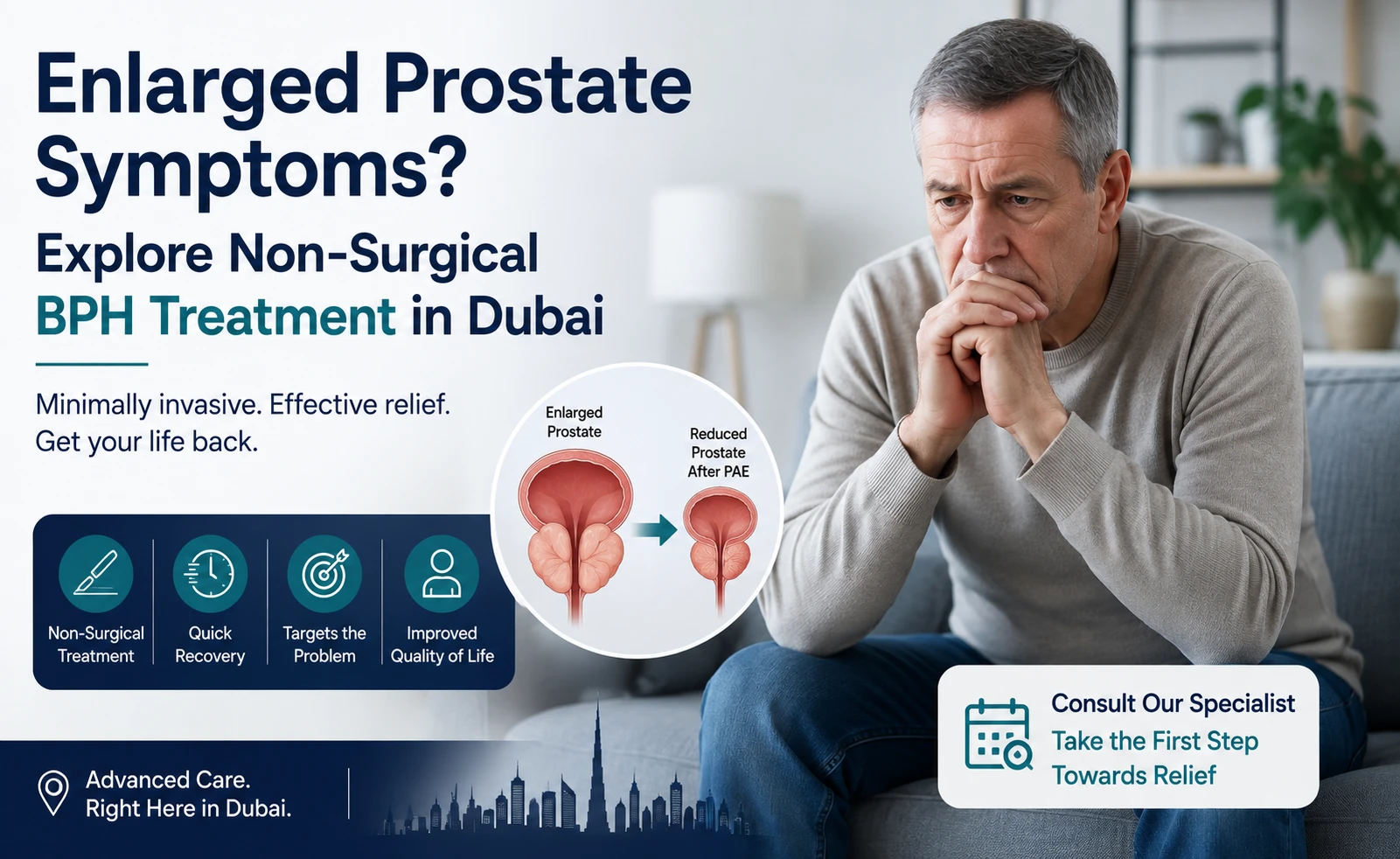
Waking up several times at night to urinate, dealing with a weak urine stream, or waiting longer than usual for your urine to start can be frustrating. These symptoms are commonly associated with benign prostatic hyperplasia (BPH), also known as an enlarged prostate.
BPH is not prostate cancer, but it can affect your comfort, sleep and quality of life. Depending on the severity of your symptoms, treatment options may include lifestyle changes, medication, minimally invasive procedures or surgery.
One option that may be considered for selected patients is Prostate Artery Embolization (PAE). This minimally invasive procedure aims to reduce blood flow to the prostate, which may allow the prostate to gradually shrink and potentially improve urinary symptoms.
If enlarged prostate symptoms are affecting your everyday life, a specialist assessment can help determine whether PAE or another treatment approach may be appropriate for you.
Book a consultation in Dubai to discuss your BPH treatment options.
What Is an Enlarged Prostate?
The prostate is a gland located below the bladder that surrounds part of the urethra. As men age, the prostate can become enlarged. When this happens, it may put pressure on the urethra and interfere with normal urine flow.
This condition is called benign prostatic hyperplasia, or BPH.
BPH is common as men get older and does not always require treatment. However, when urinary symptoms become troublesome or start affecting your daily life, medical assessment may be appropriate.
Common Enlarged Prostate Symptoms
Are you experiencing any of these problems?
- Weak or slow urine stream
- Difficulty starting urination
- Needing to strain to urinate
- Urine flow that stops and starts
- Feeling that your bladder has not emptied completely
- Frequent trips to the bathroom
- Sudden urgency to urinate
- Waking during the night to urinate
- Dribbling after urination
- Increasing difficulty managing daily activities because of urinary symptoms
These symptoms can occur with BPH, but they may also have other causes. A proper medical assessment is important before choosing treatment.
Non-Surgical BPH Treatment in Dubai: What Is PAE?
Prostate Artery Embolization (PAE) is a minimally invasive treatment performed by an interventional radiologist.
Instead of surgically removing prostate tissue, PAE uses a thin catheter inserted into an artery. With imaging guidance, the catheter is directed toward the small arteries supplying the prostate. Tiny embolic particles are then delivered to reduce blood flow to the prostate.
Over time, reduced blood flow may cause the prostate to shrink or soften. This may reduce pressure on the urethra and potentially improve urinary symptoms.
Unlike traditional prostate surgery, PAE does not require prostate tissue to be removed through the urethra.
However, PAE is not suitable for every man with BPH. Your prostate size, anatomy, symptoms, medical history and previous treatments should be considered before the procedure.
How Does PAE Compare With Other BPH Treatments?
BPH treatment is not one-size-fits-all. The appropriate option depends on your symptoms, prostate characteristics and overall health.
Lifestyle Changes and Monitoring
Men with mild or non-bothersome symptoms may sometimes be monitored without an immediate procedure. Lifestyle adjustments and regular medical reviews may be appropriate in selected cases.
Medication
Prescription medications may help improve urine flow, relax the prostate and bladder muscles, or reduce prostate size. Your doctor can determine which medication, if any, may be suitable for you.
Minimally Invasive Procedures
Several minimally invasive treatments are available for BPH. These procedures use different techniques to improve urinary flow.
PAE approaches the prostate through its blood supply rather than removing prostate tissue through the urethra.
Traditional Surgery
Surgical treatments such as TURP and other prostate procedures may be recommended when symptoms are severe, complications develop, or other treatment options are not suitable or effective enough.
Who May Consider Prostate Artery Embolization?
PAE may be considered for men who have bothersome BPH symptoms and are looking for a minimally invasive treatment option.
It may be worth discussing if:
- Your urinary symptoms are affecting your quality of life
- Medication has not provided enough improvement
- You experience troublesome medication side effects
- You prefer to explore a minimally invasive approach
- You want to understand alternatives to traditional prostate surgery
- Your specialist believes your prostate anatomy may be suitable for PAE
PAE should be evaluated individually. A coordinated assessment may involve both an interventional radiologist and urologist to determine the most appropriate treatment pathway.
Book a specialist consultation to find out whether PAE may be appropriate for your situation.
How Is BPH Diagnosed Before Treatment?
Before recommending PAE or another treatment, your doctor may assess your symptoms and overall urinary health.
1. Medical History
Your doctor will ask about your urinary symptoms, how long you have experienced them and how they affect your daily routine.
2. Symptom Assessment
The severity and type of urinary symptoms can help determine whether further evaluation or treatment may be needed.
3. Physical Examination
A physical examination may be performed as part of your assessment.
4. Urine and Blood Tests
Depending on your circumstances, tests may be recommended to identify other possible causes of urinary symptoms and assess your general health.
5. Prostate and Bladder Imaging
Ultrasound may be used to assess prostate size and determine how much urine remains in your bladder after urination. In selected cases, MRI or other imaging may also be considered.
6. Treatment Planning
Once your symptoms, test results and prostate anatomy have been reviewed, your doctor can discuss whether medication, PAE, another minimally invasive treatment or surgery may be appropriate.
What Happens During Prostate Artery Embolization?
PAE is performed using image guidance.
A small catheter is inserted into an artery, commonly through the wrist or groin. The interventional radiologist carefully guides the catheter toward the arteries supplying the prostate.
Small embolic particles are then delivered to reduce blood flow to the prostate.
The procedure aims to reduce the prostate’s blood supply so that it may gradually shrink or soften.
Because the treatment is performed through vascular access rather than by removing prostate tissue through the urethra, PAE is considered a minimally invasive approach.
Your doctor will explain preparation, procedure time, expected recovery and possible risks before treatment.
PAE Recovery: What Can You Expect?
Recovery can vary depending on your health, symptoms and the way the procedure is performed.
After PAE, you may experience temporary symptoms such as:
- Pelvic discomfort
- Increased urinary frequency
- Mild pain or cramping
- Tiredness
- Discomfort around the catheter access site
Your medical team will provide instructions for medication, activity and follow-up.
It is also important to understand that symptom improvement may take time. PAE works by reducing blood flow to the prostate, after which the prostate may gradually shrink.
Is PAE Better Than BPH Surgery?
There is no single BPH treatment that is best for every patient.
PAE offers a minimally invasive approach, but its effectiveness and durability can vary between patients. Traditional surgical procedures remain important options for men with severe symptoms or complications.
Surgery may be considered when problems such as urinary retention, recurrent urinary infections, bladder stones, significant bleeding or other complications develop.
The right decision depends on your individual anatomy, symptoms, medical history and treatment goals.
When Should You See a BPH Specialist?
Consider speaking with a specialist if:
- Your urinary symptoms are becoming more frequent
- You wake repeatedly during the night to urinate
- Your urine stream has become noticeably weaker
- You have difficulty starting urination
- Medication is not providing enough improvement
- You are experiencing troublesome medication side effects
- You are considering a minimally invasive treatment
- You have been advised to undergo prostate surgery
- BPH symptoms are affecting your sleep, work or daily activities
Seek Urgent Medical Attention If You Cannot Urinate
If you suddenly become unable to pass urine, you should seek prompt medical assessment. Significant urinary obstruction may require immediate treatment.
Non-Surgical BPH Treatment in Dubai
If you are looking for non-surgical BPH treatment in Dubai, Prostate Artery Embolization may be an option worth discussing with an experienced interventional radiologist.
Dr. AbdulRahman Alvi is a UK-trained Consultant Vascular & Interventional Radiologist with extensive experience in minimally invasive, image-guided procedures.
A consultation can help you understand:
- Whether your symptoms may be related to BPH
- Whether PAE may be suitable for you
- What investigations may be required
- What other treatment options are available
- What you can expect during recovery
- Whether a urology consultation is also recommended
Treatment decisions should be based on your individual assessment rather than symptoms alone.
Book a consultation to discuss your enlarged prostate symptoms and available treatment options in Dubai.