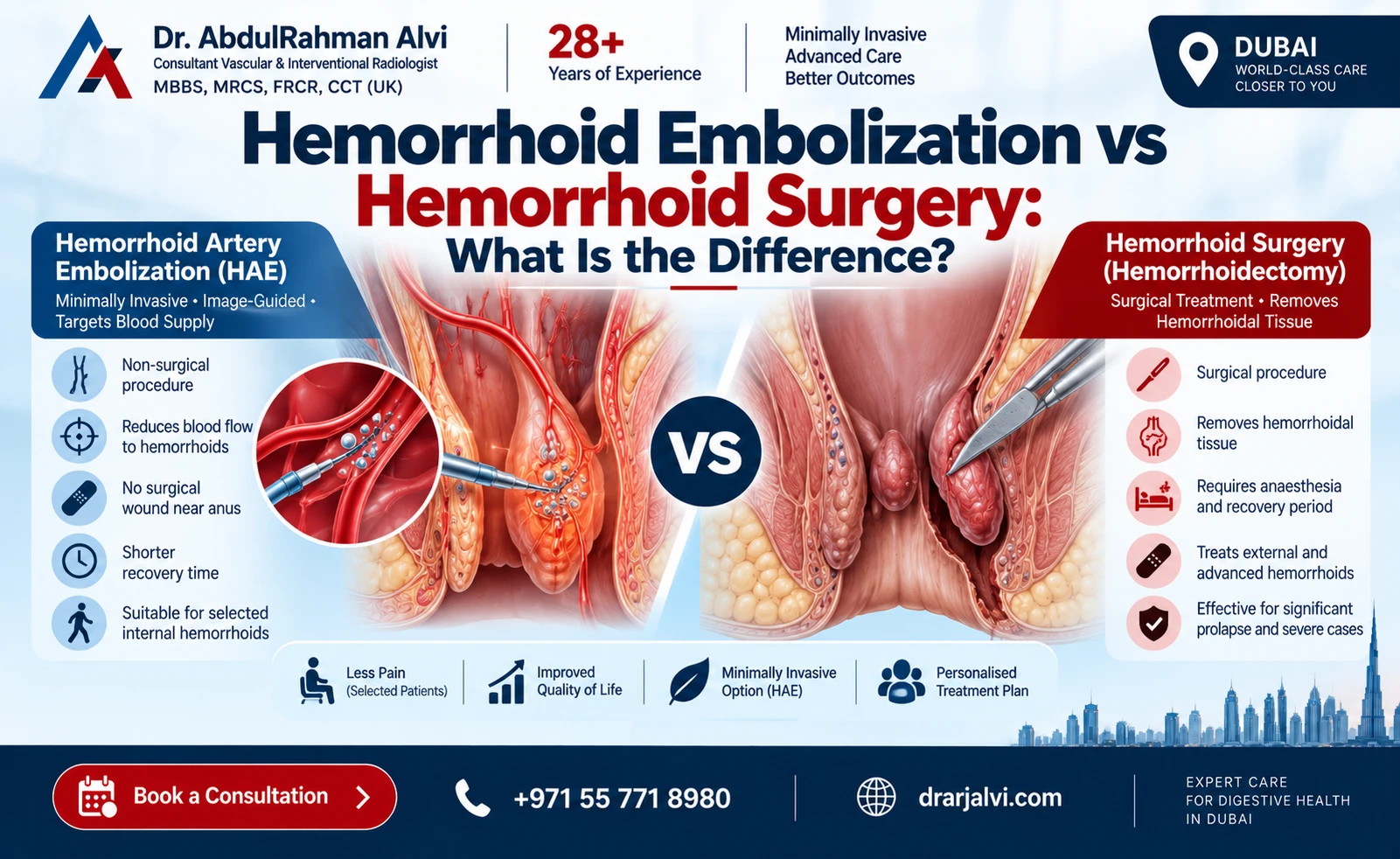
Hemorrhoid artery embolization (HAE), also called rectal artery embolization or Emborrhoid, is a minimally invasive, image-guided procedure that reduces blood flow to the arteries supplying internal hemorrhoids. Surgical hemorrhoidectomy removes hemorrhoidal tissue and is an established treatment for selected patients with significant external hemorrhoids or combined internal and external hemorrhoids, particularly when prolapse is substantial.
The main difference is that embolization targets the blood supply, while hemorrhoidectomy removes the affected tissue. Embolization may offer a shorter recovery for selected patients, but it does not treat every type of hemorrhoid, and recurrence or further treatment may occur. Surgery remains an established option for patients whose symptoms and anatomy make tissue removal appropriate.
The right treatment depends on the hemorrhoid type and grade, bleeding, prolapse, pain, previous treatment, medical history, and individual goals.
Why Are Hemorrhoid Embolization and Surgery Compared?
Hemorrhoids, commonly called piles, can cause rectal bleeding, discomfort, swelling, itching, and tissue that protrudes during bowel movements.
For some people, symptoms improve with dietary changes, adequate fibre and fluid intake, and adjustments to bowel habits. Others need office-based treatments such as rubber band ligation. When symptoms persist, a specialist may discuss additional procedures or surgery.
Patients who want to avoid a surgical wound often ask whether hemorrhoid embolization could be an alternative to hemorrhoidectomy.
Although both treatments are used for hemorrhoidal disease, they work differently and are not suitable for exactly the same patients.
A proper comparison begins with identifying whether the problem is internal, external, or a combination of both.
What Is Hemorrhoid Artery Embolization?
Hemorrhoid artery embolization (HAE) is a minimally invasive procedure performed by an interventional radiologist.
The procedure is designed primarily to treat symptomatic internal hemorrhoids, particularly when bleeding is a major concern.
A thin catheter is introduced through a small arterial access point, usually in the wrist or groin. Under X-ray guidance, the catheter is navigated into the arteries supplying the hemorrhoidal tissue.
Small embolic particles or other suitable materials are then used to reduce blood flow through selected vessels.
The aim is to reduce the vascular supply contributing to hemorrhoidal symptoms without surgically removing the tissue.
HAE does not involve cutting out the hemorrhoids or creating a surgical wound around the anus.
However, it does not directly remove a large external hemorrhoid or correct every form of prolapse. Careful assessment is necessary before considering it.
What Is Surgical Hemorrhoidectomy?
Hemorrhoidectomy is an operation in which symptomatic hemorrhoidal tissue is surgically removed.
It is an established treatment for selected patients with significant external hemorrhoids or combined internal and external hemorrhoids, particularly when prolapse is substantial.
The operation may be performed using different surgical techniques, including open or closed excisional hemorrhoidectomy.
Depending on the patient’s condition and the surgical approach, anaesthesia and postoperative monitoring are required.
Because the procedure removes the affected tissue, hemorrhoidectomy can address anatomical problems that embolization alone may not correct.
However, the recovery can involve considerable discomfort, particularly during bowel movements while the surgical area heals.
Hemorrhoid Embolization vs Hemorrhoid Surgery: Key Differences
| Feature | Hemorrhoid Artery Embolization | Surgical Hemorrhoidectomy |
|---|---|---|
| Treatment type | Minimally invasive, catheter-based procedure | Surgical removal of hemorrhoidal tissue |
| Main target | Arterial blood supply to internal hemorrhoids | Symptomatic hemorrhoidal tissue |
| Access | Small arterial puncture, usually wrist or groin | Surgical access to the anal area |
| Tissue removal | No | Yes |
| Surgical wound near the anus | No | Yes |
| Main clinical focus | Often bleeding from internal hemorrhoids | External or combined disease and significant prolapse |
| Anaesthesia | Usually local anaesthesia, sometimes with sedation | Anaesthesia determined by the surgical team |
| Recovery | Often shorter, depending on the case | Usually longer, with postoperative wound discomfort |
| Recurrence | Possible; repeat treatment may be needed | Recurrence is possible |
| Treats large external hemorrhoids directly | No | Yes, when appropriate |
| Evidence base | Evolving; long-term comparative evidence remains limited | Established surgical treatment with extensive clinical experience |
| Suitable for everyone | No | No |
How Does Hemorrhoid Embolization Work?
Hemorrhoidal tissue receives blood through branches of the rectal arterial circulation.
In symptomatic internal hemorrhoids, increased blood flow and changes in the supporting tissue may contribute to bleeding and other symptoms.
During embolization, the interventional radiologist uses angiographic imaging to identify the relevant arterial branches.
A catheter is guided into selected vessels, and embolic material is delivered to reduce blood flow to the targeted areas.
The intended effect is to reduce the vascular contribution to symptoms, particularly bleeding.
The procedure does not remove the hemorrhoidal cushions themselves. It also does not directly repair the supporting tissue responsible for significant prolapse.
That distinction is important when deciding whether embolization is appropriate.
How Does Hemorrhoid Surgery Work?
During a surgical hemorrhoidectomy, the surgeon removes the symptomatic hemorrhoidal tissue.
The specific technique depends on the location and extent of the disease.
In an open procedure, the wound is left open to heal. In a closed procedure, the wound is closed with sutures.
The surgeon considers the hemorrhoid grade, external component, prolapse, previous treatment, and the patient’s overall health when selecting the approach.
Because tissue is removed directly, hemorrhoidectomy can be appropriate for patients whose symptoms are caused by substantial prolapse or external disease.
Who May Be a Candidate for Hemorrhoid Embolization?
Embolization may be considered for carefully selected patients with symptomatic internal hemorrhoids.
Factors that may support assessment include:
- Persistent or recurrent bleeding from confirmed internal hemorrhoids.
- Symptoms that continue despite appropriate conservative or office-based treatment.
- A clinical situation in which avoiding an excisional surgical procedure is an important consideration.
- Medical conditions that may increase the risks of conventional surgery, after individual assessment.
- Internal hemorrhoidal disease for which the vascular anatomy is suitable for embolization.
The procedure is not automatically appropriate simply because a patient wants to avoid surgery.
The source of bleeding must be confirmed, and other causes of rectal bleeding must be considered.
Who May Be a Candidate for Hemorrhoidectomy?
Surgical hemorrhoidectomy may be considered for patients with:
- Significant external hemorrhoids causing persistent symptoms.
- Combined internal and external hemorrhoids.
- Advanced prolapse, particularly grade III or IV disease.
- Symptoms that persist despite appropriate non-surgical or office-based treatment.
- Hemorrhoidal tissue that requires direct removal to address the patient’s symptoms.
The 2024 American Society of Colon and Rectal Surgeons guideline recommends offering hemorrhoidectomy to selected patients with external hemorrhoids or combined internal and external hemorrhoids with prolapse, particularly grades III–IV.
The decision should be based on the clinical examination, symptom burden, and the patient’s individual circumstances.
Can Hemorrhoid Embolization Replace Surgery?
Hemorrhoid embolization may provide an alternative for selected patients, but it should not be considered a universal replacement for hemorrhoidectomy.
The two procedures address different aspects of hemorrhoidal disease.
Embolization reduces blood flow to selected internal hemorrhoids. Hemorrhoidectomy removes the symptomatic tissue directly.
For patients whose main problem is bleeding from internal hemorrhoids, embolization may be worth discussing when appropriate.
For patients with large external hemorrhoids or substantial prolapse, surgery may address the anatomical problem more directly.
The decision should also account for the possibility of persistent symptoms, recurrence, or a need for further treatment after embolization.
What Does the Research Say About Hemorrhoid Embolization?
Research into rectal artery embolization has reported encouraging results for selected patients, particularly for bleeding control. However, the evidence is still developing, and studies differ in patient selection, techniques, outcome definitions, and follow-up duration.
A 2025 systematic review of 22 studies covering 810 procedures reported technical success rates of 93–100% and clinical success rates ranging from 63% to 94%. Recurrence requiring repeat treatment was reported in approximately 8–20% of patients. The authors noted that the available comparative evidence was limited and that larger studies are needed.
A 2026 systematic review and meta-analysis included 25 studies with 908 patients. It reported a pooled clinical success rate of 81% and a reintervention rate of 14%. However, the authors rated the overall certainty of evidence as low, largely because most studies were observational and results varied considerably.
These findings suggest that embolization may help selected patients, but they do not establish that it is superior to hemorrhoidectomy or appropriate for every hemorrhoid grade.
Published Evidence at a Glance
| Study | Evidence | Main finding |
|---|---|---|
| 2025 systematic review | 22 studies, 810 procedures | Technical success 93–100%; clinical success 63–94%; recurrence requiring further treatment 8–20% |
| 2026 systematic review and meta-analysis | 25 studies, 908 patients | Pooled clinical success 81%; reintervention 14%; overall certainty of evidence rated low |
| 2022 systematic review and meta-analysis | 13 studies, 381 patients | Technical success approximately 99%; pooled clinical efficacy approximately 82% |
The percentages above come from studies with different methods and outcome definitions. They should not be interpreted as a direct comparison between embolization and surgery or as a guaranteed result for an individual patient.
What Happens During Hemorrhoid Embolization?
The procedure generally involves several stages.
1. Clinical Assessment
The specialist reviews the symptoms, previous treatments, medical history, and available investigations.
The hemorrhoid type and grade must be assessed, and other causes of rectal bleeding may need to be excluded.
2. Arterial Access
A small puncture is made to access an artery, commonly in the wrist or groin.
3. Angiographic Mapping
A catheter is guided through the arterial system under X-ray guidance.
Contrast imaging helps identify the vessels supplying the hemorrhoidal tissue.
4. Embolization
Small embolic particles or other suitable materials are delivered to selected arterial branches to reduce blood flow.
5. Post-procedure Monitoring
The access site is monitored, and the patient is observed for any immediate complications.
Many patients can return home the same day, depending on the clinical setting and individual circumstances.
What Happens During Hemorrhoid Surgery?
Hemorrhoidectomy involves a surgical procedure under an appropriate anaesthetic.
The surgeon identifies the symptomatic hemorrhoidal tissue and removes it using the selected technique.
The wound may be left open or closed with sutures.
After surgery, the patient receives instructions for pain management, wound care, bowel habits, and follow-up.
Some patients require a period of hospital observation, while others may be discharged on the day of surgery, depending on the procedure and their recovery.
Recovery: Embolization vs Surgery
Recovery is one of the differences patients often consider when comparing the two treatments.
Recovery After Hemorrhoid Embolization
Because embolization does not create a surgical wound around the anus, recovery may be less disruptive for selected patients.
Possible short-term effects include:
- Mild discomfort around the arterial access site.
- Temporary pelvic or rectal discomfort.
- Bruising at the access site.
- Temporary changes in bowel-related symptoms.
- Fatigue or mild discomfort after the procedure.
The time needed to return to normal activity varies. Symptom improvement may develop gradually rather than immediately.
Recovery After Hemorrhoidectomy
Recovery after surgery is usually more involved.
Patients may experience:
- Pain around the surgical area.
- Discomfort during bowel movements.
- Swelling and local tenderness.
- Minor bleeding during healing.
- Temporary difficulty sitting comfortably.
- A need for regular pain relief and bowel-management measures.
Healing time varies according to the surgical technique, extent of disease, and individual recovery.
A return to normal activities should follow the surgeon’s instructions.
What Are the Risks of Hemorrhoid Embolization?
Embolization is minimally invasive, but it is not risk-free.
Potential complications include:
- Bruising or bleeding at the arterial access site.
- Local discomfort.
- Temporary pelvic or rectal pain.
- Persistent or recurrent hemorrhoidal bleeding.
- Incomplete symptom improvement.
- Need for repeat embolization or another treatment.
- Rare non-target embolization or reduced blood supply to unintended tissue.
- Contrast-related reactions or vascular complications.
The likelihood and nature of complications depend on the patient’s anatomy, medical history, and procedural factors.
What Are the Risks of Hemorrhoid Surgery?
Hemorrhoidectomy is an established operation, but it also carries potential risks.
These may include:
- Postoperative pain.
- Bleeding.
- Infection.
- Delayed wound healing.
- Urinary retention.
- Constipation or discomfort during bowel movements.
- Anal stenosis, which is narrowing of the anal canal.
- Rare injury to the anal sphincter or changes in continence.
- Recurrence or persistent symptoms.
The surgeon should explain the risks relevant to the individual patient before treatment.
Can Hemorrhoids Return After Embolization or Surgery?
Yes. Recurrence or persistent symptoms are possible after either treatment.
After embolization, symptoms may continue if the targeted blood supply is not fully addressed, if collateral vessels contribute to the condition, or if the underlying tissue prolapse remains significant.
Some patients may need repeat embolization or another treatment.
After hemorrhoidectomy, symptoms can recur or new hemorrhoidal symptoms may develop, although the procedure removes the treated tissue directly.
Maintaining healthy bowel habits, avoiding prolonged straining, and addressing constipation can support long-term bowel health after either treatment.
What About Rubber Band Ligation and Other Non-Surgical Treatments?
Embolization and hemorrhoidectomy are not the only options.
For many patients with internal hemorrhoids, treatment begins with conservative measures and may progress to office-based procedures.
Common options include:
- Dietary fibre and adequate fluid intake.
- Avoiding prolonged straining and excessive time on the toilet.
- Rubber band ligation.
- Sclerotherapy.
- Infrared coagulation.
- Other treatments selected according to the hemorrhoid type and grade.
The 2024 ASCRS guideline states that many patients with grade I or II internal hemorrhoids, and selected patients with grade III disease that has not responded to conservative treatment, can be treated with office-based procedures. Rubber band ligation is generally considered the most effective office-based option.
The appropriate treatment pathway depends on the severity of symptoms and the findings of the clinical assessment.
Which Treatment Is Right for You?
There is no single procedure that suits every patient with hemorrhoids.
A specialist assessment should consider the following factors.
Type of Hemorrhoids
Internal hemorrhoids, external hemorrhoids, and combined disease may require different approaches.
Hemorrhoid Grade
The degree of prolapse and whether the tissue can be reduced are important considerations.
Main Symptom
Bleeding, prolapse, pain, itching, and swelling may point toward different treatment needs.
Previous Treatment
The response to dietary measures, medication, banding, or other procedures should be reviewed.
Medical History
Other health conditions, medications, bleeding risks, and anaesthetic considerations can affect treatment planning.
Treatment Goals
Some patients prioritise avoiding an excisional operation. Others need direct treatment of prolapsed or external tissue.
These factors should be discussed with the appropriate specialist before deciding on a procedure.
Why Specialist Assessment Matters
Rectal bleeding should not automatically be attributed to hemorrhoids.
Other conditions can cause similar symptoms, and the appropriate investigations depend on the patient’s age, symptoms, medical history, and risk factors.
A careful assessment helps establish whether hemorrhoids are the source of symptoms and whether embolization, office treatment, or surgery is appropriate.
Dr. AbdulRahman Alvi is a UK-trained Consultant Vascular and Interventional Radiologist with MBBS, MRCS, FRCR, and Dual CCT-UK qualifications and more than 28 years of international clinical experience.
His practice includes minimally invasive, image-guided procedures, including hemorrhoid artery embolization for selected patients.
For patients considering embolization, the central question is whether the type and severity of hemorrhoidal disease make the procedure a reasonable option.
Questions to Ask Your Specialist
Before choosing hemorrhoid embolization or surgery, consider asking:
- Are my symptoms definitely caused by hemorrhoids?
- Do I have internal, external, or combined hemorrhoids?
- What grade are my hemorrhoids?
- Is my main problem bleeding, prolapse, pain, or a combination?
- Am I a suitable candidate for embolization?
- Would rubber band ligation or another office-based procedure be appropriate?
- What are the potential benefits and risks of embolization in my case?
- What are the likely recovery requirements after surgery?
- What is the chance that I may need further treatment?
- What should I do if symptoms persist after treatment?
These questions can help you understand the available options and make an informed decision with your treating specialist.
What If Embolization Does Not Work?
If symptoms persist after embolization, further assessment may be needed to determine why the treatment has not provided sufficient relief.
Possible explanations include persistent arterial supply, significant prolapse, external hemorrhoidal disease, or another cause of the symptoms.
Depending on the findings, the next step may involve:
- Further clinical examination.
- Repeat imaging or assessment of the arterial supply.
- Repeat embolization in selected cases.
- Office-based treatment.
- Surgical consultation.
- Evaluation for another cause of rectal bleeding or discomfort.
A lack of response to embolization does not mean that no further treatment options are available.
Cost of Hemorrhoid Embolization vs Surgery in Dubai
The cost of hemorrhoid treatment in Dubai varies according to the procedure, hospital or clinic, anaesthesia, investigations, complexity of the condition, and follow-up requirements.
Embolization and hemorrhoidectomy involve different treatment pathways, so the total cost cannot be compared reliably without understanding the patient’s clinical needs.
Insurance coverage also varies by insurer, policy, and medical indication.
A consultation can help clarify the recommended treatment, expected costs, and any insurance-related requirements.
Bottom Line
Hemorrhoid embolization and hemorrhoidectomy are different treatments designed to address different aspects of hemorrhoidal disease.
Embolization reduces blood flow to selected internal hemorrhoids, while hemorrhoidectomy removes symptomatic hemorrhoidal tissue. Embolization may offer a less invasive approach for carefully selected patients, but its evidence base is still developing, and recurrence or additional treatment may occur.
Surgery remains an established option for selected patients with significant external hemorrhoids or combined disease with prolapse.
The most appropriate treatment depends on the diagnosis, hemorrhoid grade, symptoms, previous treatment, and individual medical circumstances.
Frequently Asked Questions
Book a Hemorrhoid Consultation in Dubai
If you are experiencing recurrent hemorrhoidal bleeding, prolapse, or discomfort, a specialist assessment can help establish the cause of your symptoms and identify the treatment options that may be appropriate.
Dr. AbdulRahman Alvi provides assessment for selected patients considering minimally invasive hemorrhoid artery embolization in Dubai.
Book a Consultation to discuss your symptoms, previous treatments, and whether embolization may be suitable for your condition.