Hemorrhoids — also commonly referred to as piles — are swollen blood vessels around the anus or lower rectum, and they are one of the most common conditions affecting adults — studies suggest as many as half of all adults experience symptomatic hemorrhoids by age 50. For many people, hemorrhoids improve with dietary changes, topical treatments, or minor office procedures such as banding. When these approaches don’t provide lasting relief, surgery — a hemorrhoidectomy — has traditionally been the next step. While effective, surgical hemorrhoidectomy is well known among patients and clinicians alike for being one of the more painful recovery experiences in general surgery, often requiring two to four weeks before a full return to normal activity.
Hemorrhoid Artery Embolization (HAE) has become a widely used, minimally invasive alternative that treats the underlying blood supply feeding the hemorrhoids, without the cutting, stitches, or extended recovery associated with traditional surgery.
This page explains what HAE involves, who it may be suitable for, and what to expect during treatment, recovery, and cost.
Hemorrhoids are typically classified into four grades based on severity, ranging from Grade I (small, internal, not prolapsing) through to Grade IV (permanently prolapsed and unable to be pushed back in). This grading matters because it directly influences which treatments are appropriate — while smaller, lower-grade hemorrhoids often respond well to conservative measures or minor office procedures, Grade II-IV hemorrhoids with persistent bleeding or prolapse are the group most commonly considered for embolization. An accurate assessment of grade, usually through a physical examination and sometimes proctoscopy, is an essential part of confirming whether HAE is the right approach.
It’s also useful to distinguish between internal hemorrhoids (which develop inside the rectum and are graded I-IV as above) and external hemorrhoids (which develop under the skin around the anus and can cause pain, swelling, or a visible lump). HAE primarily targets internal hemorrhoids and their blood supply; external hemorrhoids with thrombosis may need a different approach, which Dr. Alvi will assess during consultation.
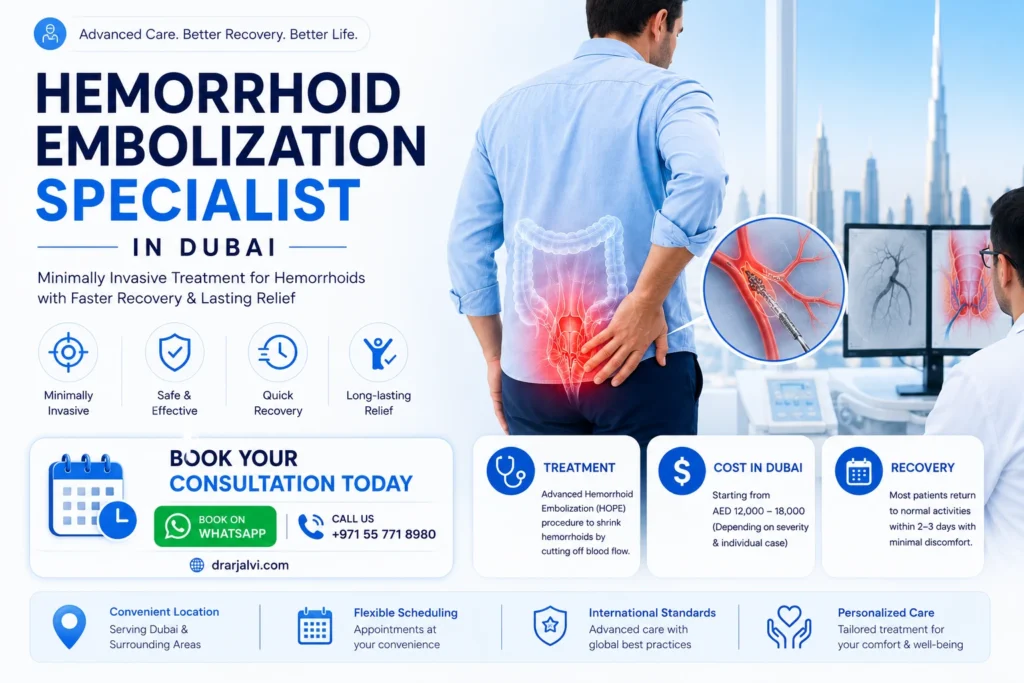
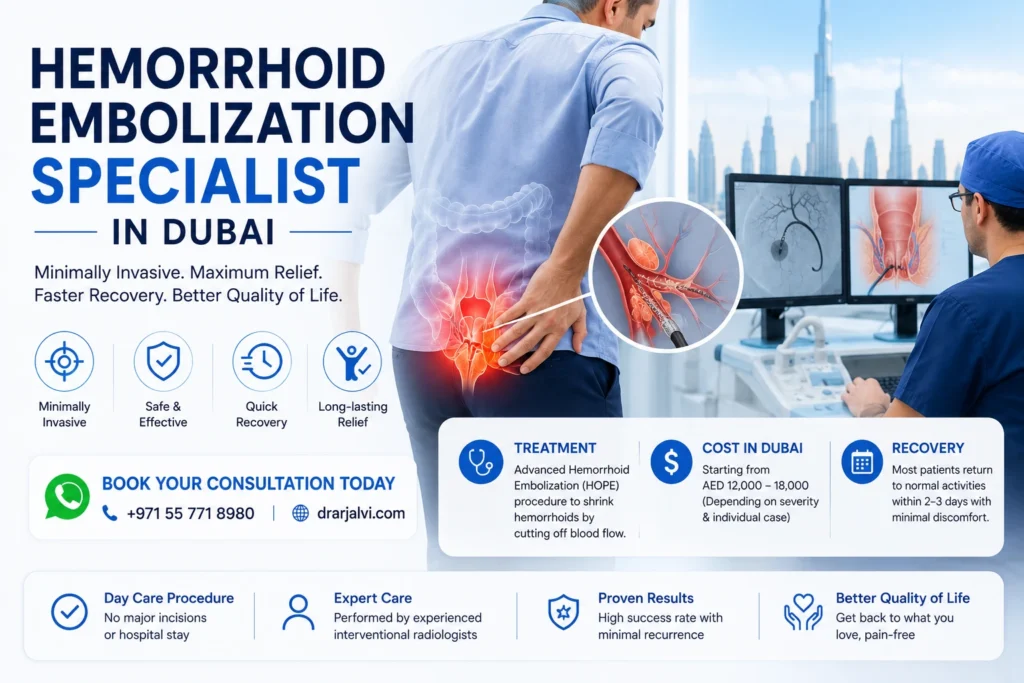
HAE is an image-guided procedure performed by an interventional radiologist. A thin catheter is guided — typically through the wrist or groin — into the arteries supplying blood to the hemorrhoids. Small particles are then released into these vessels, reducing blood flow. With less blood supply, the hemorrhoids gradually shrink, and symptoms such as bleeding and prolapse improve over the following weeks.
Because HAE is performed through a small needle puncture rather than surgical cutting, there is no wound in the sensitive anal area, which is the primary source of pain and slow recovery after traditional hemorrhoidectomy.
HAE may be a suitable option for people experiencing:
Suitability depends on the grade and characteristics of the hemorrhoids, which are assessed during a consultation — not every case is suited to embolization.
HAE is typically performed as a day-case procedure under local anaesthesia, often with sedation for comfort. The general steps are:
The procedure generally takes between 45 and 60 minutes.
One of the most notable differences between HAE and surgical hemorrhoidectomy is the recovery experience. Because there is no incision in the anal area, patients typically report significantly less pain afterward. Most people return to normal activity within a few days, compared with two to four weeks of recovery often needed after surgery.
Symptom improvement, particularly reduced bleeding, tends to develop over the days and weeks following the procedure as blood flow to the hemorrhoids decreases.
The cost of Hemorrhoid Artery Embolization in Dubai depends on several factors, including hemorrhoid grade, case complexity, pre-procedure assessment, and any follow-up care required. Coverage under UAE health insurance varies by provider, particularly depending on whether the procedure is deemed medically necessary.
Because pricing depends on individual factors, the most accurate way to understand cost is through a consultation with Dr. Alvi’s clinic.
As with any medical procedure, HAE carries some risks, which should be discussed individually during a consultation. These can include mild discomfort at the access site and, in some cases, recurrence of symptoms requiring further treatment. Not every hemorrhoid grade is equally suited to embolization; this is assessed during consultation. This page is intended to provide general information and does not replace individualised medical advice — a consultation is necessary to determine whether HAE is the right treatment for your specific case.
Dr. AbdulRahman Alvi is a UK-trained Consultant Vascular and Interventional Radiologist and a specialist in Hemorrhoid Artery Embolization in Dubai, with 28 years of international clinical experience. He holds dual accreditation from the Royal College of Surgeons of England and the Royal College of Radiologists (MBBS, MRCS, FRCR, Dual CCT-UK), and is registered with the Dubai Health Authority (License No. 13256111). He is rated 5 out of 5 stars across 18 verified patient reviews on Doctify.