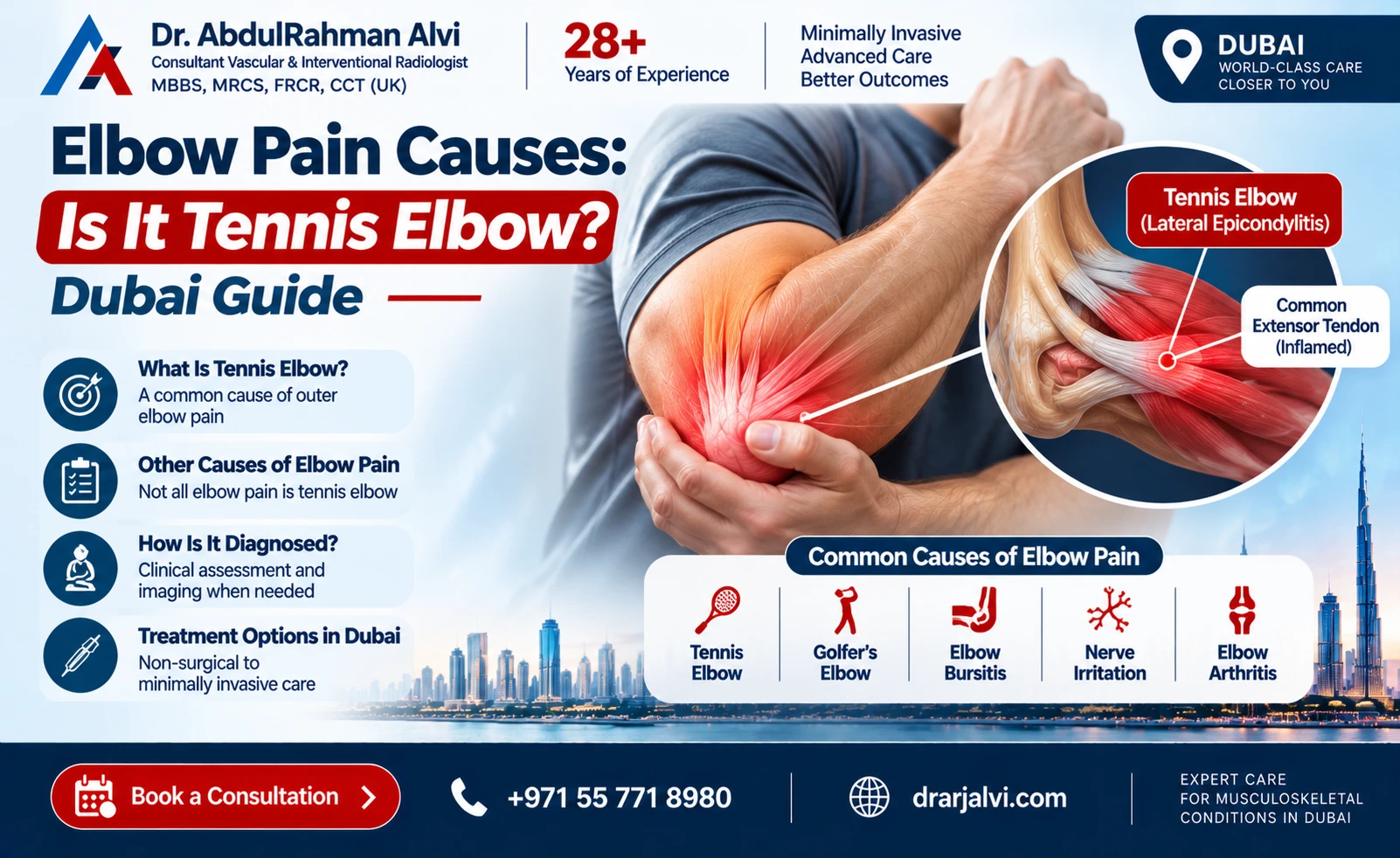
Elbow pain is one of the most common reasons people in Dubai see a doctor for joint pain, and in most adults it comes from an overloaded tendon rather than the joint itself. Where you feel the pain is the best first clue. Pain on the outside of the elbow usually points to tennis elbow, pain on the inside to golfer’s elbow, and swelling at the back to bursitis.
This guide explains the main causes of elbow pain, how to tell them apart, which symptoms need prompt attention, and what treatment options are available in Dubai when rest and physiotherapy have not been enough.
What Does Your Elbow Pain Location Mean?
Use the table below as a starting point. It does not replace an examination, but it helps you describe your symptoms clearly at your appointment.
| Where it hurts | Most likely cause | Typical feeling |
|---|---|---|
| Outside of the elbow | Tennis elbow (lateral epicondylitis) | Burning pain when gripping, lifting a cup or turning a door handle |
| Inside of the elbow | Golfer’s elbow (medial epicondylitis) | Ache when gripping, throwing or bending the wrist forward |
| Back of the elbow (tip) | Olecranon bursitis | Soft swelling like a small balloon, often painless unless infected |
| Inside with tingling in ring and little fingers | Ulnar nerve irritation (cubital tunnel syndrome) | Pins and needles, worse with the elbow bent for long periods |
| Deep inside the joint, with stiffness | Elbow arthritis | Stiffness, clicking, loss of full straightening |
| Front of the elbow | Distal biceps tendon problem | Pain when lifting with the palm up; sudden pain after a heavy lift needs urgent review |
Common Causes of Elbow Pain
Tennis Elbow (Pain on the Outside)
Tennis elbow is the most common cause of elbow pain in adults, usually between the ages of 40 and 60. Despite the name, most patients do not play tennis. It develops when the tendon that attaches the forearm muscles to the outer elbow is overloaded by repeated gripping and wrist movements.
Office work with a mouse, manual work, gym training, padel and carrying children or shopping bags are common triggers in Dubai. Read our full guide to tennis elbow treatment in Dubai for symptoms, diagnosis and every treatment option.
Golfer’s Elbow (Pain on the Inside)
Golfer’s elbow affects the tendon on the inner side of the elbow. It is less common than tennis elbow but behaves in a similar way: pain with gripping, lifting and bending the wrist forward. Golf, throwing sports, weight training and repetitive tool use are typical causes.
Olecranon Bursitis (Swelling at the Back)
A small fluid-filled sac sits at the tip of the elbow. Leaning on the elbow for long periods or a direct knock can make it swell. Bursitis is often painless, but redness, warmth and fever suggest infection and need same-day medical review.
Ulnar Nerve Irritation (Tingling in the Fingers)
The ulnar nerve runs behind the inner elbow, the “funny bone”. Keeping the elbow bent for long periods, for example while using a phone or sleeping with the arm bent, can irritate it. Tingling or numbness in the ring and little fingers, or weakness in the hand, should be assessed so that the nerve is not damaged long term.
Elbow Arthritis
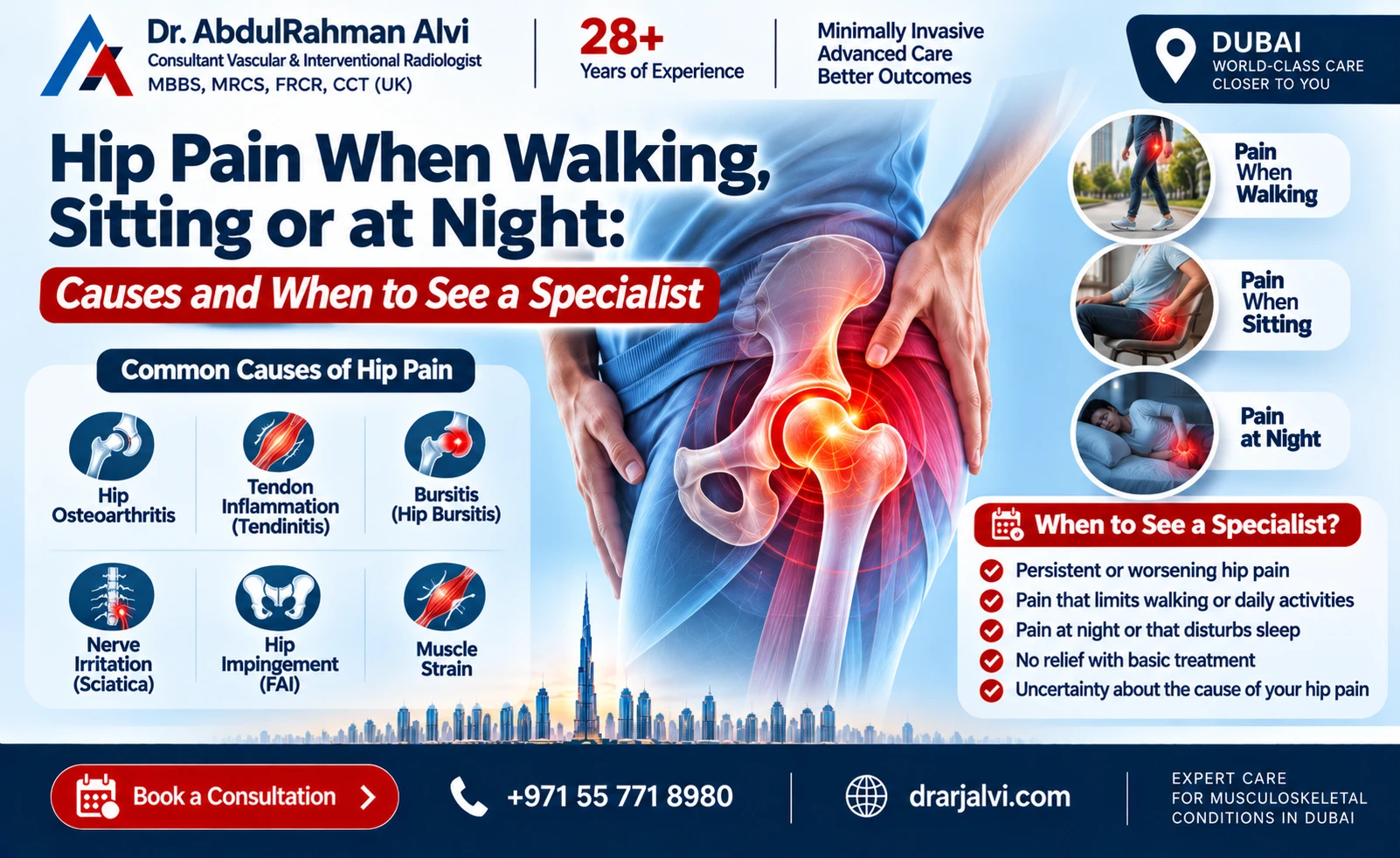
Arthritis of the elbow is less common than knee or hip arthritis. It is usually linked to an old injury, rheumatoid arthritis or heavy manual work. Stiffness and loss of movement are often more noticeable than pain. If you also have pain in other joints, see our pages on hip pain treatment in Dubai and knee pain treatment in Dubai. Hip pain has its own patterns too: see hip pain when walking or at night.
Overuse and Tendon Strain
Short-term elbow pain after a new activity, such as starting a new gym programme or a weekend of DIY, is often a simple strain. It usually settles within one to two weeks with rest and gradual return to activity. Pain that lasts longer than six weeks is worth having checked.
When Should You Worry About Elbow Pain?
Most elbow pain is not dangerous, but some symptoms need prompt attention. Seek urgent care if you have:
- Severe pain, swelling or an obvious deformity after a fall or injury
- An elbow that you cannot bend or straighten at all
- Redness, heat and fever around the elbow, which may mean infection
- A sudden pop and pain at the front of the elbow after lifting, with bruising
- Elbow or arm pain with chest pain, breathlessness or sweating: call 998 for an ambulance immediately, as this can be a sign of a heart problem
Book a specialist appointment if your pain lasts more than six weeks, wakes you at night, keeps coming back, or has not improved with physiotherapy.
How Is the Cause of Elbow Pain Diagnosed?
Diagnosis starts with a careful history and examination. The doctor will check where the pain is, which movements trigger it, your grip strength and the nerves in your arm.
Ultrasound
Ultrasound shows tendon thickening, small tears, fluid and inflammation in real time. It is quick, uses no radiation and is often the most useful test for tendon problems such as tennis and golfer’s elbow.
MRI and X-ray
MRI gives detailed images of tendons, cartilage and bone and is used when the diagnosis is unclear or when surgery or an advanced procedure is being considered. An X-ray is helpful when arthritis, a fracture or loose bone fragments are suspected.
Elbow Pain Treatment Options
Treatment depends on the cause. For tendon problems such as tennis and golfer’s elbow, most people improve with simple measures, although recovery can take several months.
First-Line Treatment
- Reduce or modify the activity that triggers the pain, without stopping all movement
- Physiotherapy, with stretching and gradual strengthening exercises for the forearm
- A forearm brace (counterforce strap) during activity
- Short courses of pain relief or anti-inflammatory gel, as advised by your doctor
- Checking your workstation, tools, grip size or sports technique
Injections
Steroid injections can reduce pain in the short term, but research shows pain often returns and repeated injections may weaken the tendon. Other injections, such as platelet-rich plasma (PRP), are sometimes used for long-standing tendon pain. Your doctor will explain the benefits and limits of each option.
Minimally Invasive Treatment for Chronic Tennis Elbow
When tennis elbow pain lasts longer than three to six months despite physiotherapy, it is called chronic. In chronic tendon pain, small abnormal blood vessels can grow around the tendon and may contribute to ongoing pain. Transcatheter arterial embolization, often called tennis elbow embolization, is an image-guided procedure that aims to reduce these abnormal vessels.
It is performed through a small needle puncture, without cutting the tendon, and patients usually go home the same day. The research is promising but still developing, so it is offered to carefully selected patients after a full assessment. Learn more about tennis elbow embolization and who may be suitable.
Surgery
Surgery is rarely needed for tennis or golfer’s elbow and is usually reserved for severe symptoms that have not responded to other treatment for six to twelve months. Surgery may be the right option for some biceps tendon tears, nerve compression or advanced arthritis.
Elbow Pain and Other Tendon Problems
The same overload process that causes tennis elbow can affect other tendons. Patients with long-standing elbow pain sometimes also have heel or ankle pain. If that sounds familiar, our guides to Achilles tendonitis treatment in Dubai and heel pain location explain how these conditions are assessed and treated.
Elbow Pain Treatment in Dubai with Dr Abdul Rahman Alvi
Dr Abdul Rahman Alvi is a UK-trained, DHA-licensed Consultant Vascular and Interventional Radiologist. He assesses patients with persistent elbow and tendon pain, reviews previous scans and treatments, and explains every option, from physiotherapy-led care to minimally invasive procedures.
The aim is to find the cause of your pain and recommend the treatment that fits your symptoms, work and activity level. Consultations take place at his clinic in Dubai Healthcare City, with patients travelling from across Dubai, Abu Dhabi, Sharjah and the wider UAE.
Frequently Asked Questions
Pain with gripping or lifting is the classic sign of tennis elbow if it is on the outside, or golfer’s elbow if it is on the inside. Both are caused by overload of the forearm tendons.
A simple strain often settles within one to two weeks. Tennis and golfer’s elbow usually improve over several months, and most people recover within a year with the right treatment.
No. Complete rest can weaken the tendon. It is better to reduce the activity that causes pain and follow a gradual strengthening programme.
Rarely. See a doctor urgently for severe pain after an injury, a hot swollen elbow with fever, or arm pain with chest pain or breathlessness.
A GP, sports medicine doctor, orthopaedic surgeon or physiotherapist can assess new elbow pain. For chronic tennis elbow that has not improved with physiotherapy, an interventional radiologist can advise whether minimally invasive treatment is suitable.
No. It is a minimally invasive, image-guided procedure performed through a small puncture under local anaesthesia, usually as a day case.
Book an Elbow Pain Assessment in Dubai
If your elbow pain has lasted more than six weeks or keeps coming back, a specialist assessment can identify the cause and your options. Contact Dr Alvi’s clinic to book a consultation.
This article is for general information and does not replace a medical consultation. Please see a doctor for advice about your own symptoms.