
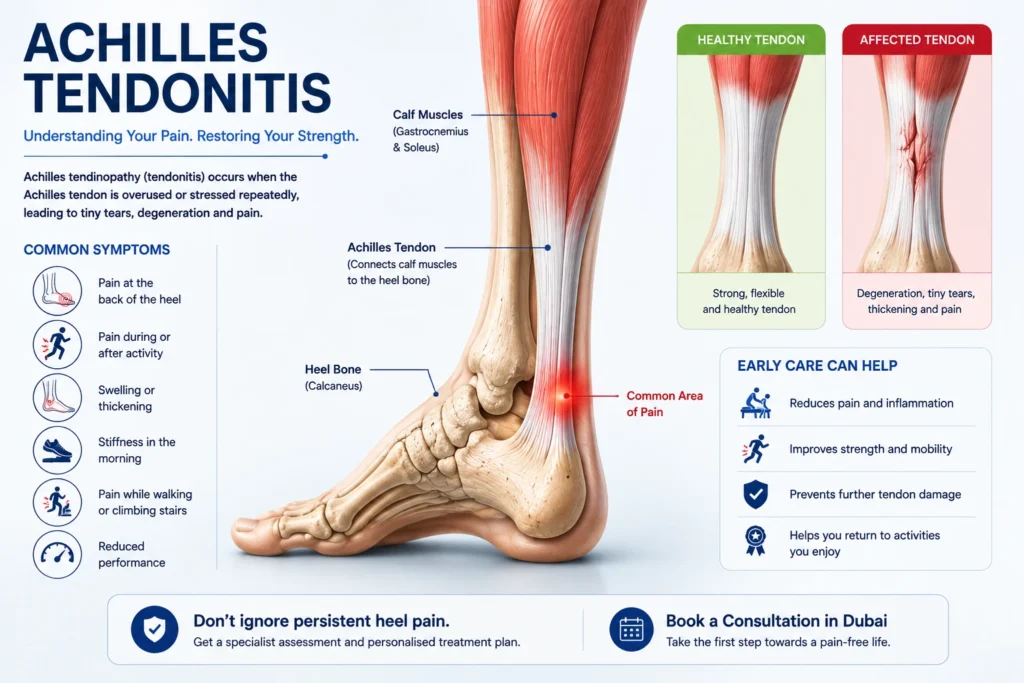
Persistent pain at the back of your heel can make walking, running, climbing stairs and even standing uncomfortable. If Achilles tendon pain continues despite appropriate rest, rehabilitation and other conservative treatment, you may need a specialist assessment to understand why the symptoms are not improving.
Achilles tendinopathy, often referred to as Achilles tendonitis, is a common condition affecting the tendon connecting the calf muscles to the heel bone. It can develop gradually from repeated loading or may occur after a sudden increase in activity.
Most patients are initially treated with non-surgical management, particularly progressive tendon-loading exercises and physiotherapy. For selected patients with chronic, treatment-resistant Achilles tendinopathy, minimally invasive image-guided procedures may also be considered.
Dr. AbdulRahman Alvi is a UK-trained Consultant Vascular & Interventional Radiologist in Dubai with extensive experience in minimally invasive, image-guided procedures.
Achilles tendon problems can be frustrating when pain continues despite reducing activity or completing a rehabilitation programme.
You may notice:
If your symptoms have persisted for several months despite appropriate treatment, a specialist assessment may help determine whether you have chronic Achilles tendinopathy and whether another treatment approach should be considered.
The Achilles tendon is the strong band of tissue that connects the calf muscles to the heel bone. It plays an important role in walking, running, jumping and pushing the foot downwards.
Achilles tendinopathy occurs when the tendon is unable to adequately adapt to repeated or excessive loading. The condition can involve structural changes within the tendon rather than simply being an acute inflammatory problem. This is why the term Achilles tendinopathy is often preferred to Achilles tendonitis.
Achilles tendinopathy can affect active people, runners and athletes, but it is not limited to sportspeople. It can also occur in people whose activity levels have changed or whose tendon is repeatedly exposed to loads it has not adapted to.
Symptoms may develop gradually and can become persistent if the underlying factors are not addressed.
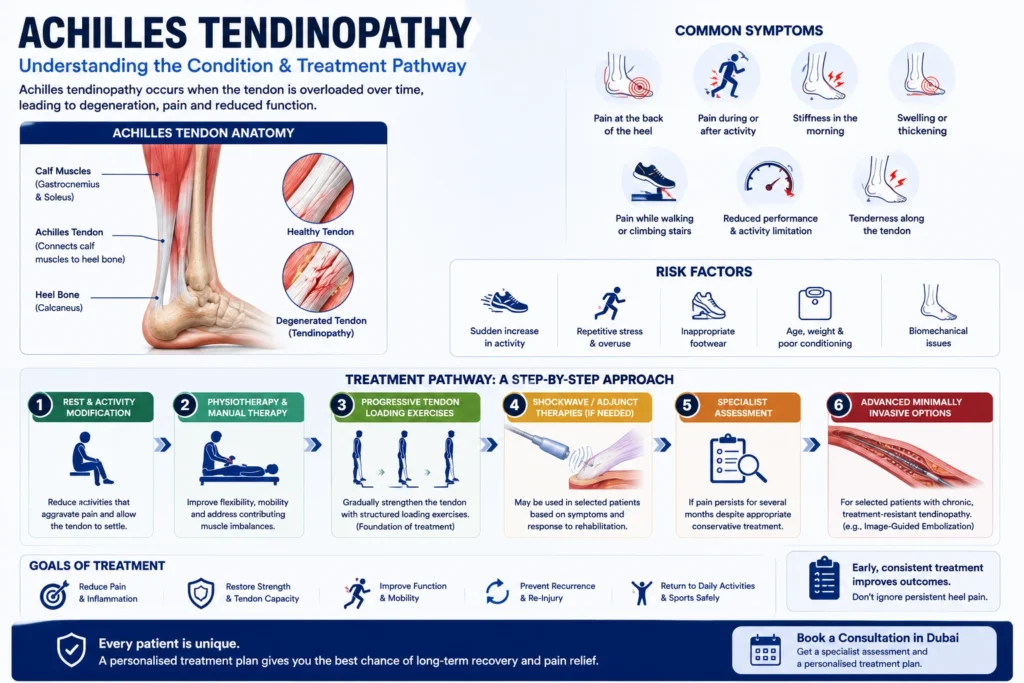
Symptoms vary depending on the location and severity of the tendon problem.
Common symptoms include:
Pain may be felt along the Achilles tendon or close to where it attaches to the heel bone.
Some people notice stiffness or discomfort when taking their first steps after getting out of bed.
Running, jumping, walking uphill or other activities that place greater load on the Achilles tendon may increase symptoms.
Symptoms may become more noticeable after exercise rather than during the activity itself.
The affected tendon may appear thicker or feel swollen or tender.
Persistent Achilles pain can gradually limit running, sports participation and everyday activities.
Symptoms that continue or progressively worsen should be assessed rather than repeatedly treated as a simple sports injury.
Achilles tendinopathy usually develops when the tendon is exposed to repeated loading that exceeds its ability to adapt.
Several factors can contribute.
Rapidly increasing running distance, speed, hill training or jumping can place additional stress on the tendon.
Running and jumping sports can repeatedly load the Achilles tendon.
Changes in training intensity, frequency, surface or footwear may contribute to symptoms.
Age, previous injury and periods of inactivity can affect the tendon’s ability to tolerate load.
Changes in foot structure or lower-limb biomechanics may influence the way forces are transferred through the Achilles tendon.
Some patients develop symptoms where the Achilles tendon attaches to the heel bone. This is known as insertional Achilles tendinopathy.
Others develop symptoms higher up the tendon, commonly referred to as midportion Achilles tendinopathy.
Understanding the location and characteristics of the tendon problem is important when planning treatment.
Diagnosis usually begins with your symptoms, medical history and a physical examination.
Your specialist may assess:
Imaging is not always required for straightforward Achilles tendinopathy, but ultrasound or MRI may be recommended when the diagnosis is uncertain, symptoms are persistent, or further treatment planning requires more detailed assessment.
Ultrasound can evaluate tendon structure and, when Doppler techniques are used, can demonstrate areas of increased blood flow around abnormal tendon tissue.
MRI can provide detailed information about the tendon and surrounding structures and may be useful in selected cases.
The appropriate imaging test depends on your symptoms and clinical findings.
Most patients with Achilles tendinopathy are initially treated without surgery.
The cornerstone of treatment is generally progressive tendon-loading rehabilitation, usually guided by a physiotherapist or other appropriately trained clinician. Activity modification and management of contributing factors may also be required.
Treatment may include:
A structured exercise programme gradually increases the load placed on the Achilles tendon to improve its capacity.
Temporarily reducing or modifying activities that significantly aggravate symptoms can allow rehabilitation to progress.
A physiotherapist can assess movement, strength and tendon loading and develop an individual rehabilitation programme.
In selected patients, footwear adjustments or temporary heel support may reduce discomfort while rehabilitation progresses.
Appropriate pain-management strategies may help patients continue their rehabilitation programme.
Recovery can take several months, particularly when symptoms have been present for a long time.
Not every patient with Achilles tendon pain needs an interventional procedure.
Specialist assessment may be appropriate when:
The first step is determining whether the pain is actually coming from the Achilles tendon and identifying the type and severity of the tendon problem.
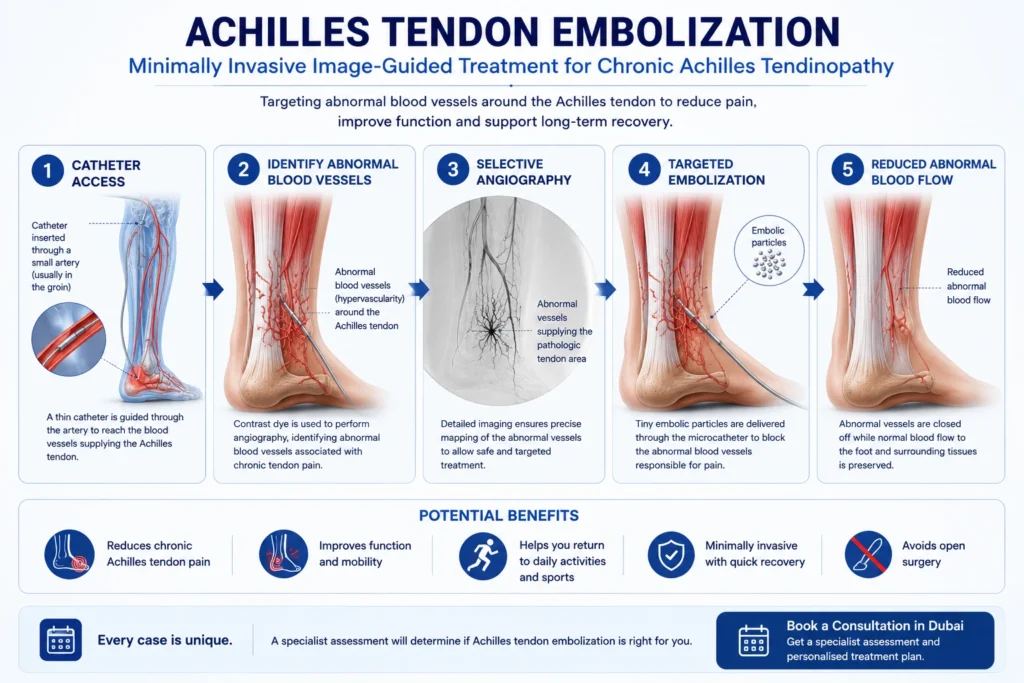
For selected patients with chronic Achilles tendinopathy that remains painful despite conservative treatment, transarterial embolization is an emerging minimally invasive treatment option being investigated and used in specialist interventional settings.
The technique involves using a small catheter to selectively reach abnormal blood vessels associated with the painful tendon region. These vessels can demonstrate abnormal hypervascularity around areas of chronic tendinopathy.
The goal of embolization is to reduce abnormal vascular supply associated with the painful area while preserving the normal arterial circulation of the foot and ankle.
This is a specialised Interventional Radiology procedure and is not considered a first-line treatment for Achilles tendinopathy. Current evidence is promising but remains less established than conventional rehabilitation-based management.
For an appropriately selected patient, an Interventional Radiologist can assess whether an image-guided approach may be relevant.
When embolization is considered appropriate, the procedure is performed under image guidance.
Your symptoms, previous treatment and imaging are reviewed to determine whether your Achilles pain is suitable for an interventional approach.
Imaging is used to identify the blood vessels supplying the area of abnormal tendon tissue.
A small catheter is introduced through an artery and guided toward the vessels supplying the affected region.
Contrast imaging helps identify abnormal vascularity and the relevant arterial branches.
Where appropriate, a small amount of embolic material is delivered through a microcatheter to the targeted abnormal vessels.
The catheter is removed and the access site is monitored.
The objective is to treat the abnormal vascular component associated with chronic tendon pain while maintaining normal circulation to the foot.
Research published in the Journal of Vascular and Interventional Radiology has reported encouraging pain and functional outcomes in selected patients with chronic Achilles tendinopathy that had not responded to conservative treatment. However, further evidence is still developing.
Embolization is not appropriate for every patient with Achilles tendon pain.
It may be considered in selected patients with:
A detailed assessment is essential before considering this type of procedure.
Patients with a recent Achilles tendon rupture, an acute injury or an uncertain diagnosis require appropriate assessment before any interventional treatment is considered.
These approaches serve different roles.
| Conservative Treatment | Embolization | |
|---|---|---|
| Typical role | First-line | Selected refractory cases |
| Physiotherapy | Core component | Usually completed before consideration |
| Exercise rehabilitation | Essential | Still important |
| Invasive procedure | No | Minimally invasive |
| Image guidance | Usually not required | Required |
| Suitable for every patient | No | No |
| Evidence base | Established | Emerging |
The goal is not to replace rehabilitation with a procedure.
For most patients, appropriate tendon loading and physiotherapy remain fundamental. Embolization may be discussed only when chronic symptoms persist despite appropriate conservative management and the patient meets suitable clinical and imaging criteria.
Recovery depends on the underlying tendon condition and the treatment performed.
If you undergo conservative treatment, rehabilitation is typically gradual. Tendons can take several months to adapt to progressive loading, and improvement may not be immediate.
If an interventional procedure is performed, your specialist will provide individual instructions regarding:
Importantly, an interventional procedure does not eliminate the need for appropriate rehabilitation.
The tendon still needs to regain strength and load tolerance.
Many people improve substantially with appropriate rehabilitation, although recovery can take several months.
The outcome depends on:
Chronic Achilles tendinopathy should therefore be approached as a rehabilitation process rather than expecting an instant solution.
If symptoms remain persistent despite appropriate treatment, specialist assessment can help identify whether another diagnosis or treatment option should be considered.
Dr. AbdulRahman Alvi is a UK-trained Consultant Vascular & Interventional Radiologist with:
His specialist training focuses on image-guided minimally invasive procedures involving the vascular system.
For patients with persistent Achilles tendon pain, the assessment should begin with understanding the cause of the symptoms rather than immediately recommending an invasive procedure.
A specialist evaluation can consider:
If a minimally invasive vascular procedure is not appropriate, the correct next step may instead be continued rehabilitation or referral to another relevant specialist.
This patient-specific approach helps ensure that treatment is recommended only when there is a reasonable clinical basis for it.
You should consider specialist evaluation if:
A sudden popping sensation, immediate severe pain, difficulty walking or an inability to push off with the affected foot can indicate an Achilles tendon rupture rather than ordinary tendinopathy.
This requires prompt medical assessment and should not be treated as chronic Achilles tendonitis.
Persistent Achilles pain can limit your ability to walk, exercise and return to the activities you enjoy.
If your symptoms have continued despite appropriate rehabilitation, a specialist assessment can help determine why the tendon is not improving and whether additional treatment options should be considered.
Dr. AbdulRahman Alvi provides specialist Interventional Radiology assessment in Dubai for patients with chronic musculoskeletal and vascular conditions, including Achilles tendon problems.