
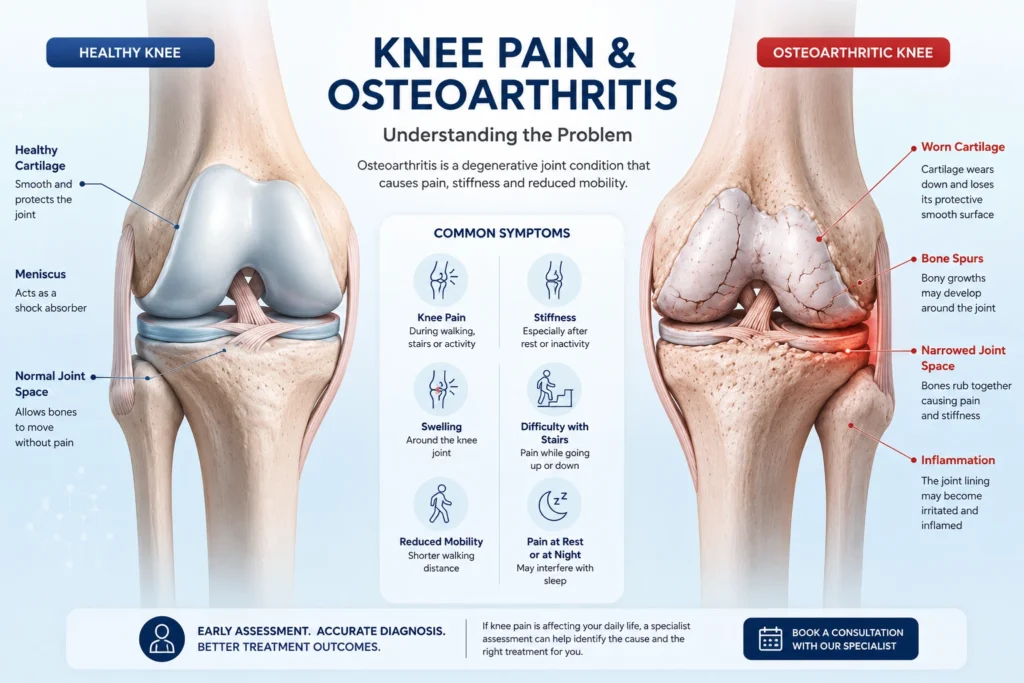
Persistent knee pain can affect almost every part of daily life — from walking and climbing stairs to exercising, working and getting a good night’s sleep.
If your knee pain is related to osteoarthritis and has continued despite appropriate non-surgical treatment, a specialist assessment can help determine what options may be appropriate for you.
Treatment for knee pain depends on its underlying cause. Many patients benefit from exercise, physiotherapy, weight management, medication or other conservative approaches. For selected patients with chronic knee osteoarthritis who continue to experience significant pain despite conservative treatment, Genicular Artery Embolization (GAE) is an emerging minimally invasive treatment option that may be considered.
Dr. AbdulRahman Alvi provides specialist Interventional Radiology assessment and minimally invasive image-guided treatment options in Dubai.
Knee pain can develop gradually or appear after an injury. When pain persists, it is important to identify its cause rather than treating every type of knee pain in the same way.
You may experience:
If your symptoms have continued despite appropriate treatment, a specialist assessment may help identify the underlying problem and determine whether further treatment should be considered.
Book a knee pain consultation in Dubai.
Knee pain can have many different causes. Osteoarthritis is one of the most common causes of chronic knee pain, particularly in older adults, but it is not the only possible cause.
Other causes include:
Because treatment varies according to the diagnosis, persistent knee pain should be properly assessed before deciding on an intervention.
Knee osteoarthritis is a degenerative joint condition that can cause pain, stiffness and reduced function.
As osteoarthritis progresses, changes can occur within the cartilage, bone and surrounding tissues of the knee. Some patients develop inflammation and abnormal small blood vessels around the joint lining, known as synovial neovascularization.
This abnormal vascularity has become one of the targets of research into Genicular Artery Embolization.
GAE aims to selectively reduce abnormal blood flow associated with the painful knee tissues. It does not rebuild damaged cartilage or reverse osteoarthritis itself.
Common symptoms can include:
Pain may occur during walking, standing, climbing stairs or other weight-bearing activities.
The knee may feel stiff after waking up or after sitting for a prolonged period.
Some patients develop swelling around the knee, particularly after activity.
Pain and stiffness can gradually reduce the distance you can comfortably walk.
Going up or down stairs can become increasingly uncomfortable.
More advanced osteoarthritis may cause pain even when the knee is not being actively used.
If knee pain is progressively affecting your ability to move or participate in normal activities, an appropriate medical assessment is important.
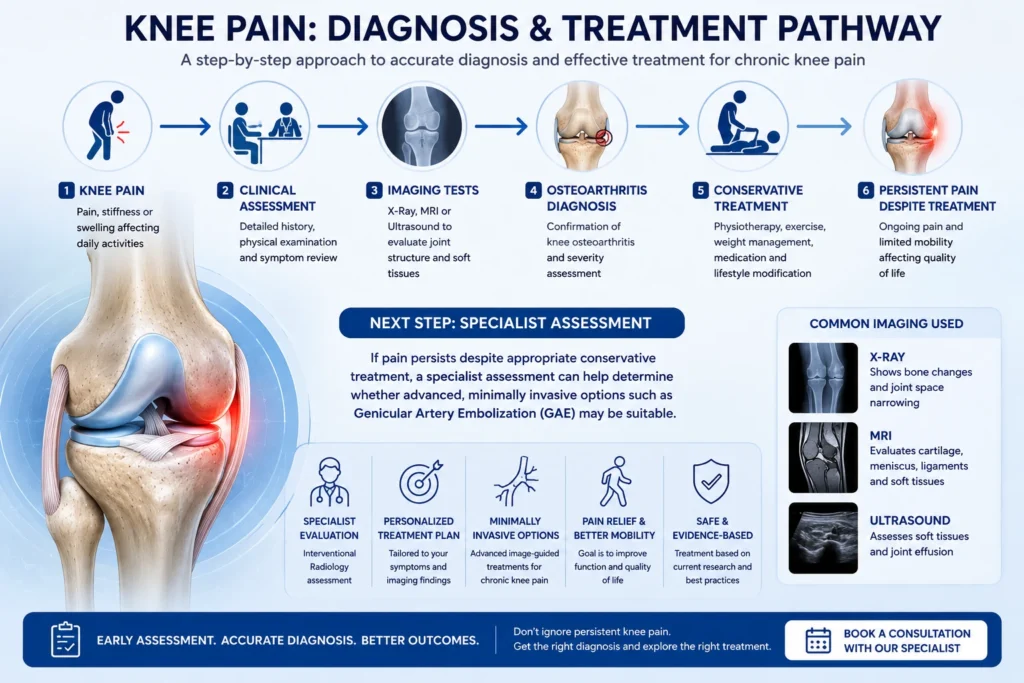
A specialist assessment begins with your symptoms, medical history and physical examination.
Depending on your symptoms, investigations may include:
X-rays can show structural changes associated with osteoarthritis, including joint-space narrowing and changes in the bone.
MRI may be recommended when additional information about cartilage, menisci, ligaments or surrounding soft tissues is required.
Ultrasound can be useful for evaluating certain soft-tissue structures and may be used in selected clinical situations.
If Genicular Artery Embolization is being considered, vascular imaging can help identify the arterial anatomy and abnormal vascularity around the knee.
The appropriate investigation depends on your symptoms and clinical findings.
GAE is not a first-line treatment for ordinary knee pain.
Most patients with knee osteoarthritis should initially receive appropriate conservative management. Depending on the individual, this may include:
A structured exercise programme is an important part of managing knee osteoarthritis.
If pain remains significant despite appropriate conservative treatment, further treatment options can be discussed.
Genicular Artery Embolization (GAE) is a minimally invasive, image-guided procedure being investigated and used in selected patients with painful knee osteoarthritis.
The procedure targets small abnormal blood vessels around the knee joint. These vessels can be associated with chronic synovial inflammation and pain.
During GAE, an Interventional Radiologist uses a small catheter to selectively reach the relevant genicular arteries. Tiny embolic material is then delivered to targeted abnormal vessels to reduce their blood flow.
The goal is to reduce pain associated with abnormal vascularity around the knee.
GAE does not remove the joint, replace cartilage or cure the underlying osteoarthritis. It is an emerging treatment option for selected patients, particularly those who continue to experience significant symptoms despite conservative treatment.
GAE is not appropriate for everyone with knee pain.
A specialist may consider the procedure in selected patients who have:
Recent studies have reported encouraging improvements in pain and function after GAE, but high-quality evidence remains limited and results between controlled and uncontrolled studies have not always been consistent.
For this reason, patient selection and realistic expectations are important.
GAE is performed through a small arterial catheter rather than an open surgical incision.
Your symptoms, previous treatment, medical history and imaging are reviewed to determine whether GAE may be appropriate.
The arterial blood supply around the knee is assessed using image-guided angiography.
A thin catheter is introduced through a small arterial access point and carefully guided toward the genicular arteries.
Contrast imaging helps identify the vessels associated with abnormal vascularity around the painful knee.
Small embolic particles are delivered through a microcatheter to selected abnormal vessels.
The catheter is removed and the access site is monitored following the procedure.
The objective is selective treatment of abnormal vascularity while preserving the normal arterial blood supply to the leg and foot.
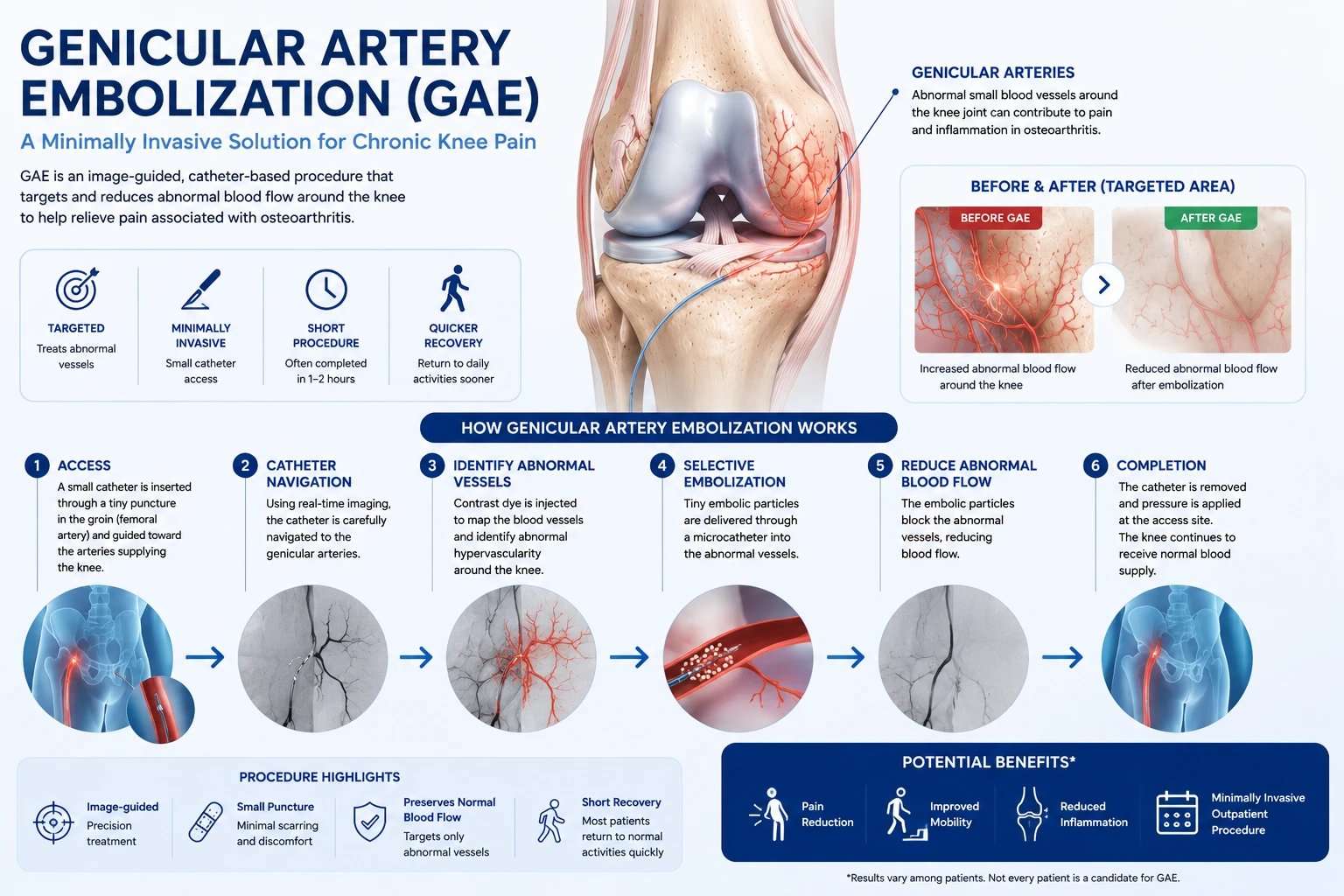
For appropriately selected patients, GAE may offer several potential advantages:
The procedure is performed through a small catheter access point rather than open knee surgery.
GAE does not involve replacing the knee joint.
Treatment is performed through vascular access rather than a large surgical incision around the knee.
Clinical studies have reported reductions in pain and improvements in function in many treated patients, although results vary and the evidence base continues to develop.
For some patients who are not ready for, are unsuitable for, or wish to discuss alternatives to surgery, GAE may be considered as part of an individualised treatment discussion.
It is important to understand that GAE is not guaranteed to relieve pain and is not a replacement for appropriate management of osteoarthritis.
GAE and knee replacement are fundamentally different treatments.
| Genicular Artery Embolization | Knee Replacement | |
|---|---|---|
| Type of treatment | Minimally invasive | Major surgery |
| Joint replacement | No | Yes |
| Large surgical incision | No | Yes |
| Cartilage replaced | No | Yes |
| Catheter-based | Yes | No |
| Recovery | Generally less invasive | Longer surgical recovery |
| Appropriate for every patient | No | No |
GAE may be considered in selected patients with persistent knee osteoarthritis pain, while knee replacement may be appropriate for patients with advanced joint damage and severe symptoms.
The right choice depends on the severity of your osteoarthritis, symptoms, functional limitations, overall health and treatment goals.
Research into GAE has produced encouraging results, with multiple studies reporting improvements in pain and function following treatment.
A 2025 meta-analysis of 14 studies involving 510 patients found substantial improvements in pain and function in many patients, but also highlighted uncertainty because sham-controlled trials have produced mixed results.
A 2025 prospective trial reported clinically meaningful pain improvement at 12 months in selected patients with symptomatic knee osteoarthritis that had not responded to conservative treatment.
However, a 2026 meta-analysis of sham-controlled trials found that the pooled randomized evidence did not demonstrate a statistically significant benefit over sham treatment. This means that while GAE remains promising, further high-quality research is needed to establish its effectiveness and identify which patients benefit most.
For patients, this means GAE should be presented as an emerging treatment option, not as a guaranteed cure or universally superior alternative to surgery.
Like any minimally invasive procedure, GAE has potential risks.
Reported complications can include:
Recent reviews have identified skin discoloration and access-site hematoma among the more commonly reported minor adverse events. Serious complications have been uncommon in published studies, but the risks should still be discussed individually before treatment.
Your suitability for GAE depends on your individual medical history and vascular anatomy.
Because GAE is minimally invasive, recovery is generally different from recovery after knee replacement surgery.
After the procedure, the catheter access site is monitored and you will receive instructions regarding:
The response to GAE varies between patients.
Even when pain improves, appropriate strengthening and rehabilitation remain important for managing knee osteoarthritis and maintaining function.
GAE should not be described as a replacement for knee replacement in every patient.
Knee replacement may remain the appropriate treatment for some patients with advanced osteoarthritis, severe structural damage and major functional limitation.
GAE may be considered in selected patients who want to explore a minimally invasive treatment option before proceeding to major surgery or who are not ideal surgical candidates.
A specialist assessment is needed to determine which approach is appropriate for you.
Dr. AbdulRahman Alvi is a UK-trained Consultant Vascular & Interventional Radiologist with:
Interventional Radiology uses image guidance to perform minimally invasive procedures through small catheter access points.
For patients considering an interventional approach to chronic knee pain, treatment planning should begin with a careful assessment rather than assuming that embolization is appropriate.
Your consultation can consider:
The goal is to identify the treatment option that best fits your individual condition.
Consider specialist assessment if:
Sudden severe knee pain after an injury, inability to bear weight, significant swelling or a visibly deformed knee may require urgent medical assessment rather than an elective interventional consultation.
You do not have to continue accepting persistent knee pain as part of everyday life.
If your knee pain is affecting your walking, exercise, work or sleep — particularly if you have already tried appropriate conservative treatment — a specialist assessment can help you understand your options.
Dr. AbdulRahman Alvi provides specialist Interventional Radiology assessment in Dubai and can discuss minimally invasive treatment options for selected patients with chronic knee pain associated with osteoarthritis.