Many women live with pelvic pain for years before they get a clear answer. Endometriosis is the diagnosis most people have heard of, and it is often the first one considered. But when scans, laparoscopy and hormone treatment do not explain or relieve the pain, another cause is frequently overlooked: pelvic congestion syndrome (PCS), a condition caused by enlarged, poorly working veins in the pelvis.
The two conditions can feel similar, and they can even occur together. Yet they have different causes, are found with different tests, and are treated in very different ways. This guide explains how to tell them apart and why pelvic vein problems are so often missed.
Medically reviewed by Dr Abdul Rahman Alvi, Consultant Vascular & Interventional Radiologist (MBBS, MRCS, FRCR, Dual CCT UK), Dubai. DHA License No. 13256111.
What Is Endometriosis?
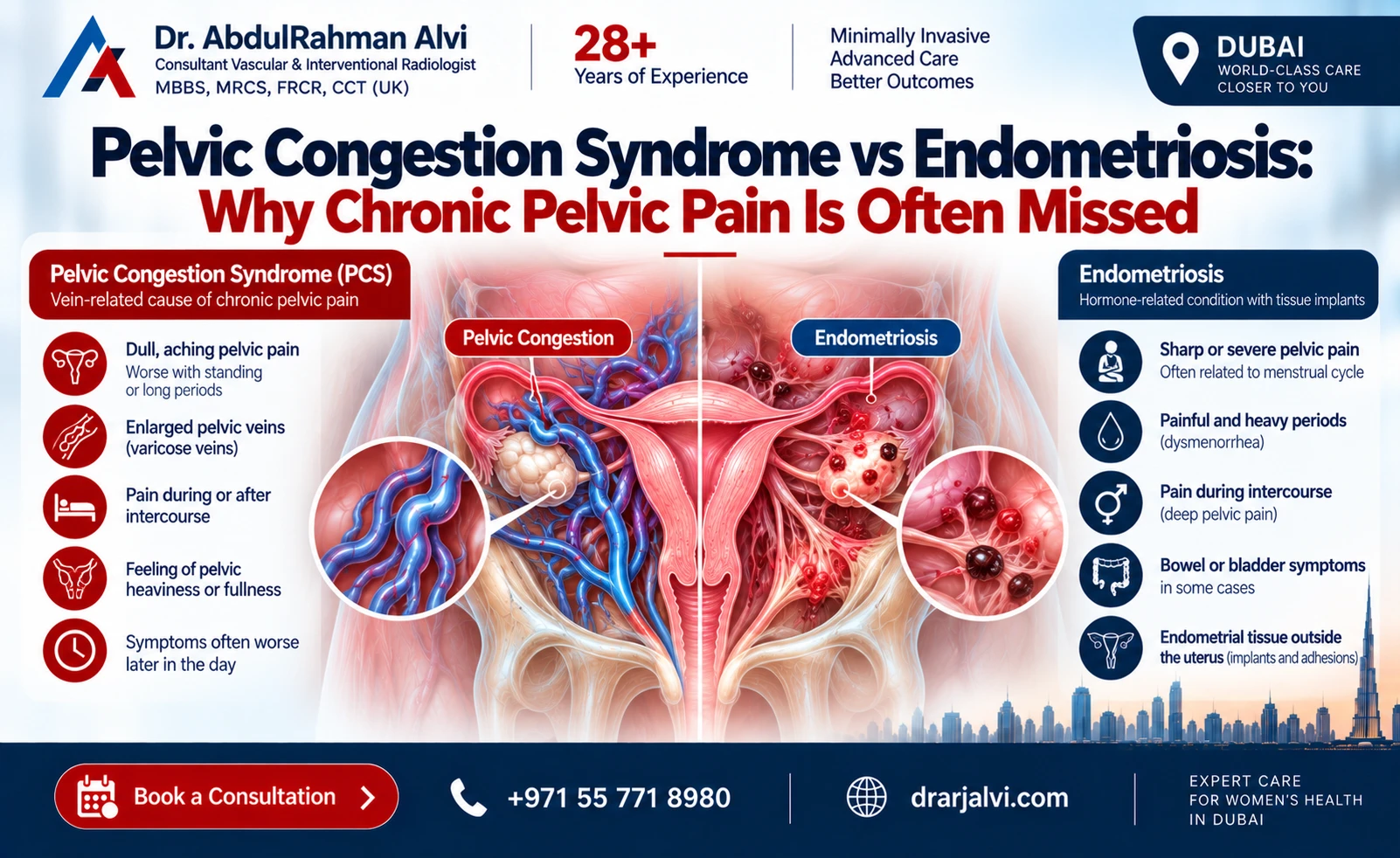
Endometriosis is a condition in which tissue similar to the lining of the womb grows outside the uterus, on the ovaries, the lining of the pelvis, the bowel or the bladder. This tissue responds to the monthly hormone cycle, which causes inflammation, pain and sometimes scarring. It affects around 1 in 10 women of reproductive age.
Endometriosis pain is typically linked to the menstrual cycle, and the condition is a well-known cause of difficulty getting pregnant.
What Is Pelvic Congestion Syndrome?
Pelvic congestion syndrome is caused by varicose veins in the pelvis. The veins that drain blood from the ovaries and pelvis normally have one-way valves. When these valves stop working, blood flows backwards and pools, and the veins stretch and swell, much like varicose veins in the legs. The congested veins cause a dull, heavy, aching pain.
PCS most often affects women of childbearing age, particularly those who have had one or more pregnancies, because pregnancy greatly increases blood flow and pressure in the pelvic veins.
Pelvic Congestion Syndrome vs Endometriosis: Symptoms Compared
The pattern of the pain, rather than its location, is often the best clue.
| Pelvic congestion syndrome | Endometriosis | |
|---|---|---|
| Type of pain | Dull, heavy, dragging ache | Often sharp, cramping or stabbing |
| When it is worst | Later in the day, after standing or walking for a long time | Before and during periods |
| What eases it | Lying down | Pain relief and hormonal treatment |
| Pain with intercourse | Aching that often continues for hours afterwards | Deep pain during intercourse |
| Visible signs | Varicose veins on the vulva, buttocks or upper thighs in some women | Usually none visible |
| Typical patient | Women who have had children | Can start in teenage years; often women without children |
| Effect on fertility | Not usually linked to infertility | A common cause of difficulty conceiving |
| Bladder or bowel | Sometimes urinary urgency | Painful bowel movements or urination during periods |
Symptoms more typical of pelvic congestion syndrome
- A constant dull ache or heaviness in the lower abdomen or pelvis, lasting six months or more
- Pain that builds through the day and is worse after standing, walking or lifting
- Relief when lying down, especially with the legs raised
- Pain that worsens during pregnancy or just before a period
- An ache after intercourse that can last for hours
- Visible varicose veins around the vulva, buttocks or inner thighs
Symptoms more typical of endometriosis
- Severe period pain that has worsened over time
- Deep pain during intercourse
- Pain on opening the bowels or passing urine during periods
- Heavy or irregular periods
- Difficulty getting pregnant
Both conditions can exist together. If treatment for one has not fully relieved your pain, the other is worth checking for.
Why Pelvic Congestion Syndrome Is Often Missed
Women with PCS are often told their tests are normal. There are several reasons for this:
- The veins shrink when you lie down. Most scans, and laparoscopy, are done lying flat. In that position the enlarged pelvic veins can collapse and look normal, even though they swell when you are upright.
- Routine pelvic ultrasound looks at the womb and ovaries, not the veins. Unless the scan is specifically set up to look for pelvic varicose veins, with Doppler to show the direction of blood flow, they can be missed.
- The pain is assumed to be gynaecological. Women are often investigated for endometriosis, fibroids or infection first. When nothing is found, the pain may be put down to stress or labelled as unexplained.
- Fewer clinicians are familiar with it. Pelvic vein problems sit between gynaecology and vascular medicine, so they are less widely recognised.
The result is that many women with PCS go years without a diagnosis.
How Each Condition Is Diagnosed
Diagnosing endometriosis
A gynaecologist will take a history and examine you. Transvaginal ultrasound and MRI can show endometriosis cysts on the ovaries and deeper disease. Laparoscopy (keyhole surgery) lets the surgeon see and sample the endometriosis directly and remains the most definite way to confirm it.
Diagnosing pelvic congestion syndrome
PCS is diagnosed by looking specifically at the pelvic veins:
- Transvaginal Doppler ultrasound, set up to look for enlarged pelvic veins and backward blood flow, often with the patient asked to strain or stand
- CT or MR venography, detailed scans of the veins in the abdomen and pelvis
- Catheter venography, the most accurate test, usually done at the same time as treatment
An interventional radiologist, a doctor who specialises in image-guided diagnosis and treatment of blood vessels, is often the specialist who confirms and treats PCS.
How the Treatments Differ
Treating endometriosis
Endometriosis is usually managed by a gynaecologist. Options include pain relief, hormonal treatments that calm the cycle (such as the pill, progestogens or other hormone therapies), and keyhole surgery to remove endometriosis tissue. Treatment is often long-term.
Treating pelvic congestion syndrome
The main treatment for PCS is pelvic vein embolization, a minimally invasive procedure performed by an interventional radiologist:
- Under local anaesthetic, a thin catheter is passed through a small puncture in the neck or groin
- Using live X-ray imaging, it is guided into the enlarged ovarian and pelvic veins
- Tiny coils and a sealing medicine are placed to close off the faulty veins, so blood takes healthier routes
- Most women go home the same day and return to normal activities within a few days
Most women notice a gradual improvement in pain over the following weeks to months. Surgery to tie off the veins, or hysterectomy, is now rarely needed. Learn more about pelvic congestion syndrome treatment in Dubai, including what to expect, risks and cost.
Other Causes of Chronic Pelvic Pain
Pelvic pain lasting more than six months has many possible causes, and sometimes more than one is present:
- Uterine fibroids, which can cause heavy periods, pressure and pain
- Adenomyosis, where womb lining grows into the muscle of the womb
- Pelvic inflammatory disease or past infection
- Irritable bowel syndrome
- Bladder pain syndrome (interstitial cystitis)
- Muscle and nerve causes in the pelvic floor or lower back
When to See a Specialist
Book an assessment if:
- You have had pelvic pain for six months or more
- The pain is worse after standing and better lying down
- You have visible varicose veins around the vulva, buttocks or thighs
- Tests for endometriosis were normal, or treatment has not helped
- The pain affects your work, sleep, relationships or family life
Seek urgent care for sudden, severe pelvic pain, pain with fever, heavy bleeding, or pain in early pregnancy.
Dr Abdul Rahman Alvi, a UK-trained Consultant Interventional Radiologist in Dubai Healthcare City, assesses and treats women with suspected pelvic congestion syndrome. Book a consultation on WhatsApp.
Frequently Asked Questions
This article is for general information and does not replace a medical consultation. Pelvic pain has many causes, and the right treatment depends on a proper assessment.