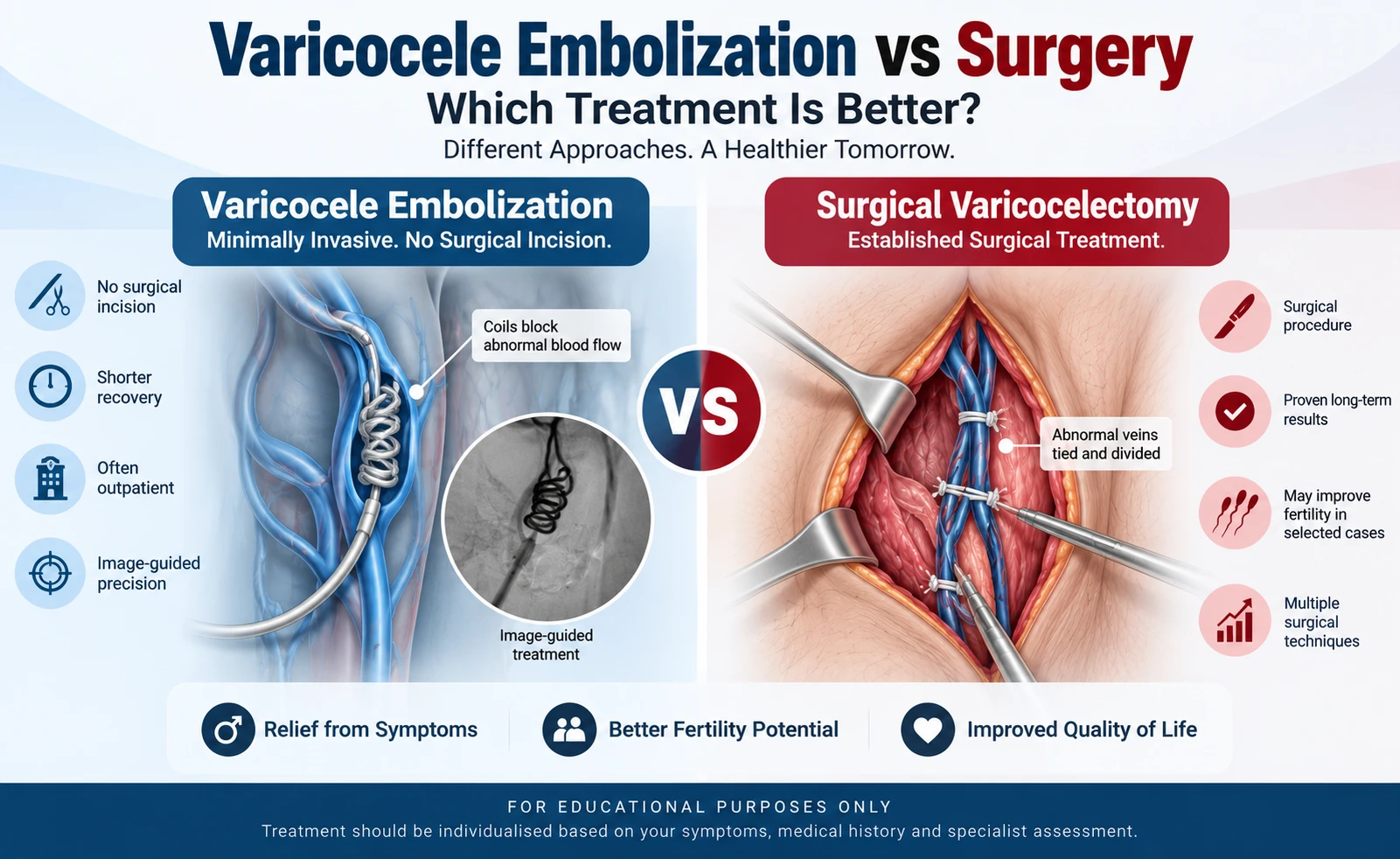
Varicocele embolization and surgical varicocelectomy can both treat a clinically significant varicocele, but neither is automatically better for every patient. Embolization is a minimally invasive, catheter-based procedure with no surgical incision and generally faster recovery, while microsurgical varicocelectomy remains an established treatment, particularly for men with infertility, a palpable varicocele and abnormal semen parameters.
A 2022 systematic review and meta-analysis of 16 studies involving 2,138 patients found similar recurrence and pregnancy outcomes between endovascular and surgical treatment, while endovascular treatment had a lower overall adverse-event rate. More recent evidence suggests there is still a trade-off between recurrence, complications and treatment approach.
You Have a Varicocele — But Which Treatment Should You Choose?
Being diagnosed with a varicocele does not automatically mean you need treatment.
Some men have no symptoms and do not require an intervention. Others may experience persistent scrotal or testicular discomfort, visible enlarged veins, testicular changes or fertility problems.
When treatment is recommended, two options commonly come into the conversation:
- Varicocele embolization
- Surgical varicocelectomy
The decision can feel confusing because both treatments are designed to stop abnormal blood flow through the enlarged veins.
The important question is not simply “Which treatment is better?”
It is:
Which treatment is appropriate for your varicocele, symptoms, fertility goals, anatomy and previous treatment history?
This guide explains the differences so you can have a more informed discussion with your specialist.
What Is a Varicocele?
A varicocele is an enlargement of the veins surrounding the testicle, caused by abnormal or reversed venous blood flow.
Varicoceles are relatively common and are particularly associated with male infertility. The European Association of Urology reports that varicocele is found in approximately 15% of the general male population and in a higher proportion of men with abnormal semen analysis or infertility.
A varicocele may cause:
- Dull or dragging testicular pain
- Scrotal heaviness
- Enlarged or prominent veins
- Symptoms that become worse after standing or exercise
- Testicular size changes in some younger patients
- Abnormal semen parameters
- Difficulty conceiving in some couples
However, not every varicocele requires treatment.
Treatment is generally considered when there is a clinically meaningful reason, such as persistent pain, fertility problems associated with a clinical varicocele and abnormal semen parameters, or testicular changes requiring intervention.
What Is Varicocele Embolization?
Varicocele embolization is a minimally invasive, image-guided treatment performed by an Interventional Radiologist.
Instead of surgically exposing and tying off the abnormal veins, a thin catheter is introduced into the venous system, usually through a small access point in the groin or neck.
Using X-ray guidance and contrast imaging, the specialist navigates the catheter to the abnormal testicular vein.
Tiny coils and/or another embolic material are then placed to block the abnormal blood flow.
Blood is redirected through healthier veins.
There is no conventional surgical incision over the scrotum or groin, and stitches are generally not required.
In simple terms:
Embolization treats the problematic vein from inside the blood vessel rather than through open surgical access.
The procedure is commonly performed as an outpatient treatment and generally takes around an hour, although the exact duration depends on the patient’s anatomy and the complexity of the procedure.
What Is Surgical Varicocelectomy?
Varicocelectomy is a surgical procedure used to stop abnormal blood flow through the veins responsible for the varicocele.
There are several surgical approaches, including:
- Microsurgical subinguinal varicocelectomy
- Microsurgical inguinal varicocelectomy
- Open surgical techniques
- Laparoscopic approaches
Among surgical approaches, microsurgical techniques are generally regarded as having favourable recurrence and complication profiles when performed by appropriately trained specialists.
The surgeon identifies and treats the abnormal veins while attempting to preserve important structures such as arteries and lymphatic vessels.
Varicocele Embolization vs Surgery: Quick Comparison
| Factor | Varicocele Embolization | Surgical Varicocelectomy |
|---|---|---|
| Treatment type | Catheter-based | Surgical |
| Large incision | No | No large incision, but surgical access is required |
| Access | Usually groin or neck vein | Groin/subinguinal or other surgical approach |
| Imaging | X-ray guidance | Direct surgical visualization/microscopy |
| Anaesthesia | Local anaesthesia ± sedation commonly used | Depends on surgical technique |
| Hospital stay | Often outpatient | Often outpatient |
| Recovery | Generally shorter | Generally longer |
| Post-procedure pain | Usually limited, but temporary discomfort can occur | Surgical discomfort is expected |
| Fertility outcomes | May improve in selected patients | Established treatment for appropriate infertility cases |
| Recurrence | Possible | Possible |
| Hydrocele risk | Generally low | Depends on surgical technique |
| Suitable for recurrent varicocele | Can be useful in selected cases | Can also be considered |
| Main specialist | Interventional Radiologist | Urologist |
The evidence does not support saying that one treatment is universally superior. Patient selection and specialist experience matter.
What Does the Research Say?
This is where the decision becomes more interesting.
A 2022 systematic review and meta-analysis included 16 studies and 2,138 patients comparing endovascular and surgical varicocele treatments.
The analysis found:
- Adverse events: lower with endovascular treatment, RR 0.63
- Recurrence: similar between treatments, RR 1.03
- Pregnancy outcomes: similar between treatments, RR 1.03
The researchers concluded that endovascular treatment had similar recurrence and pregnancy outcomes compared with surgery while being associated with fewer adverse events.
However, more recent evidence highlights an important nuance.
A 2025 systematic review and meta-analysis involving 30 studies found that sclero-embolization was associated with a higher recurrence rate than high ligation, while also showing a lower overall complication rate and substantially lower hydrocele incidence. The authors concluded that treatment selection should be individualised.
The EAU also notes that there are no large prospective randomised trials directly comparing all varicocele interventions, making it difficult to declare one approach the universal winner.
What does this mean for you?
The evidence supports a balanced decision rather than a blanket claim that embolization or surgery is always better.
Who May Be a Good Candidate for Varicocele Embolization?
Embolization may be considered when:
- You have a clinically significant varicocele
- Your symptoms are persistent
- Conservative management has not provided sufficient relief
- You prefer a minimally invasive treatment
- You want to avoid conventional surgical access
- You have an appropriate venous anatomy for catheter treatment
- You have a recurrent or persistent varicocele after previous treatment
- A specialist believes embolization is appropriate for your fertility or pain-related goals
Embolization can be particularly attractive to patients who value a shorter recovery and minimally invasive approach.
However, suitability must be determined after clinical assessment and review of imaging.
Who May Be Better Suited to Surgery?
Surgical varicocelectomy may be preferred or specifically recommended in certain situations.
For example, surgical varicocelectomy may be considered in men attempting to conceive who have a palpable varicocele, infertility and abnormal semen parameters.
Surgery may therefore be particularly relevant when:
- There is a palpable clinical varicocele
- Infertility is being investigated
- Semen parameters are abnormal
- Microsurgical expertise is readily available
- The urologist believes surgical repair provides the most appropriate approach
- The patient’s anatomy or previous treatment makes embolization less suitable
This is one reason a fertility-focused assessment is important before choosing treatment.
When Might Embolization Have an Advantage?
The biggest practical advantage of embolization is how the abnormal vein is accessed.
There is no conventional surgical incision in the scrotum or groin.
Potential advantages include:
1. Minimally Invasive Treatment
A catheter is introduced through a very small skin opening.
2. Shorter Recovery
Patients can often return to normal activities relatively quickly. Many patients can resume normal activities within approximately 24 hours, although local discomfort can continue for several days.
3. No Conventional Surgical Scar
The catheter access site is very small and generally does not require visible stitches.
4. Useful Option After Previous Surgery
Embolization may be considered in selected patients with persistent or recurrent varicocele after previous treatment.
5. Avoids Surgical Dissection
The abnormal vein is treated from inside the vascular system.
When Might Surgery Have an Advantage?
Microsurgical varicocelectomy has an established role in the treatment of clinical varicocele, particularly in appropriately selected men with infertility.
Potential advantages include:
- Direct identification of veins
- Ability to preserve important structures using microsurgical techniques
- Strong clinical experience and long-term use
- Established role in male infertility management
- Low recurrence and complication rates when performed using appropriate microsurgical techniques
How Is Varicocele Diagnosed Before Treatment?
Choosing treatment starts with confirming that the varicocele is clinically significant.
1. Medical History
Your specialist will ask about:
- Testicular pain
- Duration of symptoms
- Fertility history
- Previous fertility treatment
- Previous varicocele treatment
- Previous surgery
- Testicular changes
- Other medical conditions
2. Physical Examination
The scrotum may be examined while standing and lying down.
You may also be asked to perform a Valsalva manoeuvre, which can make abnormal veins more noticeable.
3. Doppler Ultrasound
A scrotal Doppler ultrasound can help assess:
- Enlarged veins
- Venous reflux
- Varicocele size
- Testicular appearance
- Other possible causes of symptoms
4. Semen Analysis
If fertility is a concern, semen analysis may be important before treatment.
This is particularly relevant because treatment decisions for infertility should not be based on the ultrasound finding alone.
What Happens During Varicocele Embolization?
A typical embolization involves several stages.
Step 1 — Specialist Assessment
Your symptoms, ultrasound findings and fertility goals are reviewed.
Step 2 — Local Anaesthesia
The catheter access site is numbed.
Sedation may also be used depending on the procedure and patient.
Step 3 — Catheter Placement
A thin catheter is introduced through a vein, commonly from the groin or neck.
Step 4 — Venography
Contrast is used under X-ray guidance to map the abnormal veins and identify the blood-flow pattern.
Step 5 — Embolization
Tiny coils and/or embolic material are placed to block the abnormal vein.
Step 6 — Blood Flow Redistribution
Blood is redirected through healthier venous pathways.
Step 7 — Catheter Removal
The catheter is removed and a small dressing is placed over the access site.
No conventional surgical stitches are usually needed.
Recovery: Embolization vs Surgery
Recovery is one of the biggest differences patients consider.
After Embolization
You may experience:
- Mild groin or neck discomfort
- Temporary scrotal discomfort
- Bruising at the access site
- A feeling of pressure or aching
Localized scrotal discomfort can persist for up to about a week, although normal activities may often be resumed sooner.
After Surgery
Recovery depends heavily on the surgical technique.
You may experience:
- Incisional discomfort
- Bruising or swelling
- Restrictions on strenuous exercise
- Temporary scrotal tenderness
- A longer recovery period compared with catheter-based treatment
Your surgeon will provide individual instructions regarding exercise, sexual activity, work and follow-up.
Risks and Possible Complications
Neither treatment is completely risk-free.
Possible Embolization Risks
These can include:
- Bruising or bleeding at the catheter access site
- Infection
- Contrast reaction
- Blood-vessel injury
- Phlebitis or thrombophlebitis
- Temporary scrotal discomfort
- Epididymal inflammation
- Non-target embolization
- Radiation exposure
- Persistent or recurrent varicocele
Embolic material can rarely migrate into an unintended location and recurrence can occur after embolization.
Possible Surgical Risks
Depending on the technique, risks can include:
- Infection
- Bleeding
- Scrotal swelling
- Hydrocele
- Recurrence or persistence
- Injury to surrounding structures
- Testicular artery injury
- Chronic discomfort
- Anaesthesia-related complications
Hydrocele formation is more common after surgical ligation than after sclero-embolisation, while radiological treatment has its own potential complications.
Can Varicocele Treatment Improve Fertility?
It may, but treatment does not guarantee pregnancy.
The relationship between varicocele and fertility is complex.
Treating appropriate clinical varicoceles in infertile men with abnormal semen parameters can improve semen-related outcomes, while treatment is not generally recommended for men with a subclinical varicocele or normal semen analysis simply because a varicocele is present.
Surgical varicocelectomy is specifically considered for selected men attempting conception who have a palpable varicocele, infertility and abnormal semen parameters.
Therefore, if fertility is your main concern, the decision should ideally involve an appropriate fertility/urology assessment rather than choosing embolization or surgery based on recovery time alone.
What If the Varicocele Comes Back?
Recurrence is possible after either treatment.
Reported recurrence after embolization is approximately 5–10% in some patient information sources.
Persistent or recurrent varicoceles can sometimes be treated again.
The next treatment depends on:
- What treatment you previously had
- Why the varicocele persisted
- Your venous anatomy
- Current symptoms
- Fertility goals
- Ultrasound findings
What About Cost?
The cost of varicocele embolization or surgery can vary considerably.
Factors may include:
- Type of treatment
- Specialist fees
- Hospital or day-care facility
- Imaging requirements
- Anaesthesia or sedation
- Laboratory testing
- Follow-up appointments
- Insurance coverage
- Complexity of the varicocele
- Previous treatment
There is no single price that applies to every patient.
A specialist consultation is the best way to determine which treatment is appropriate and obtain an accurate personalised estimate.
8 Questions to Ask Your Specialist Before Choosing Treatment
Before deciding between embolization and surgery, ask:
- Is my varicocele clinically significant enough to treat?
- Is my pain definitely likely to be caused by the varicocele?
- Are my semen parameters abnormal?
- Would treatment realistically help my fertility situation?
- Which treatment do you recommend for my anatomy and why?
- What is your experience with varicocele embolization or microsurgical repair?
- What is my estimated risk of recurrence or complications?
- How quickly can I return to work, exercise and normal activities?
- What follow-up testing will I need?
- What would we do if the varicocele persists after treatment?
These questions can help you compare treatments based on your own clinical situation rather than generic claims.
Why Choose Dr. AbdulRahman Alvi for Varicocele Assessment in Dubai?
Dr. AbdulRahman Alvi is a UK-trained Consultant Vascular and Interventional Radiologist with 28+ years of international clinical experience. He holds MBBS, MRCS, FRCR and Dual CCT-UK qualifications, with specialist training at Sheffield Teaching Hospitals and advanced fellowship training at the Royal Free Hospital in London.
His practice focuses on minimally invasive, image-guided procedures, including varicocele embolization. The treatment approach is based on confirming the diagnosis, understanding the patient’s symptoms and fertility goals, reviewing imaging and determining whether embolization is appropriate.
For patients considering varicocele treatment in Dubai, the goal should not be to promote one procedure for everyone. The priority is to identify the treatment that offers an appropriate balance between effectiveness, recovery, risks and the patient’s individual goals.
Embolization or Surgery?
There is no universal winner between varicocele embolization and surgery.
Embolization offers a minimally invasive, catheter-based approach with generally fast recovery and no conventional surgical incision. Surgery—particularly microsurgical varicocelectomy—remains an established option and has an important role in appropriately selected men with infertility, palpable varicocele and abnormal semen parameters.
The best treatment depends on why your varicocele needs treatment, your anatomy, fertility goals, previous treatment and the expertise available to you.
Frequently Asked Questions
Considering Varicocele Treatment in Dubai?
If a varicocele is causing persistent discomfort, fertility concerns or other problems, a specialist assessment can help determine whether treatment is appropriate.
Book a consultation with Dr. AbdulRahman Alvi to discuss your diagnosis, treatment options and whether minimally invasive varicocele embolization may be suitable for you.