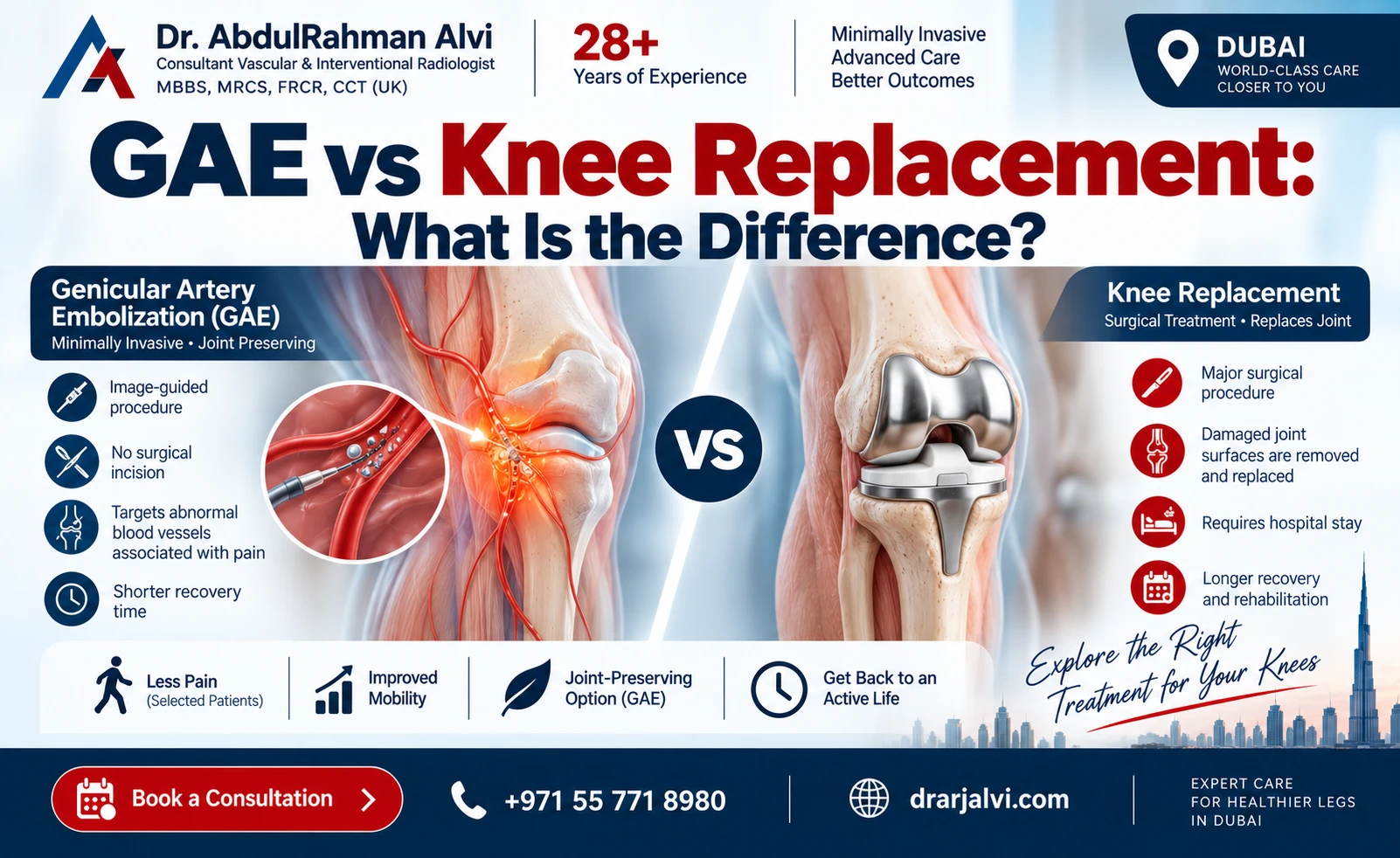
Genicular artery embolization (GAE) and knee replacement are very different treatments for chronic knee osteoarthritis. GAE is a minimally invasive catheter-based procedure that targets abnormal blood flow around the knee, while knee replacement is major surgery that removes damaged joint surfaces and replaces them with artificial components.
GAE may be considered for carefully selected patients with persistent knee pain who have not responded adequately to conservative treatment. However, current clinical evidence remains mixed, particularly from sham-controlled trials. Knee replacement has a much more established role for advanced osteoarthritis with significant structural joint damage and persistent symptoms.
The right choice depends on the severity of arthritis, symptoms, imaging findings, previous treatments, age, activity level, overall health and individual treatment goals.
Why Are GAE and Knee Replacement Compared?
Living with persistent knee pain can become frustrating, particularly when everyday activities such as walking, climbing stairs, exercising or even sleeping become difficult.
For some patients, physiotherapy, exercise, weight management, medication and activity modification provide sufficient relief. Others continue to experience significant symptoms despite these measures.
At that stage, patients often start looking at procedures that may provide longer-lasting relief.
Two treatments that may come up in discussion are genicular artery embolization (GAE) and knee replacement surgery.
Although both are used in the context of persistent knee symptoms, they work in completely different ways.
Understanding that difference is important before considering either option.
What Is Genicular Artery Embolization?
Genicular artery embolization is a minimally invasive interventional radiology procedure.
The treatment involves guiding a thin catheter through an artery, usually through a small access point in the groin or wrist, and navigating it toward selected blood vessels supplying the knee.
The interventional radiologist then identifies abnormal or increased vascularity around the painful knee and selectively delivers an embolic material to reduce blood flow through those targeted vessels.
The aim is to influence the vascular and inflammatory component associated with chronic knee pain.
Importantly, GAE does not remove damaged cartilage, reshape the joint or replace the knee joint.
It is therefore fundamentally different from knee replacement.
What Is Knee Replacement?
Knee replacement, also called knee arthroplasty, is a surgical procedure used to treat advanced knee joint disease when pain and functional limitation remain significant despite appropriate non-surgical treatment.
During the operation, damaged portions of the knee joint are removed and replaced with artificial components.
Depending on the patient’s condition, a surgeon may perform a total knee replacement or, in selected cases, a partial knee replacement.
Unlike GAE, knee replacement directly addresses structural damage within the joint.
The decision is generally based on a combination of symptoms, physical examination and imaging findings rather than an X-ray alone.
GAE vs Knee Replacement: Key Differences
| Feature | Genicular Artery Embolization | Knee Replacement |
|---|---|---|
| Type of treatment | Minimally invasive procedure | Major surgical procedure |
| Specialist | Interventional radiologist | Orthopaedic surgeon |
| Anaesthesia | Usually local anaesthesia with sedation or similar approach | Usually regional or general anaesthesia |
| Incision | Small arterial access point | Surgical incision around the knee |
| Removes damaged joint | No | Yes |
| Replaces joint surfaces | No | Yes |
| Targets abnormal vascularity | Yes | No |
| Preserves the existing joint | Yes | No — damaged surfaces are replaced |
| Hospital stay | Often short, depending on the case | Usually requires a postoperative hospital stay |
| Recovery | Generally shorter than knee replacement | Longer rehabilitation period |
| Evidence base | Still evolving | Well established |
| Suitable for every type of knee arthritis | No | No |
| Guaranteed pain relief | No | No treatment can guarantee this |
How Does GAE Work?
The exact biological mechanism of GAE is still being investigated.
In osteoarthritis and other chronic knee conditions, abnormal vascularity and accompanying nerve growth may contribute to persistent pain in some patients.
During GAE, the interventional radiologist uses angiography to identify the relevant vessels.
A microcatheter may then be positioned selectively within these vessels before embolization is performed.
The goal is to reduce excessive blood flow to the targeted abnormal vascular network.
The procedure is designed to be precise and selective.
However, it is important to understand that GAE does not regenerate cartilage or reverse established osteoarthritis.
How Does Knee Replacement Work?
Knee replacement takes a different approach.
When the joint surfaces have become severely damaged, the orthopaedic surgeon removes the affected portions of bone and cartilage and replaces them with prosthetic components.
The objective is to restore a functional joint surface and reduce pain caused by advanced structural joint damage.
Knee replacement therefore addresses the mechanical and structural problem directly.
This is one reason it remains an established treatment for appropriately selected patients with severe symptomatic knee arthritis.
Who May Be Considered for GAE?
GAE is not appropriate for everyone with knee pain.
A specialist assessment may consider GAE when a patient has:
- Persistent knee pain associated with an appropriate diagnosis
- Symptoms that continue despite conservative treatment
- Significant impact on walking or daily activities
- Imaging findings that support the clinical diagnosis
- No better explanation for the symptoms
- A clinical situation where a minimally invasive approach is being considered
Patient selection is particularly important because knee pain can originate from multiple structures.
Osteoarthritis may coexist with meniscal problems, tendon disorders, ligament injury, bursitis, referred pain or other conditions.
Treating the wrong pain generator is unlikely to provide the desired result.
Who May Be Better Suited to Knee Replacement?
Knee replacement may be considered when there is substantial structural joint damage accompanied by persistent symptoms and functional limitation.
Typical factors include:
- Advanced osteoarthritis
- Persistent pain despite appropriate non-surgical treatment
- Significant difficulty walking or performing everyday activities
- Progressive loss of knee function
- Structural joint changes that correlate with the patient’s symptoms
- Symptoms that substantially affect quality of life
The presence of arthritis on an X-ray alone does not automatically mean that knee replacement is required.
The clinical picture matters.
Can GAE Replace Knee Replacement?
This is one of the most important questions patients ask.
At present, GAE should not simply be viewed as a minimally invasive replacement for knee replacement surgery.
The treatments address different aspects of the disease.
GAE is intended to influence abnormal vascularity associated with pain.
Knee replacement directly replaces damaged joint surfaces.
There is also an important difference in the strength of evidence.
GAE studies have reported reductions in pain and improvements in function, particularly in observational studies and some non-sham-controlled research. However, sham-controlled randomized trials have produced less encouraging results, with no statistically significant difference between GAE and sham treatment in key outcomes.
This means GAE remains an evolving treatment rather than an established substitute for knee replacement.
What Does the Research Show About GAE?
The evidence surrounding GAE has developed considerably in recent years.
A 2024 double-blind, sham-controlled randomized trial included 58 patients, with 29 receiving GAE and 29 receiving a sham procedure.
At four months, pain scores improved in both groups. The difference between the groups was not statistically significant.
A later 12-month analysis of the same trial also found improvement in both groups without a statistically significant difference between GAE and sham treatment.
This is important because sham-controlled trials help determine whether improvement is attributable to the treatment itself rather than factors such as expectation, natural symptom fluctuation or the procedure experience.
Other systematic reviews and meta-analyses have reported more favourable reductions in pain following GAE. However, much of this evidence comes from observational studies without a sham control, which makes the results more difficult to interpret.
Published Evidence at a Glance
| Evidence | Patients | Main finding |
|---|---|---|
| 2024 sham-controlled randomized trial | 58 | No statistically significant difference between GAE and sham treatment at 4 months |
| 2026 12-month follow-up | 58 | No statistically significant difference between groups at 12 months |
| 2023 meta-analysis | 270 patients | High technical success and improvements in pain/function reported, but most studies were uncontrolled |
| 2025 systematic review | 138 patients across sham-controlled trials | Possible short-term symptom relief, but evidence remained limited |
| 2026 systematic review/meta-analysis | 2,205 patients | Pain reductions reported, but certainty of evidence remained low to very low because much of the evidence was uncontrolled |
The important point is not simply whether some studies show improvement.
It is how confidently we can attribute that improvement to GAE itself.
That distinction is particularly important when discussing an emerging treatment with patients.
What Happens During GAE?
The procedure usually follows several steps.
1. Assessment Before Treatment
Your medical history, symptoms, previous treatment and imaging are reviewed.
The specialist needs to establish whether the knee is an appropriate target for GAE.
2. Arterial Access
A small puncture is made to access an artery.
The access site may be in the groin or wrist depending on the individual case and operator preference.
3. Angiography
Contrast dye is injected while X-ray imaging is used to map the blood vessels around the knee.
This allows the interventional radiologist to identify the vessels that may be contributing to the abnormal vascularity.
4. Selective Embolization
A very small catheter may be advanced into the relevant vessels.
Embolic material is then delivered carefully to reduce blood flow through the targeted vessels.
5. Completion Imaging
The vessels are reassessed to confirm the intended treatment effect and to ensure that non-target vessels have been avoided as far as possible.
6. Recovery
After the procedure, the arterial access site is monitored.
Many patients can return home relatively quickly, depending on their individual circumstances.
What Happens During Knee Replacement?
Knee replacement involves a substantially different process.
The patient undergoes a preoperative assessment followed by surgery under appropriate anaesthesia.
During surgery:
- The surgeon accesses the knee joint.
- Damaged bone and cartilage surfaces are removed.
- The joint surfaces are prepared.
- Prosthetic components are positioned.
- The knee is assessed for movement and stability.
- The surgical wound is closed.
After surgery, rehabilitation begins.
Physiotherapy and progressive activity are important components of recovery.
Recovery: GAE vs Knee Replacement
Recovery is one of the biggest practical differences between the two procedures.
Recovery After GAE
Patients may experience temporary:
- Bruising around the access site
- Local discomfort
- Mild swelling
- Temporary skin colour changes
- Fatigue
- Knee discomfort while the treated area settles
The recovery period is generally considerably shorter than that associated with knee replacement.
However, improvement in knee pain is not necessarily immediate.
Recovery After Knee Replacement
Knee replacement requires a more substantial recovery period.
Patients may experience:
- Postoperative pain
- Swelling
- Bruising
- Stiffness
- Muscle weakness
- Fatigue
- Reduced mobility during the early recovery period
Physiotherapy is an important part of rehabilitation.
The pace of recovery varies considerably between patients.
What Are the Risks of GAE?
GAE is minimally invasive, but minimally invasive does not mean risk-free.
Potential complications include:
- Bruising or bleeding at the arterial access site
- Haematoma
- Temporary skin discolouration
- Pain or discomfort
- Non-target embolization
- Vascular injury
- Infection
- Allergic or adverse reaction to contrast
- Temporary numbness or altered sensation
- Rare ischaemic complications
The specialist’s technique, vascular anatomy and careful identification of target vessels are important in reducing procedural risks.
What Are the Risks of Knee Replacement?
Knee replacement is a major surgical procedure and carries surgical risks.
These can include:
- Infection
- Blood clots
- Bleeding
- Persistent pain
- Stiffness
- Reduced range of movement
- Nerve or blood vessel injury
- Implant loosening or wear
- Instability
- Need for revision surgery
The individual risk depends on factors such as age, general health, mobility, weight, previous surgery and other medical conditions.
Can GAE Delay Knee Replacement?
This is an area of ongoing clinical interest.
Some patients may experience meaningful symptom improvement after GAE and may therefore postpone the need for more invasive treatment.
However, it would be inappropriate to guarantee that GAE will delay or eliminate the need for knee replacement.
If significant structural arthritis continues to progress and symptoms remain disabling, knee replacement may eventually become appropriate.
GAE should therefore be discussed as one potential treatment option within a broader treatment pathway rather than as a guaranteed way to avoid surgery.
What About Physiotherapy, Injections and Other Treatments?
GAE and knee replacement are not the only options.
Depending on the diagnosis and severity of symptoms, treatment may include:
- Physiotherapy
- Strengthening exercises
- Weight management where appropriate
- Activity modification
- Pain medication
- Anti-inflammatory medication where medically appropriate
- Intra-articular injections
- Other image-guided treatments
- Orthopaedic assessment
- Surgical treatment where indicated
The correct treatment depends on the underlying cause of the pain.
A patient with mild osteoarthritis should not automatically be moved toward an invasive procedure simply because knee pain is present.
Which Treatment Is Right for You?
There is no single procedure that is appropriate for every patient.
A specialist assessment should consider:
Severity of Arthritis
The degree of structural joint damage matters, particularly when deciding whether joint replacement should be considered.
Pain Pattern
The location, duration and characteristics of pain can help determine the likely pain generator.
Functional Limitation
Walking distance, stairs, work, exercise and sleep are all relevant.
Previous Treatment
The response to physiotherapy, medication, injections and lifestyle measures should be considered.
Imaging
X-rays and, when clinically indicated, MRI or other imaging can help define the structural problem.
Overall Health
Other medical conditions can affect procedural and surgical decisions.
Treatment Goals
Some patients prioritise avoiding major surgery. Others prioritise addressing advanced structural joint damage as definitively as possible.
These goals should be discussed openly with the treating specialist.
Why Specialist Assessment Matters
Knee pain is not a diagnosis by itself.
Two patients may both describe their symptoms as “knee pain” while having completely different underlying causes.
A specialist assessment should bring together:
- Medical history
- Physical examination
- Imaging
- Previous treatment response
- Severity of symptoms
- Functional limitations
- Individual treatment goals
Dr. AbdulRahman Alvi is a UK-trained Consultant Vascular and Interventional Radiologist with MBBS, MRCS, FRCR and Dual CCT-UK qualifications, with more than 28 years of experience.
His practice includes minimally invasive image-guided procedures, including treatments involving vascular conditions and selected musculoskeletal pain conditions.
For patients considering GAE, the key question is not simply whether the procedure is available.
The more important question is whether the patient’s specific clinical situation makes it a reasonable treatment to discuss.
What If GAE Does Not Work?
Not every patient responds to GAE.
If symptoms persist, the next step depends on the underlying diagnosis and the degree of structural disease.
Further evaluation may be required to determine whether the pain is coming from:
- Advanced osteoarthritis
- Meniscal pathology
- Tendon or ligament problems
- Inflammatory joint disease
- Referred pain
- Another structural or vascular cause
Depending on the findings, treatment may continue conservatively, involve another specialist or eventually lead to consideration of surgical treatment.
A lack of response to GAE does not mean that there are no further treatment options.
Cost of GAE vs Knee Replacement in Dubai
The cost of treatment varies depending on the procedure, hospital, anaesthesia, investigations, medical complexity and individual treatment plan.
GAE and knee replacement also involve very different treatment pathways, so comparing prices alone does not provide a meaningful clinical comparison.
Insurance coverage can also vary according to the insurer, policy and medical indication.
For an accurate estimate, patients should discuss the expected treatment plan and associated costs during their consultation.
GAE and knee replacement are not two versions of the same treatment.
GAE is a minimally invasive vascular procedure that aims to influence abnormal blood flow around the knee and may provide symptom relief in selected patients. Knee replacement is established surgery that directly replaces damaged joint surfaces.
Current evidence for GAE remains evolving, particularly because sham-controlled trials have not consistently demonstrated a significant treatment-specific benefit.
For this reason, treatment should be based on an individual assessment of symptoms, imaging, severity of arthritis, previous treatment and personal goals rather than choosing a procedure simply because it is less invasive.
Frequently Asked Questions
Book a Knee Pain Consultation in Dubai
If persistent knee pain is affecting your walking, work, exercise or everyday life, a specialist assessment can help determine what is actually causing your symptoms and which treatment options are appropriate.
Dr. AbdulRahman Alvi provides specialist assessment and image-guided treatment options for selected patients in Dubai.
Book a Consultation to discuss your knee pain, previous treatments, imaging and available treatment options.