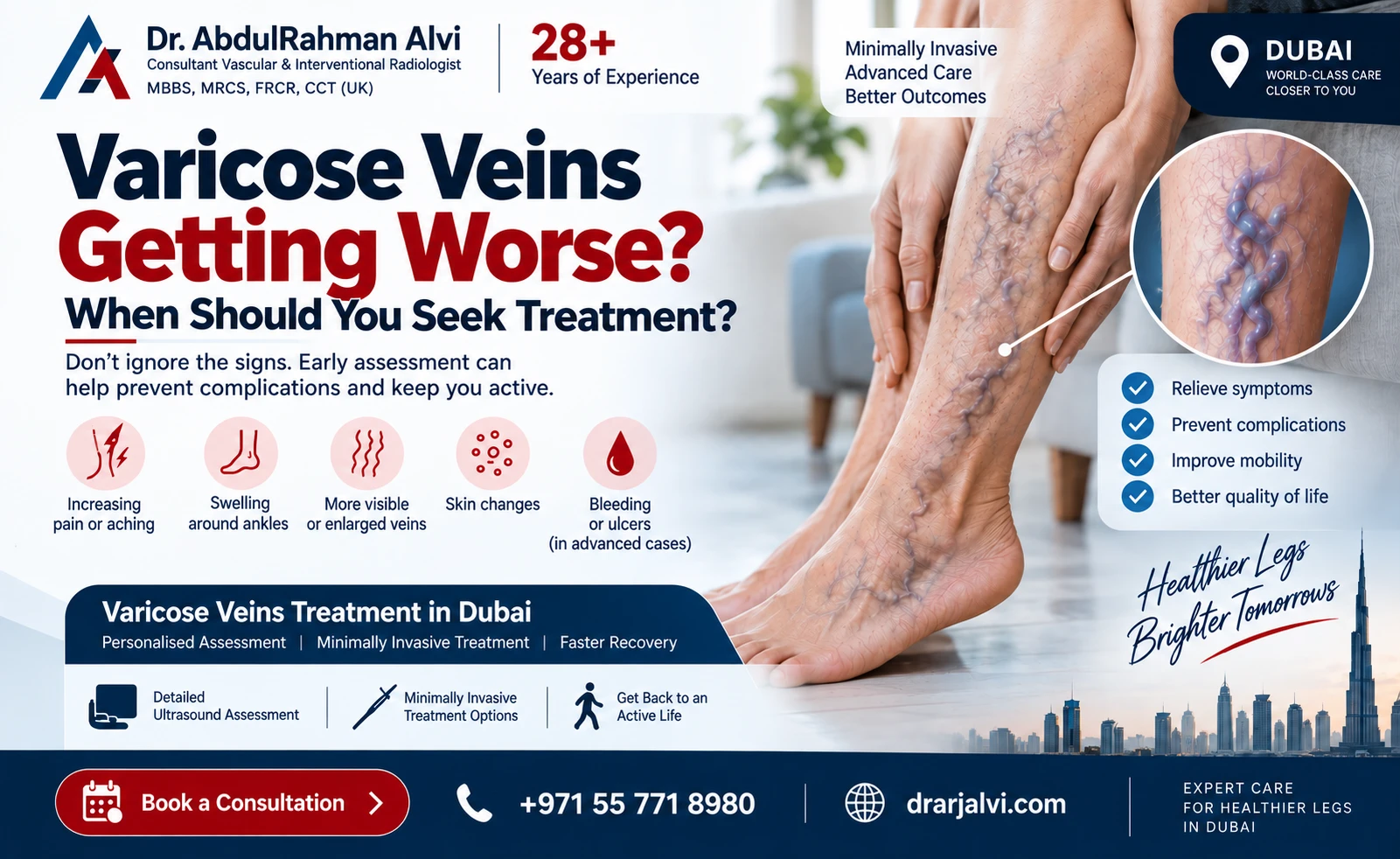
At first, varicose veins may seem like little more than a cosmetic concern.
You may notice a few raised blue or purple veins on your legs. Perhaps they become more visible after standing for several hours but disappear from your mind once you sit down.
Over time, however, some people notice a different pattern.
The veins become larger. Your legs feel heavier at the end of the day. Ankle swelling appears. You develop aching or throbbing after standing.
The skin around your ankle may also begin to change.
This is when the question becomes more important:
Are your varicose veins simply becoming more visible, or are they showing signs that the underlying vein problem needs assessment?
The answer depends on your symptoms, examination and the condition of the veins beneath the skin.
What Does It Mean When Varicose Veins Get Worse?
Varicose veins develop when the valves inside the veins do not work effectively.
Normally, these valves help blood travel upward toward the heart. When they become weak or incompetent, blood can flow backward and collect in the veins of the legs.
This is called venous reflux.
Over time, increased pressure within the veins can cause them to become enlarged, twisted and more visible.
Some people remain symptom-free. Others develop progressively more noticeable symptoms.
Possible signs that your varicose veins are becoming more troublesome include:
- Increasing leg pain or aching
- A feeling of heaviness or tiredness
- Swelling around the ankles
- Burning or throbbing
- Itching around the veins
- Night-time cramps
- Increasingly prominent veins
- Skin colour changes
- Skin thickening or irritation
- Recurrent inflammation
- Bleeding from a varicose vein
- A wound or ulcer around the lower leg
Not every symptom means that a procedure is required. But worsening symptoms are a good reason to seek a professional assessment.
When Should You See a Varicose Vein Specialist?
You should consider a specialist assessment if your varicose veins are affecting your comfort, mobility, appearance or daily activities.
Your Leg Pain Is Becoming More Frequent
Occasional discomfort after a long day is different from persistent or progressively worsening pain.
If aching becomes frequent or starts interfering with work, exercise, sleep or everyday activities, it is worth investigating the underlying cause.
Your Legs Feel Heavy or Tired
A persistent feeling that your legs are unusually heavy, tired or difficult to move comfortably can occur with chronic venous problems.
If this sensation is becoming more noticeable, particularly toward the end of the day, a vascular assessment may help determine whether venous reflux is contributing.
Your Ankles or Legs Are Swelling
Swelling that repeatedly develops after prolonged standing or sitting may be associated with venous circulation problems.
Persistent or increasing swelling should not simply be attributed to getting older.
A specialist can assess whether the swelling is related to venous disease or another condition.
The Veins Are Becoming Larger or More Prominent
A change in the size or appearance of your varicose veins does not automatically mean that treatment is required.
However, progressively enlarged veins, particularly when accompanied by pain, swelling or skin changes, deserve assessment.
Your Skin Is Changing
Skin changes around the ankle or lower leg can occur with long-standing venous disease.
These may include:
- Darkening or pigmentation
- Dry or irritated skin
- Thickening
- Persistent itching
- Changes in skin texture
Skin changes can be a sign that the venous problem is having a longer-term effect.
A Varicose Vein Starts Bleeding
A bleeding varicose vein requires prompt medical attention.
If a vein breaks and bleeding is significant or difficult to control, seek urgent medical care.
Do not ignore recurrent bleeding simply because the wound appears small.
You Develop a Leg Ulcer
A persistent wound around the ankle or lower leg may be associated with chronic venous disease.
Venous ulcers require appropriate assessment and treatment rather than relying solely on home remedies.
Your Symptoms Keep Returning Despite Conservative Measures
Lifestyle measures can help manage symptoms, but they may not correct significant underlying venous reflux.
If symptoms continue despite appropriate activity, leg elevation or compression advice, further assessment may be appropriate.
Are Varicose Veins Dangerous?
Most varicose veins are not immediately dangerous, but some can cause complications.
Varicose veins may remain stable for years, while others become progressively symptomatic.
Potential complications can include:
- Superficial vein inflammation
- Superficial vein thrombosis
- Skin pigmentation
- Skin thickening
- Bleeding
- Venous ulcers
- Persistent swelling
- Chronic discomfort
This does not mean every person with visible varicose veins is at high risk.
It means that new or worsening symptoms should be assessed rather than ignored.
When Is Varicose Vein Treatment Recommended?
Treatment is not based simply on how the veins look.
A specialist considers:
- Your symptoms
- Physical examination
- The location and size of the affected veins
- Venous reflux
- Duplex ultrasound findings
- Skin changes
- Previous treatment
- Your daily activities
- Your treatment preferences
Treatment may be considered when varicose veins are causing persistent symptoms or complications.
For people with confirmed varicose veins and appropriate truncal reflux, treatment options may include endothermal ablation, ultrasound-guided foam sclerotherapy and surgery, depending on suitability.
The important point is that there is no single procedure that is right for every patient.
How Are Worsening Varicose Veins Diagnosed?
The first step is usually a detailed clinical assessment.
Discuss Your Symptoms
Your specialist may ask:
- When did your varicose veins first appear?
- Are they becoming larger?
- Do you experience pain or heaviness?
- Does swelling occur?
- Do symptoms worsen after standing?
- Have you experienced bleeding?
- Have you noticed skin changes?
- Have you previously received treatment?
Physical Examination
Your legs may be examined while standing and lying down.
This allows the specialist to assess visible veins, swelling and other physical signs.
Venous Duplex Ultrasound
A venous duplex ultrasound is an important part of evaluating varicose veins.
It can help identify abnormal blood flow and determine whether venous reflux is present.
The scan can assess:
- Which veins are affected
- Direction of blood flow
- Venous reflux
- Superficial veins
- Deeper veins
- The extent of the venous problem
- Which treatment options may be appropriate
Treating only the visible veins without understanding the underlying source may not address the actual problem.
Semen Analysis
Not applicable to varicose veins. The relevant investigation is a venous duplex ultrasound, which helps map the veins and identify abnormal reflux.
Can Varicose Veins Be Treated Without Surgery?
Yes. In appropriately selected patients, modern varicose vein treatment can often be performed using minimally invasive techniques.
Depending on your vein anatomy and the cause of the reflux, options may include:
Endovenous Ablation
Endovenous treatment uses a catheter and image guidance to close an incompetent vein.
Common techniques include:
- Radiofrequency ablation
- Endovenous laser treatment
The aim is to close the vein responsible for abnormal reflux so blood can return through healthier veins.
Foam Sclerotherapy
Foam sclerotherapy uses a medication injected into a selected vein under ultrasound guidance.
The treatment causes the targeted vein to close.
It can be useful for certain varicose veins and smaller veins.
Phlebectomy
Phlebectomy involves removing selected surface varicose veins through very small skin punctures.
It may be combined with treatment of an underlying refluxing vein when appropriate.
Surgery
Traditional surgery still has a role in selected patients when minimally invasive options are unsuitable.
The appropriate treatment depends on your individual venous anatomy and clinical situation.
For a detailed overview, see Varicose Veins Treatment in Dubai.
What Happens If You Ignore Worsening Varicose Veins?
This depends on the severity of the condition.
Some people have varicose veins that remain stable and cause little or no trouble.
Others gradually develop:
- More frequent pain
- Increasing swelling
- Skin changes
- Inflammation
- Bleeding
- Venous ulcers
The presence of visible veins alone does not predict exactly what will happen.
That is why a specialist assessment is more useful than trying to predict progression based only on appearance.
If your symptoms are changing, a duplex ultrasound can help identify whether there is significant venous reflux and whether treatment should be considered.
Can Lifestyle Changes Stop Varicose Veins From Getting Worse?
Lifestyle measures may help control symptoms and support healthy circulation.
Stay Physically Active
Walking and appropriate exercise can help the calf muscles support venous return.
Avoid Long Periods of Standing or Sitting
If your work requires prolonged sitting or standing, try to take regular movement breaks.
Elevate Your Legs
Raising your legs while resting may help reduce swelling and discomfort.
Maintain a Healthy Weight
Managing excess weight can reduce pressure on the veins and support overall vascular health.
Use Compression When Appropriate
Compression stockings may help some patients with swelling and discomfort.
However, compression does not necessarily correct the underlying venous reflux.
If significant reflux is present and symptoms continue, a specialist may discuss whether an interventional treatment is appropriate.
What Does Modern Varicose Vein Treatment Involve?
For suitable patients, minimally invasive treatment can often be performed without a large surgical incision.
A typical treatment pathway may include:
1. Specialist Consultation
Your symptoms, medical history and treatment goals are reviewed.
2. Duplex Ultrasound
The venous system is mapped to identify abnormal reflux.
3. Treatment Planning
The specialist determines which veins require treatment and which procedure may be appropriate.
4. Image-Guided Treatment
The selected vein is treated using an appropriate minimally invasive technique.
5. Blood Flow Redirection
Blood continues to return through healthier veins.
6. Follow-Up
Your recovery and symptoms can be reviewed after treatment.
Modern endovenous treatments are designed to avoid the larger incisions associated with traditional vein surgery and can often allow a more convenient recovery.
Can Varicose Veins Come Back After Treatment?
Yes. Treatment does not guarantee that you will never develop another varicose vein.
The treated vein can be successfully closed, but venous disease can affect other veins over time.
Patients may require more than one treatment session, and new varicose veins can develop after treatment.
This is why long-term management and follow-up can be important for patients with chronic venous disease.
What Should You Do If a Varicose Vein Suddenly Becomes Painful?
A sudden change in a previously stable varicose vein should be assessed.
Particular attention is needed if you develop:
- Sudden or significant swelling
- Increasing pain
- Redness or warmth around a vein
- Significant tenderness
- Bleeding
- A new wound or ulcer
Some of these symptoms can have causes other than uncomplicated varicose veins.
If you experience sudden severe swelling or pain in one leg, chest pain, sudden shortness of breath or coughing up blood, seek urgent medical care rather than waiting for a routine varicose vein appointment.
When Should You Seek Treatment Rather Than Just Monitor?
A simple way to think about it is:
Monitoring May Be Reasonable When:
- Varicose veins are small
- They cause little or no discomfort
- There are no skin changes
- There is no bleeding
- There are no ulcers
- They are not affecting your daily life
Specialist Assessment Is More Important When:
- Pain is persistent or worsening
- Swelling is increasing
- Veins are becoming increasingly prominent
- Symptoms interfere with daily activities
- Skin changes develop
- Inflammation keeps returning
- You have experienced bleeding
- You develop a venous ulcer
- Conservative measures are no longer controlling symptoms
The decision to treat should ultimately follow a proper clinical and ultrasound assessment.
Why Choose Dr. AbdulRahman Alvi for Varicose Vein Treatment in Dubai?
Dr. AbdulRahman Alvi is a UK-trained Consultant Vascular and Interventional Radiologist with MBBS, MRCS, FRCR and Dual CCT-UK qualifications and more than 28 years of clinical experience.
His practice focuses on minimally invasive, image-guided treatment.
For varicose veins, the focus is not simply on treating the veins that are visible on the surface.
Assessment considers:
- Your symptoms
- Physical examination
- Venous duplex ultrasound
- Venous reflux
- The underlying vein anatomy
- Previous treatment
- Your personal treatment goals
The goal is to identify the underlying problem and determine whether minimally invasive treatment is appropriate for you.
Learn more about Dr. AbdulRahman Alvi and his specialist experience before deciding on treatment.
Questions to Ask Your Varicose Vein Specialist
Before choosing treatment, consider asking:
- What is causing my varicose veins?
- Do I have significant venous reflux?
- Do I need treatment or can I safely monitor the condition?
- Which veins are responsible for my symptoms?
- Would endovenous treatment be suitable for me?
- Would foam sclerotherapy be appropriate?
- Do I need surgery?
- How long should recovery take?
- Could my varicose veins return?
- What happens if I decide not to treat them?
Having clear answers can help you make a more informed treatment decision.
When Should You Treat Worsening Varicose Veins?
Varicose veins do not automatically need treatment simply because they are visible. However, increasing pain, swelling, skin changes, inflammation, bleeding or ulcers are important reasons to seek specialist assessment.
A venous duplex ultrasound can help determine whether underlying venous reflux is contributing to your symptoms and whether treatment may be appropriate.
For suitable patients, modern minimally invasive options such as endovenous ablation and foam sclerotherapy can treat problematic veins without traditional open surgery.
Frequently Asked Question
Are Your Varicose Veins Getting Worse?
If your varicose veins are becoming more painful, swollen or prominent, or you have developed skin changes, bleeding or persistent discomfort, it may be time for a specialist assessment.
Dr. AbdulRahman Alvi provides varicose vein assessment and minimally invasive treatment in Dubai, with treatment recommendations based on your symptoms, venous anatomy and ultrasound findings.
Book a consultation to find out whether treatment may be appropriate for you.