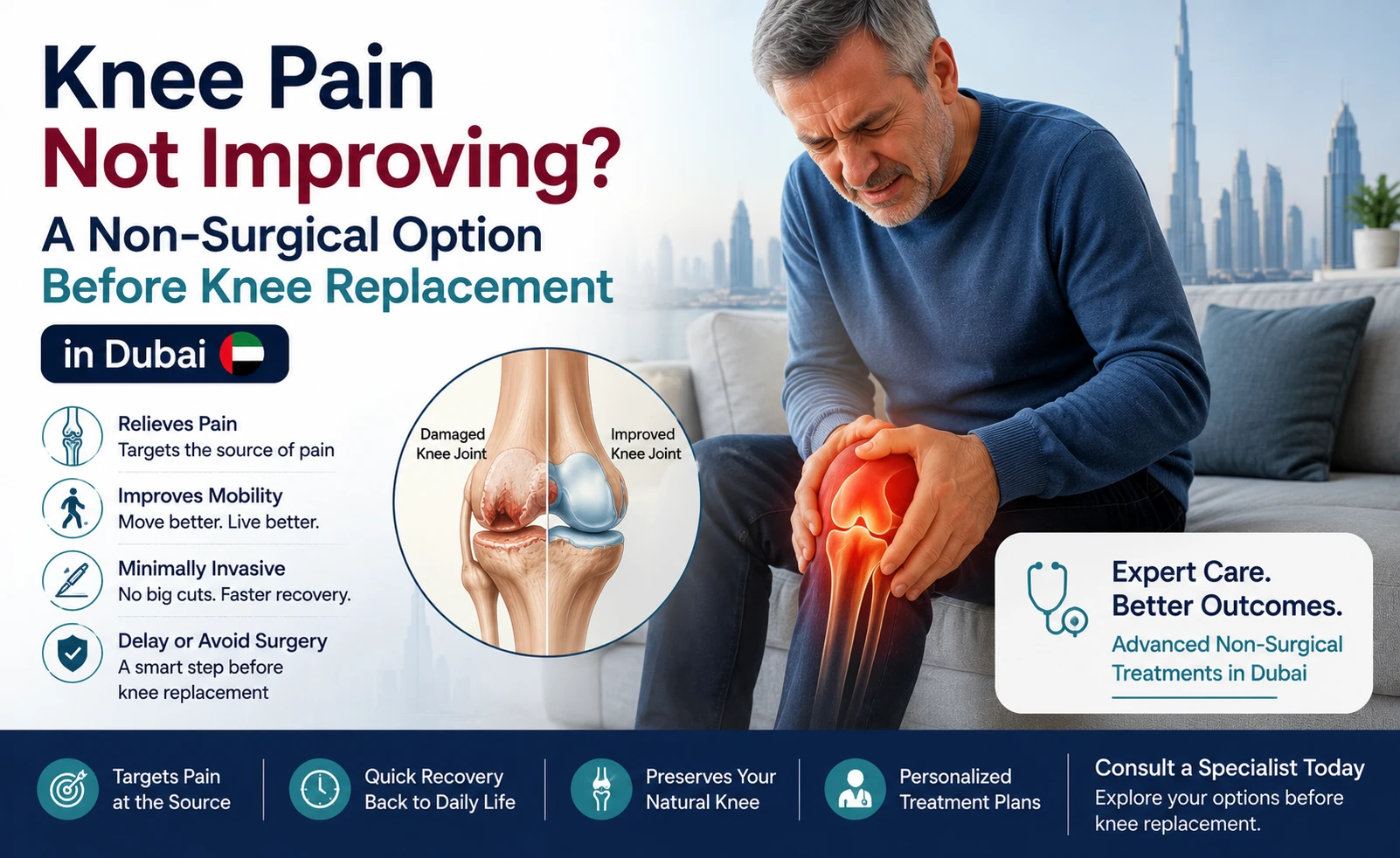
Genicular Artery Embolization (GAE) is a minimally invasive, image-guided procedure that treats chronic knee osteoarthritis pain by blocking the abnormal blood vessels driving inflammation in the joint. Clinical studies report significant, sustained pain reduction over 12–24 months. It’s not a substitute for knee replacement in severe structural damage, but offers an option for patients who’ve exhausted conservative treatment and want to delay or avoid surgery.
Why Does Knee Osteoarthritis Hurt So Much?
As the cartilage cushioning the knee joint wears down over time, the underlying bones begin to rub against each other, triggering inflammation. What’s less commonly known is that this inflammation drives the growth of new, abnormal blood vessels within the joint lining (synovium) — and these vessels are closely linked to the nerve fibres that transmit pain signals. More abnormal vessels generally means more inflammation, and more pain.
This is the mechanism GAE specifically targets — rather than treating the joint damage itself, it addresses the abnormal blood supply feeding the inflammation and pain.
What Is Genicular Artery Embolization?
GAE is a minimally invasive, image-guided procedure performed by an interventional radiologist. A thin catheter is guided — typically through the wrist or groin — into the genicular arteries, the small vessels supplying blood to the knee joint. Tiny particles are then released to block the abnormal, inflamed vessels specifically, while sparing normal blood flow to the rest of the joint.
By reducing blood flow to these abnormal vessels, GAE reduces inflammation within the joint, which in turn reduces pain and stiffness — often without the extended recovery associated with knee replacement surgery.
Who Is a Good Candidate for GAE?
GAE may be worth discussing if you have:
- Chronic knee pain from osteoarthritis, generally lasting several months or more
- Pain that hasn’t responded adequately to physiotherapy, anti-inflammatory medication, or injections such as corticosteroids or hyaluronic acid
- A wish to delay or avoid total knee replacement surgery, whether due to age, other health conditions, or personal preference
- Persistent pain following a previous knee replacement, in some cases, where increased blood flow to specific areas is contributing to ongoing discomfort
It’s important to note that GAE is not positioned as a replacement for total knee replacement surgery in cases of severe structural joint damage — it’s most appropriate for patients with mild-to-moderate osteoarthritis whose pain is disproportionate to what conservative treatments have managed, or those specifically looking to delay surgery.
What Happens During the Procedure?
- Assessment. Clinical evaluation, sometimes alongside imaging, identifies the areas of the knee driving your specific pain pattern.
- Local anaesthesia. The procedure is performed under local anaesthesia, avoiding general anaesthesia risks.
- Catheter access. A small needle puncture is made, typically at the wrist or groin.
- Embolization. Using continuous imaging, the catheter is guided to the genicular arteries, where particles are released to block the abnormal vessels contributing to inflammation.
- Recovery and discharge. Patients are monitored briefly afterward and are usually able to go home the same day.
The procedure generally takes 60–90 minutes, and can be performed on one or both knees depending on individual assessment.
How Effective Is GAE, and How Long Does It Last?
Clinical research on GAE has generally shown meaningful, sustained reductions in knee pain scores following the procedure, with improvement typically continuing over the following months as inflammation subsides. It’s worth noting that evidence quality is still developing compared with long-established treatments like knee replacement, and results can vary between patients — this is discussed individually based on the severity and pattern of your osteoarthritis.
How Much Does GAE Cost in Dubai?
The cost of Genicular Artery Embolization depends on several factors, including whether one or both knees are treated, the complexity of the vascular anatomy, pre-procedure imaging, and follow-up care. As a general market reference, orthopedic and joint pain consultations in Dubai commonly start from around AED 250, though this is only the starting consultation fee — GAE itself, as a specialised interventional procedure, is priced separately based on individual case complexity. Insurance coverage for GAE varies, partly because it’s a newer, less universally established procedure compared to options like knee replacement — it’s worth checking directly with your provider. Because of these variables, the most reliable way to understand your specific cost is through a consultation with Dr. Alvi’s clinic.
GAE vs Knee Replacement — Which Should You Consider First?
For many patients, GAE and knee replacement aren’t necessarily competing options — they can be sequential ones. Patients with mild-to-moderate osteoarthritis who aren’t ready for, or want to delay, a major joint replacement may consider GAE first, while knee replacement remains available later if structural damage progresses or symptoms aren’t adequately controlled. Patients with severe structural joint damage, however, are generally better served going straight to knee replacement, since GAE addresses inflammation rather than restoring joint structure. This is a decision best made individually, with Dr. Alvi reviewing your specific imaging and symptom pattern.
How Does GAE Compare to Other Non-Surgical Knee Treatments?
If you’ve researched knee pain treatment in Dubai, you’ve likely come across other non-surgical options, including physiotherapy, corticosteroid or hyaluronic acid injections, PRP (platelet-rich plasma) injections, and radiofrequency ablation. It’s worth understanding how GAE differs, since these treatments work through different mechanisms:
- Physiotherapy strengthens the muscles supporting the knee and improves movement patterns, but doesn’t address inflammation at its source.
- Hyaluronic acid and corticosteroid injections lubricate the joint or temporarily reduce inflammation, but effects are often short-lived and may require repeat injections.
- PRP injections use a concentration of the patient’s own platelets to encourage healing, with variable evidence for long-term pain relief.
- Radiofrequency ablation targets the nerves transmitting pain signals directly, rather than the vascular changes causing inflammation.
- GAE targets the abnormal blood vessels driving inflammation itself, which is a different mechanism from all of the above, and is generally considered after these more conservative options have been tried without lasting success.
None of these approaches are mutually exclusive — GAE is often considered specifically for patients who’ve already tried physiotherapy and injections without adequate relief.
Recovery After GAE
Most patients experience mild soreness or bruising at the catheter access site (wrist or groin) for a few days, which is generally more related to the access point than the knee itself. Unlike knee replacement, there’s no surgical wound in the joint to heal, no requirement for crutches or a structured rehabilitation programme, and no restriction on weight-bearing.
Most patients resume normal daily activities within a few days, though pain relief in the knee itself tends to build gradually over the following weeks to months, rather than being immediate, as inflammation in the joint subsides.
Risks and Considerations
As with any medical procedure, GAE carries some risks, which should be discussed individually during a consultation. These can include temporary skin discoloration over the treated area, mild post-procedure pain, and — rarely — non-target embolization affecting nearby tissue. GAE is not suitable for every patient; the severity and pattern of osteoarthritis, overall vascular anatomy, and individual health factors all need to be assessed beforehand. This page is intended to provide general information and does not replace individualised medical advice — a consultation is necessary to determine whether GAE is the right option for your specific case.