

A varicocele can be easy to ignore. Some men have no symptoms at all, while others notice a dragging sensation, aching in the testicle, prominent veins in the scrotum, or concerns about fertility.
If you’ve been told that you have a varicocele, the important question is not simply whether the veins are enlarged. It is whether the varicocele is affecting your comfort, testicular health or fertility—and whether treatment could benefit you.
Varicocele embolization offers a minimally invasive alternative to conventional surgery. Instead of making an incision in the scrotum or groin, an Interventional Radiologist uses a thin catheter to reach the abnormal testicular vein and block the unwanted blood flow. Blood is then redirected through healthy veins.
At his Dubai practice, Dr. AbdulRahman Alvi provides specialist assessment for men considering minimally invasive treatment for varicocele. With UK training, Dual CCT in Interventional & Clinical Radiology and more than 28 years of experience, his approach focuses on careful diagnosis and choosing the treatment that is appropriate for each individual patient.
Book a consultation to find out whether varicocele embolization is suitable for you.
A varicocele is an enlargement of the veins that carry blood away from the testicle.
Healthy veins contain valves that help blood move in the correct direction. When the venous valves do not work properly, blood can flow backwards and pool within the veins around the testicle. Over time, those veins can become enlarged and more noticeable.
Varicoceles are particularly common on the left side and often develop gradually. Some are discovered during a routine examination, while others are identified when a man seeks help for scrotal discomfort or fertility concerns.
Not every varicocele requires treatment. If it is not causing symptoms or affecting testicular function or fertility, monitoring may be all that is needed.
Treatment is considered when there is a clear clinical reason, such as persistent pain, testicular changes or fertility-related concerns.
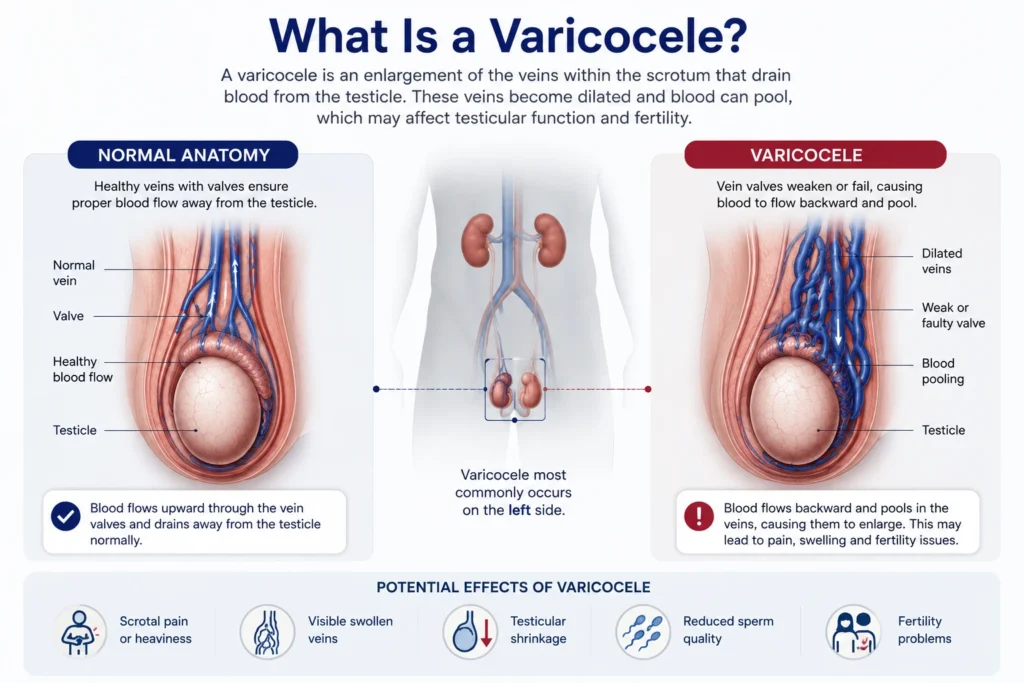
Many men with a varicocele do not experience any symptoms. When symptoms do occur, they can be mild at first and become more noticeable over time.
Common symptoms can include:
Varicocele-related discomfort can sometimes improve when lying down because pressure within the affected veins decreases.
However, testicular pain has many possible causes. Persistent, severe or sudden pain should always be assessed by a qualified medical professional rather than automatically being attributed to a varicocele.
A varicocele does not automatically mean infertility.
Many men with varicoceles have normal fertility and never require treatment. However, in some men, a varicocele may be associated with reduced sperm production, abnormal semen parameters or changes in testicular development.
If you are having difficulty conceiving and have also been diagnosed with a varicocele, a proper fertility assessment can help determine whether the varicocele may be contributing to the problem.
Depending on your circumstances, assessment may include:
The presence of a varicocele alone does not mean that an intervention is necessary. Treatment should be based on your symptoms, examination, fertility goals and clinical findings.
There is no single treatment rule that applies to every man.
A varicocele may be monitored when it is not causing significant symptoms or complications. Treatment may be considered when there is:
If discomfort continues despite conservative measures and the varicocele is considered the likely cause, treatment may be discussed.
In selected men with infertility and abnormal semen parameters, treating a clinically significant varicocele may form part of the fertility treatment plan.
In younger patients, changes in testicular development may require specialist evaluation and monitoring.
Men who have previously undergone treatment but continue to have or develop a recurrent varicocele may have other treatment options available, including embolization.
The right decision depends on your individual circumstances.
Diagnosis usually begins with a physical examination.
Your doctor may examine the scrotum while you are standing and lying down. You may also be asked to perform a Valsalva manoeuvre, which involves taking a breath, holding it and bearing down. This can make the enlarged veins easier to identify.
A Doppler ultrasound can provide more information about the veins and blood flow around the testicle.
It may help to:
A proper diagnosis is important before deciding whether an intervention is necessary.
Varicocele embolization is a minimally invasive, image-guided treatment that blocks the abnormal vein responsible for the varicocele.
Rather than repairing the vein through conventional surgery, an Interventional Radiologist approaches the abnormal vein from inside the blood vessel.
A very thin catheter is introduced through a small access point, usually through a vein in the groin or neck. Using X-ray guidance, the catheter is carefully navigated to the affected testicular vein.
Once the abnormal vein has been identified, tiny coils and/or an embolic material are used to block the abnormal blood flow.
The blood is then redirected through healthy veins, providing an alternative route for normal venous drainage.
There is no large surgical incision, and stitches are generally not required.
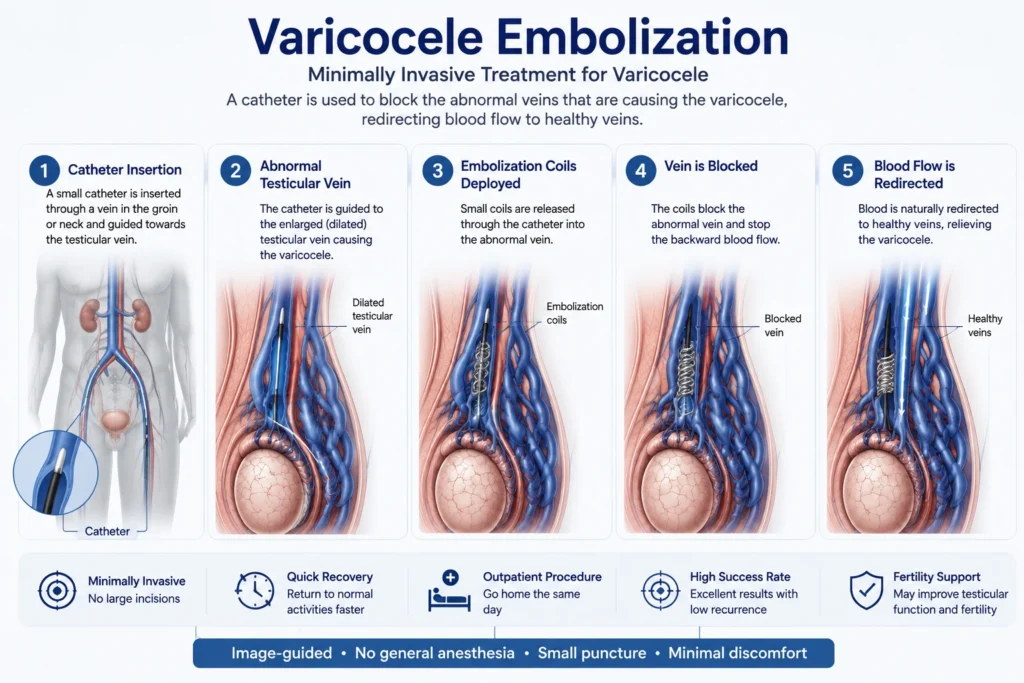
The procedure is performed in an image-guided interventional radiology environment.
Your symptoms, medical history, previous ultrasound reports and fertility investigations are reviewed.
The aim is to determine whether the varicocele is clinically significant and whether embolization is an appropriate treatment option.
The skin is cleaned and local anaesthetic is used at the access site.
A very small opening is made and a thin catheter is introduced into a vein, commonly through the groin or neck.
Using real-time X-ray imaging and contrast, the catheter is guided towards the abnormal testicular vein.
This allows the Interventional Radiologist to identify the venous anatomy and locate the abnormal blood flow.
Tiny coils and/or an embolic material are placed within the abnormal vein.
This creates a blockage that stops the unwanted blood flow through the varicocele.
Once the abnormal vein is blocked, blood is redirected through healthier veins that continue to drain the testicle normally.
The catheter is removed and a small dressing is applied to the access site.
The procedure is commonly performed on an outpatient basis.
For appropriately selected patients, embolization provides a less invasive alternative to conventional varicocele surgery.
Potential advantages include:
Mayo Clinic notes that recovery following embolization is generally short, with many patients returning to work within one to two days and resuming exercise after approximately one week, subject to individual medical advice.
RadiologyInfo also describes embolization as less invasive than conventional surgery and reports a shorter recovery period.
Both embolization and surgical varicocelectomy are designed to stop abnormal blood flow through the affected veins.
The difference is how the abnormal vein is reached and treated.
| Varicocele Embolization | Surgical Varicocelectomy | |
|---|---|---|
| Treatment approach | Catheter-based | Surgical |
| Major incision | No | Small surgical incision |
| Access | Vein through groin or neck | Surgical access |
| Imaging | Real-time X-ray guidance | Surgical visualization/microscopy |
| Stitches | Generally not required | May be required |
| Anaesthesia | Local ± sedation commonly used | Depends on technique |
| Recovery | Generally short | Generally longer |
| Hospital stay | Usually outpatient | Usually outpatient |
Neither treatment is automatically right for every patient. Your anatomy, symptoms, previous treatment, fertility goals and overall health should guide the decision.
Varicocele embolization may be considered for men who have a clinically significant varicocele together with an appropriate reason for treatment.
This may include:
A consultation is essential before treatment. A varicocele that is found incidentally and causes no problems may not require any intervention.
One of the main reasons men choose embolization is the relatively short recovery.
After the procedure, you will spend some time in a recovery area before being discharged when medically appropriate.
You may experience:
RadiologyInfo states that normal activities can generally be resumed within approximately 24 hours, although individual instructions may differ. Localised scrotal discomfort can persist for up to about a week in some patients.
Your specialist will advise you when to return to exercise, heavy lifting and other activities.
Varicocele embolization is an established image-guided procedure performed by specially trained Interventional Radiologists.
As with any medical procedure, there are potential risks. These may include bleeding or bruising at the catheter access site, infection, an allergic reaction to contrast material, blood-vessel injury or unintended embolization. Varicocele recurrence is also possible.
Your individual risks depend on your medical history and anatomy and will be discussed before treatment.
The purpose of the consultation is not simply to recommend a procedure. It is to determine whether treatment is appropriate and explain the available options clearly.
When a procedure involves detailed venous anatomy and image-guided catheter treatment, specialist experience matters.
Dr. AbdulRahman Alvi is a Consultant Vascular & Interventional Radiologist in Dubai with:
His practice focuses on advanced minimally invasive and image-guided treatments.
For men considering varicocele treatment, the consultation is centred around your individual situation—not simply the ultrasound report.
Dr. Alvi will consider your symptoms, medical history, imaging, fertility concerns and treatment preferences before discussing whether embolization is suitable.