Persistent heel pain can make simple activities such as walking, standing, exercising or taking your first steps in the morning surprisingly difficult.
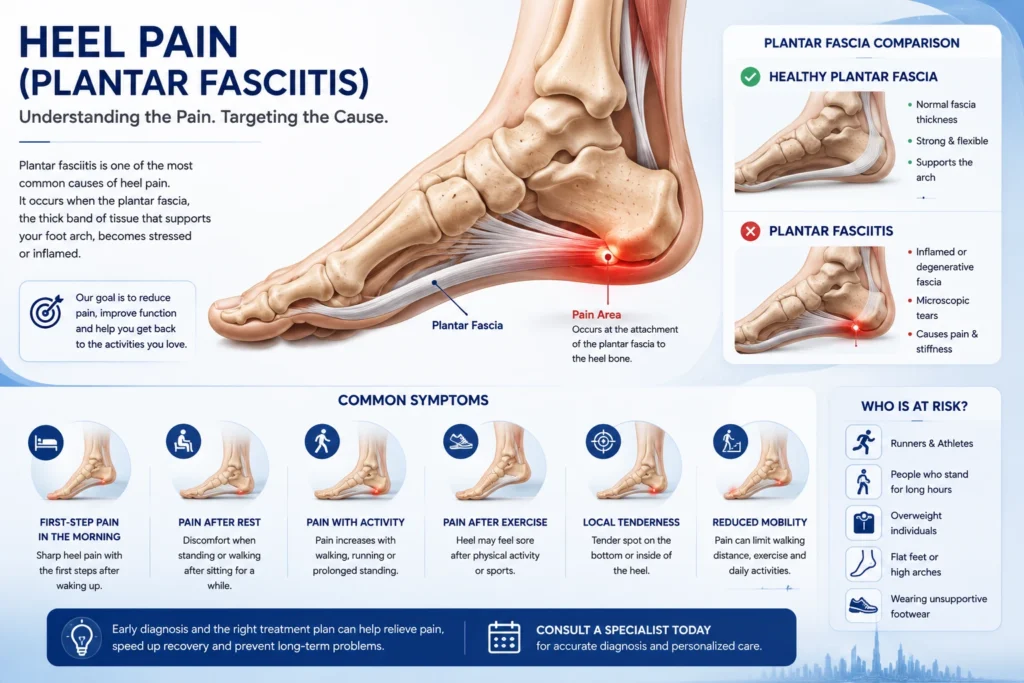
One of the most common causes of heel pain is plantar fasciitis, a condition involving the plantar fascia — the strong band of tissue that supports the arch of the foot and connects the heel to the front of the foot.
Most people with plantar fasciitis improve with appropriate conservative treatment, including activity modification, stretching, strengthening and other rehabilitation strategies. However, some patients continue to experience significant pain despite months of appropriate treatment.
For selected patients with chronic, treatment-resistant plantar fasciitis, minimally invasive transarterial embolization is an emerging treatment option that may be considered after specialist assessment.
Dr. AbdulRahman Alvi provides specialist Interventional Radiology assessment in Dubai for patients exploring minimally invasive options for persistent heel pain.
Plantar fasciitis can start gradually and may become increasingly frustrating when pain continues despite rest or home treatment.
You may experience:
If heel pain has continued for several months or is limiting your normal activities, a specialist assessment can help determine the cause and identify appropriate treatment options.
Book a consultation in Dubai to discuss your persistent heel pain.
The plantar fascia is a thick band of connective tissue running along the bottom of the foot. It helps support the arch and absorbs mechanical forces when you walk, run and stand.
Plantar fasciitis is commonly associated with pain around the heel and the attachment of the plantar fascia to the heel bone.
The condition can develop gradually when the tissue is repeatedly exposed to loading that exceeds its ability to adapt.
Although the name contains the word “fasciitis,” chronic plantar fasciitis is not simply an inflammatory condition. Structural changes within the plantar fascia can occur over time, which is why persistent cases are often described as plantar fasciopathy.
Plantar fasciitis is recognised as one of the most common causes of heel pain.
Symptoms can vary between patients, but several patterns are particularly common.
One of the classic symptoms is sharp heel pain when getting out of bed and taking the first few steps.
The pain may gradually ease as you move around.
Some people experience pain when standing or walking after sitting for a prolonged period.
Walking, running, prolonged standing or other weight-bearing activities may aggravate symptoms.
Symptoms can sometimes become more noticeable after physical activity rather than during the activity itself.
The underside or inner portion of the heel may feel particularly tender when pressure is applied.
Persistent pain can gradually reduce your walking distance and ability to exercise.
Plantar fasciitis usually develops through a combination of repeated mechanical loading and individual risk factors.
Possible contributing factors include:
A sudden increase in running, walking or other exercise can place additional stress on the plantar fascia.
People who spend long periods standing or walking at work may place repeated loads on the plantar fascia.
Running and jumping activities repeatedly load the foot and heel.
Certain foot characteristics, including variations in arch structure, may influence how forces are distributed through the foot.
Reduced flexibility around the calf and ankle can contribute to altered loading of the plantar fascia.
Higher body weight can increase the mechanical load placed on the plantar fascia during standing and walking.
Shoes that provide inadequate support or cushioning may aggravate symptoms in some individuals.
Not every patient has an obvious single cause. A proper assessment is therefore more useful than assuming that all heel pain has the same origin.
Plantar fasciitis is often diagnosed through your symptoms and a physical examination.
Your clinician may assess:
Ultrasound can be useful in selected patients to assess the plantar fascia and identify structural changes.
MRI may be recommended when the diagnosis is uncertain or when another cause of heel pain needs to be investigated.
Imaging is not automatically required for every patient. The appropriate investigation depends on the clinical situation and whether there are features suggesting another diagnosis.
Not every heel pain problem is plantar fasciitis.
Other possible causes include:
This is why persistent or unusual heel pain should be properly assessed before treatment.
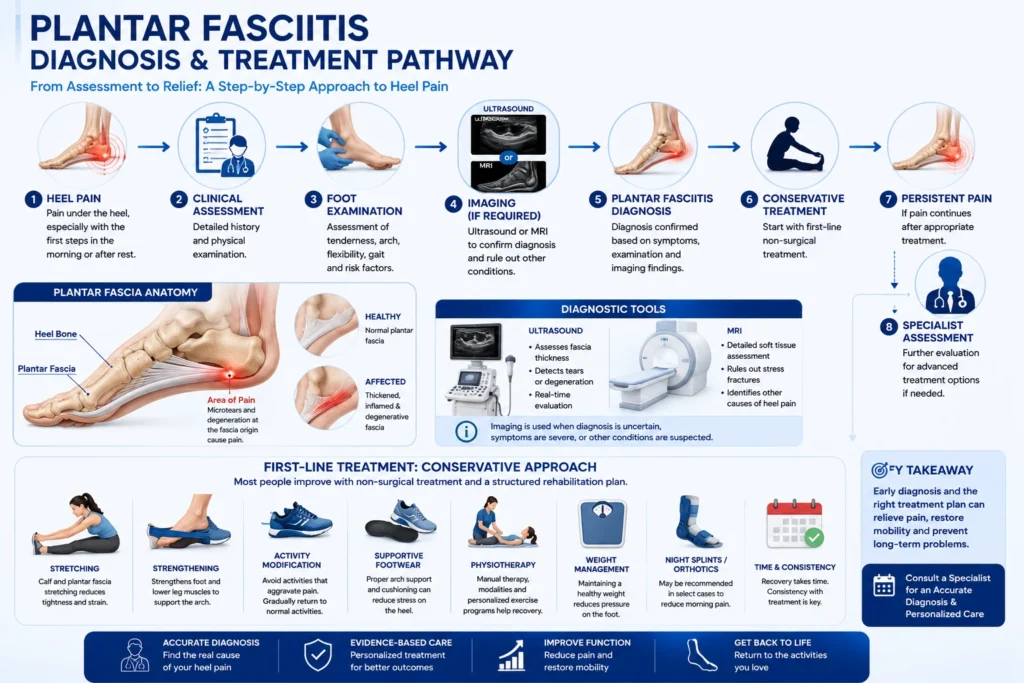
Most patients with plantar fasciitis are initially treated without surgery.
The 2023 clinical practice guideline for heel pain and plantar fasciitis provides evidence-based recommendations for physical therapy management of non-arthritic heel pain.
Treatment may include:
Calf and plantar fascia stretching can form an important part of rehabilitation.
Progressive strengthening can help improve the capacity of the foot and lower-limb muscles to tolerate loading.
Temporarily modifying activities that significantly aggravate symptoms may allow rehabilitation to progress.
Supportive footwear may help reduce mechanical stress on the foot.
A structured rehabilitation programme can be tailored to your symptoms, mobility and activity requirements.
Where appropriate, managing body weight may reduce mechanical loading on the foot.
Recovery can take time, particularly when symptoms have already become chronic.
There is no single time point that defines every patient’s chronic heel pain.
However, when symptoms continue for months despite appropriate conservative management and begin significantly affecting daily activities, further assessment may be appropriate.
Before considering an invasive procedure, it is important to confirm the diagnosis and establish whether appropriate conservative treatment has genuinely been attempted.
For patients with persistent plantar fasciitis despite conventional treatment, specialist assessment can help determine whether advanced treatment options may have a role.
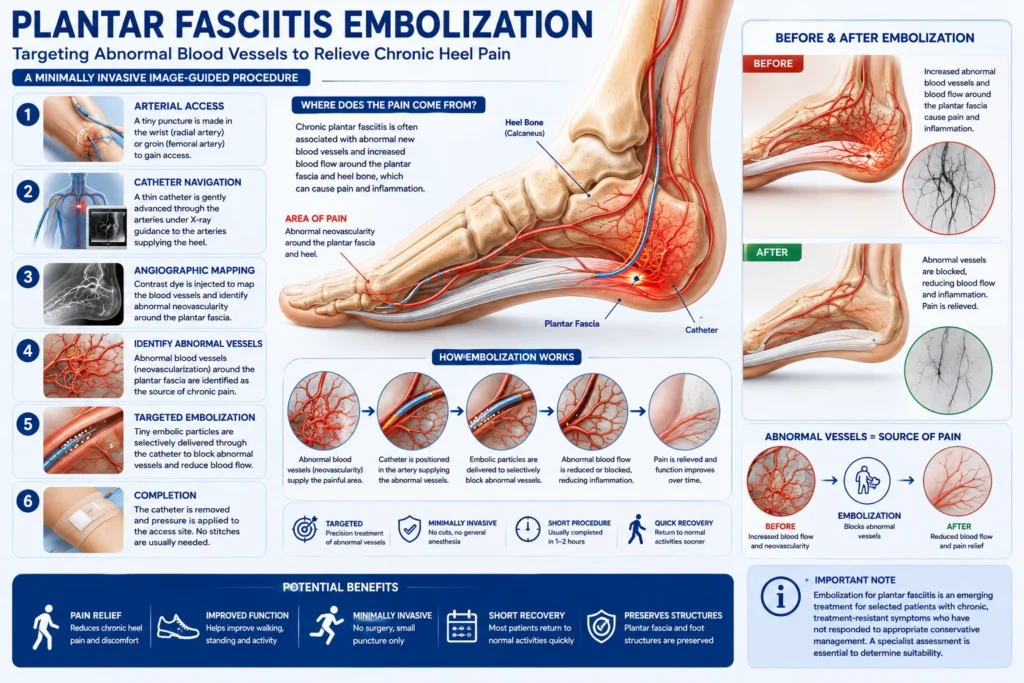
Transarterial embolization (TAE) is an emerging minimally invasive treatment approach being investigated for selected patients with chronic plantar fasciitis that has not responded adequately to conservative treatment.
Research suggests that chronic plantar fasciitis can be associated with abnormal small blood vessels, or neovascularization, around the symptomatic plantar fascia.
During embolization, an Interventional Radiologist uses a small catheter or vascular access technique to identify abnormal vessels supplying the painful region.
Tiny embolic material can then be delivered selectively to reduce blood flow within those abnormal vessels.
The objective is to target the abnormal vascular component associated with chronic pain while preserving the normal circulation of the foot.
This approach does not surgically remove the plantar fascia and should not be presented as a guaranteed cure.
The evidence is promising but still developing, and embolization is best considered for carefully selected patients with persistent symptoms after appropriate conservative treatment.
When embolization is considered appropriate, the procedure is performed using image guidance.
Your symptoms, previous treatments and imaging are reviewed to confirm that chronic plantar fasciitis is the likely cause of your pain.
The blood vessels around the heel and plantar fascia are evaluated to identify abnormal vascularity.
A small vascular access point is used to introduce the catheter or appropriate delivery system.
Contrast imaging helps identify abnormal vessels associated with the symptomatic area.
Small embolic material is selectively delivered to the abnormal vessels.
The catheter is removed and the access site is monitored.
The procedure is designed to target abnormal vascularity rather than block the normal arterial circulation supplying the foot.
Embolization is not appropriate for everyone with heel pain.
It may be considered for carefully selected patients who have:
A specialist assessment is essential before deciding whether embolization is appropriate.
Research into arterial embolization for plantar fasciitis is still relatively new, but several studies have reported encouraging results.
A 2024 study of 66 patients with plantar fasciitis refractory to conservative treatment reported significant improvements in pain and foot function following ultrasound-guided intra-arterial embolization, with follow-up extending to a mean of approximately 31 months. The study reported no major adverse events, although it was not a randomised controlled trial.
A 2026 prospective case series evaluated 24 people with chronic plantar heel pain who had not responded adequately to previous treatments. At six months, 70.8% met the study’s responder definition, with improvements in pain and function; importantly, the authors described the findings as preliminary evidence and called for further evaluation.
Other recent research has also investigated different vascular access and embolization techniques for treatment-resistant plantar fasciitis.
These findings are encouraging, but the current evidence is still developing. For this reason, embolization should be presented as an emerging option for selected refractory cases, rather than as a universally established first-line treatment.
For appropriately selected patients, a catheter-based approach may offer potential advantages.
Treatment is performed through a small vascular access point rather than open surgery.
The procedure does not require surgical removal of the plantar fascia.
Imaging allows the specialist to identify and selectively treat abnormal vessels associated with the painful area.
Published studies have reported meaningful improvements in pain and function in selected patients.
It may provide an additional treatment option for patients who continue to experience significant symptoms despite appropriate conservative care.
The potential benefits need to be balanced against the limitations of the current evidence and the individual patient’s clinical circumstances.
As with any vascular procedure, embolization carries potential risks.
Possible complications can include:
Published plantar fasciitis studies have reported relatively low rates of serious complications, but the evidence base is still limited and procedures vary between centres and techniques.
Your specialist should discuss the specific risks and expected benefits with you before treatment.
Recovery depends on the individual patient, treatment technique and access site.
Following the procedure, you will receive instructions regarding:
Improvement in chronic heel pain should not be expected to happen identically in every patient.
Even after an interventional procedure, appropriate rehabilitation and gradual return to activity remain important.
Yes.
Most patients should initially receive appropriate conservative treatment.
Exercise-based rehabilitation, stretching, strengthening, activity modification and other non-surgical measures form the foundation of plantar fasciitis management. The 2023 APTA clinical practice guideline specifically addresses physical therapy management of heel pain and plantar fasciitis.
Surgical or interventional treatment is generally considered only when symptoms remain persistent and significantly affect the patient’s quality of life despite appropriate conservative care.
| Conservative Treatment | Embolization | |
|---|---|---|
| First-line approach | Yes | No |
| Physiotherapy | Core treatment | Usually attempted beforehand |
| Exercise/stretching | Important | Still relevant |
| Surgery required | No | No |
| Catheter procedure | No | Yes |
| Suitable for every patient | No | No |
| Evidence base | Established | Emerging |
| Best suited to | Most patients initially | Selected refractory cases |
The aim is not to replace physiotherapy or rehabilitation.
For most patients, conservative treatment remains the starting point. Embolization may be considered only when symptoms remain significant despite appropriate management and the patient is clinically suitable.
Dr. AbdulRahman Alvi is a UK-trained Consultant Vascular & Interventional Radiologist with:
Interventional Radiology focuses on minimally invasive, image-guided procedures performed through small access points.
For patients with chronic heel pain, the goal should first be to understand the diagnosis and determine whether an interventional treatment is actually appropriate.
Your assessment can consider:
This individualised approach helps avoid unnecessary procedures and ensures that treatment recommendations are based on your specific condition.
Consider specialist assessment if:
Sudden severe heel pain following an injury, inability to bear weight or significant swelling may require prompt assessment because other conditions can cause acute heel pain.
Persistent heel pain can affect your walking, exercise, work and quality of life.
If you have chronic plantar fasciitis that has not improved despite appropriate treatment, a specialist assessment can help determine why your symptoms are continuing and whether additional treatment options should be considered.
Dr. AbdulRahman Alvi provides specialist Interventional Radiology assessment in Dubai for patients exploring minimally invasive options for persistent heel pain.
Your consultation can help determine:
Book a consultation with Dr. AbdulRahman Alvi in Dubai to discuss your persistent heel pain and treatment options.